

Horsepower Considerations
Over the years I have done a huge amount of custom machine work for custom Harley motorcycles.
Over the years I have done a huge amount of custom machine work for custom Harley motorcycles. You see, I am an old motorhead and I understand the addiction some people have for horsepower. This month’s article explains how to put an oversize rear axle in a Harley to deal with a ridiculous amount of power.
This particular bike came with an engine capable of 60 horsepower. The biker who owned it was not satisfied, and so he had an engine built with double the horsepower — 120 hp. That’s great, but the stock 3/4″ axle couldn’t take it. Breaking parts, of course, is a common thing for horsepower junkies. The 3/4″ axle got bent.
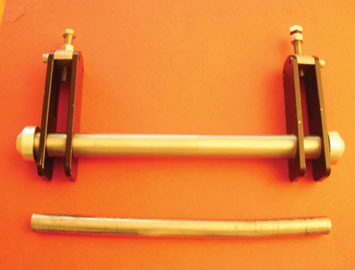
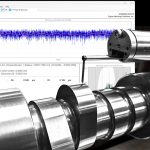
The wrench who built the big motor got in touch with me to replace the bent axle with a 1″ axle. Figure 1 shows the new axle setup beside the bent part. The 1″ diameter makes the new axle 1.8 times stronger because the strength is related to the cross-sectional area of the axle, not the diameter. So, if the axle was doubled in diameter, the strength would quadruple. I also made the new axle of heat-treated 416 stainless for good tensile strength. The rear wheel bearing bores were increased in diameter to accept the larger bearing units. Those operations are pretty straight-forward machine shop practices.
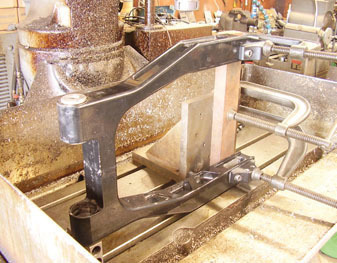
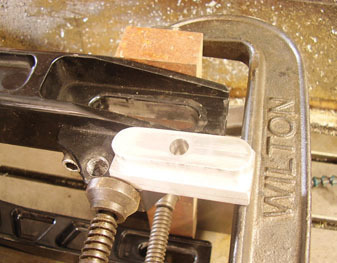
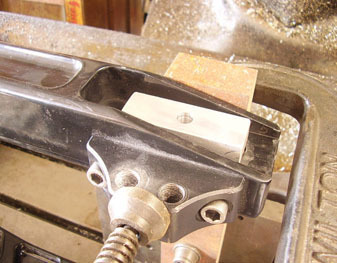
That said, one part of the job was a little tricky: increasing the size of the axle slots in the swingarm. It is important to have the centerline of the axle parallel to the engine crankshaft centerline. To ensure this, I made a tool to locate the center of both the length and width of the axle slots with precise accuracy. Figure 2 shows the swingarm on the milling machine clamped to an angle plate. Figure 3 shows the tool I made. It fits snuggly into a slot and has a hole through it for indexing with an indicator. Figure 4 shows the tool in a slot ready to be indicated. From there, it is a simple matter to mill the slot to the desired dimension.
Review the print ads from this magazine to continue
This quick advertiser review unlocks the rest of the article and keeps the full-screen reader focused on the ads instead of the page chrome.
Advertisers included in this article experience
Print placements connected to this article
ctemag.com/cteguide.com 3
WHAT'S INSIDE
PAGE 8 MAKING YOUR MARK PAGE 4 PAGE 18 MINI GOES DEEPER IMTS REPORTS PAGE 6 PAGE 14 HORSEPOWER ECCENTRICITY CONSIDERATIONS RINGS TRUE.
WHAT'S INSIDE PAGE 8 MAKING YOUR MARK PAGE 4 PAGE 18 MINI GOES DEEPER IMTS REPORTS PAGE 6 PAGE 14 HORSEPOWER ECCENTRICITY CONSIDERATIONS RINGS TRUE ctemag.com/cteguide.com 3
Visit ctemag.com/cteguide.com 3 View this placement in the issue recordPrint ads from this magazine
PAGE 8 MAKING YOUR MARK PAGE 4 PAGE 18 MINI GOES DEEPER IMTS REPORTS PAGE 6 PAGE 14 HORSEPOWER ECCENTRICITY CONSIDERATIONS RINGS TRUE.
WHAT'S INSIDE PAGE 8 MAKING YOUR MARK PAGE 4 PAGE 18 MINI GOES DEEPER IMTS REPORTS PAGE 6 PAGE 14 HORSEPOWER ECCENTRICITY CONSIDERATIONS RINGS TRUE ctemag.com/cteguide.com 3
Continue reading
January 2025
Taking some time thinking through a job before cutting metal is time well spent. I have found that identifying potential problems and designing solutions makes work more rewarding.
For me, doing this kind of work is really fun. You can tell the age of the boy by the price of the toy.
Postscript: Because of the 1″ axle, this bike required a custom brake caliper bracket. That, in turn, required a custom fixture to hold the part for milling. I will go through what I did to make the caliper bracket in the next Machinist’s Corner column, which will appear in the January/February 2025 issue of Cutting Tool Engineering.
Glossary terms in this article
Related



Subscribers can use MFGAxis notes, saves and discussion tools with their innoNET account.


