


How to avoid grinding burn
Cutting Tool Engineering's Ask the Grinding Doc columnist, Dr. Jeffrey Badger, advises a shop hoping to avoid grinding burn.
Dear Doc: I grind the OD and shoulder of hardened-steel shafts using a wheel swiveled 30°. I do just fine on the OD but burn like crazy on the shoulder regardless of what I do. Why? For more on grinding burn, see this related guide.
The Doc Replies: You’re burning the shoulder because the grit-penetration depth on the shoulder is too shallow. When the grits don’t penetrate deeply enough, they rub the workpiece, which generates lots of heat and causes burn. To exacerbate the problem, the shallow grit-penetration depth produces poor wheel self-sharpening, so the grits become dull, exacerbating burn.
The reason grit-penetration depth on the shoulder is almost always smaller than on the OD has to do with geometry. First, grinding an OD is cylindrical grinding, so the arc length is small. This means only a few grits are in the action, and those grits penetrate deeply. On the other hand, grinding a shoulder is surface grinding, so the arc length is longer. Therefore, more grits are involved but don’t penetrate as far.
Second, the effective diameter of a wheel rotated 30° is larger on the shoulder, making the arc length even longer. Third, most grinder operators who swivel the wheel 30° also plunge at 30°. That means the grits penetrate more on the OD and less on the shoulder.
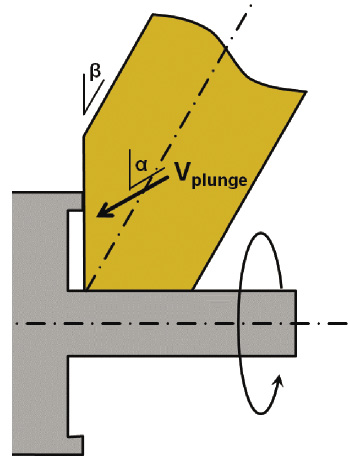
Courtesy of J. Badger
In this example, cylindrical plunge grinding with a swiveled wheel burns the shoulder but not the OD, because the grits are penetrating and effectively grinding the OD but just rubbing the shoulder. Usually, the swivel angle (α) and the plunge angle (β) are both 30°, but a larger plunge angle is recommended for this example.
Let’s take a 16 “-dia., 60-mesh wheel swiveled 30° that’s running at 1,800 rpm and simultaneously plunging at 30° and 0.020 ipm to grind a 3 “-dia. OD and a 4 “-dia. shoulder on a workpiece running at 60 rpm. My Grinder’s Toolbox software program for calculating grinding parameters gives an effective grit-penetration depth of 2.3µm on the OD but only 0.90µm on the shoulder, which means rubbing occurs.
Unfortunately, there’s no surefire cure-all. Nonetheless, I’ve alleviated the problem for several customers by taking the following actions.
First, angle the wheel as much as possible. The standard is 30°, but attempt 45° or more. Second, if the machine allows it, plunge directly into the shoulder at 60° or 90° instead of the standard 30°. The idea is to get the grits to deeply penetrate the shoulder.
Third, aim a dedicated, high-pressure coolant nozzle with a small orifice directly at the wheel/shoulder interface to cool the surface and enhance lubrication. Fourth, increase the workpiece rpm and/or reduce the wheel velocity. This will increase the grit-penetration depth on the shoulder. Unfortunately, it will also increase it on the OD, producing more wheel wear. But as long as you don’t go overboard, you can keep it within an acceptable level.
Dear Doc: I grind at a various wheel speeds, but always dress with diamond roll at a constant wheel speed of 2,400 rpm. I was told this is bad. Why?
The Doc Replies: You want to dress at the same wheel speed you grind at. Why? Because all wheels have some imbalance, and dressing “corrects” this imbalance. The result is an egg-shaped wheel, but it’s egg-shaped in just the right way to correct for the imbalance and maintain constant contact between the wheel and part during grinding.
However, if you dress at a higher wheel speed than you grind at, you overcorrect, and the wheel becomes overly egg-shaped. When you grind, this egg-shaped wheel hits on the high points, causing chatter marks. CTE
About the Author: Dr. Jeffrey Badger is an independent grinding consultant. His Web site is www.TheGrindingDoc.com. He’ll be giving his High Intensity Grinding Course April 28-30 in Latrobe, Pa., hosted by Rush Machinery Inc.
Glossary terms in this article
Related


Subscribers can use MFGAxis notes, saves and discussion tools with their innoNET account.