

Inside the impact of inserts
CNC machines loaded with indexable tools are the foundation of modern machining.
Over time, innovative products and ideas have been introduced that significantly altered the landscape of machining. Screw cutting lathes, EDMs, CNCs, CAD/CAM software and lasers are all milestone technologies on the manufacturing timeline.
In the 1920s, scientists and engineers brought cemented carbides to the market. That substantially affected the path of metalcutting, not only boosting productivity but changing machine tool design. Shortly after cemented carbides arrived, so did the tools we commonly refer to as inserts.
CNC machine tools, EDMs and lasers are far more exciting than carbide inserts, and it is easy to see how these technologies have helped manufacturing. However, the common carbide insert may well have had a much larger impact than all the other developments combined.
Before inserts, cutting tools had to be sharpened when dulled. This required them to be removed from a machine tool and transported to another location where someone would manually grind them to restore cutting edges. Today, we recognize the disadvantages of having to take off tools for sharpening. Increased tool inventories, lost production and longer setup times are just some of the downsides. The introduction of carbide inserts changed all this. A person now simply indexes, or turns, an insert to a fresh cutting edge or replaces a fully worn insert, and a machine tool is ready to run with no setup and minimal adjustment.
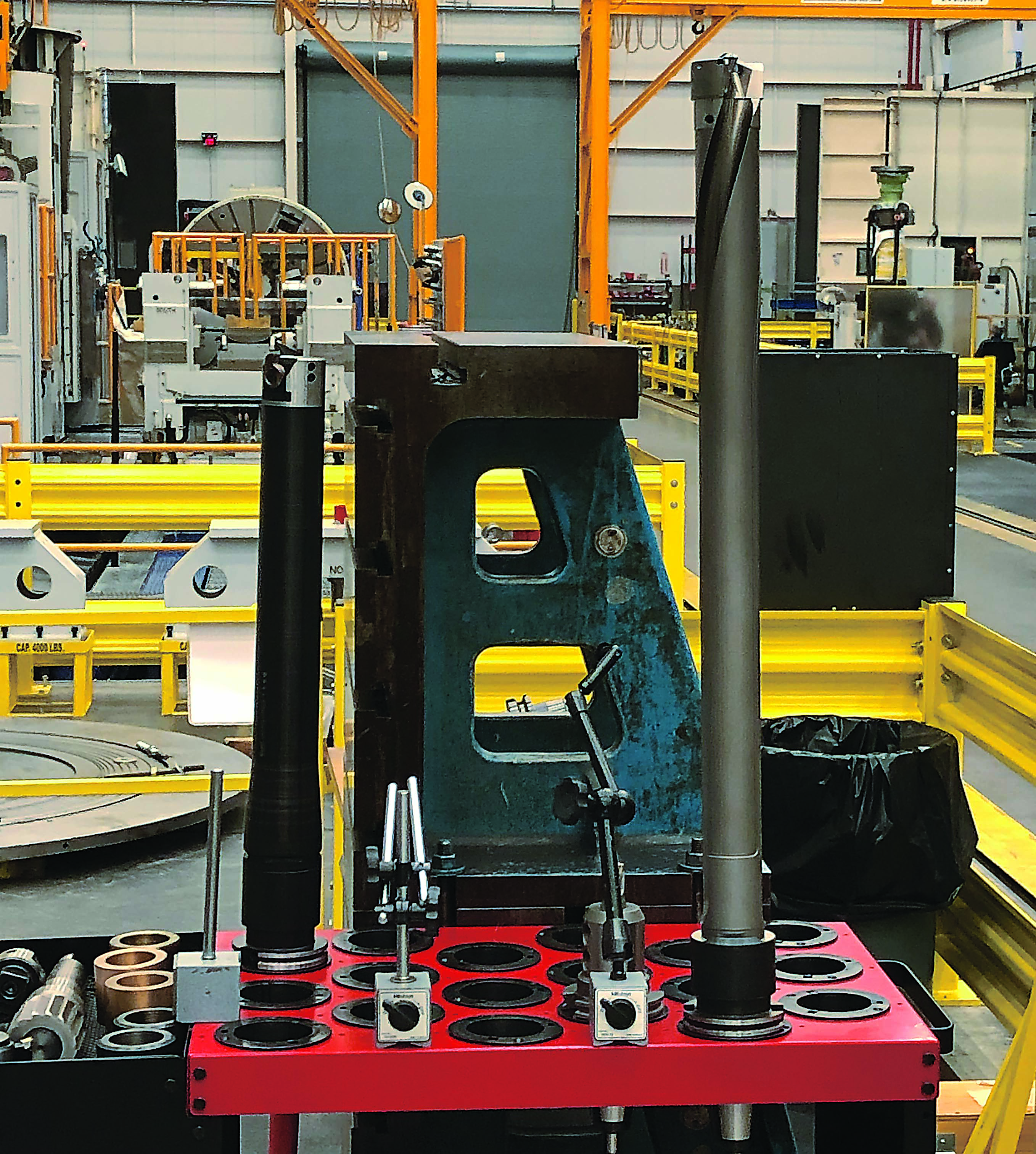
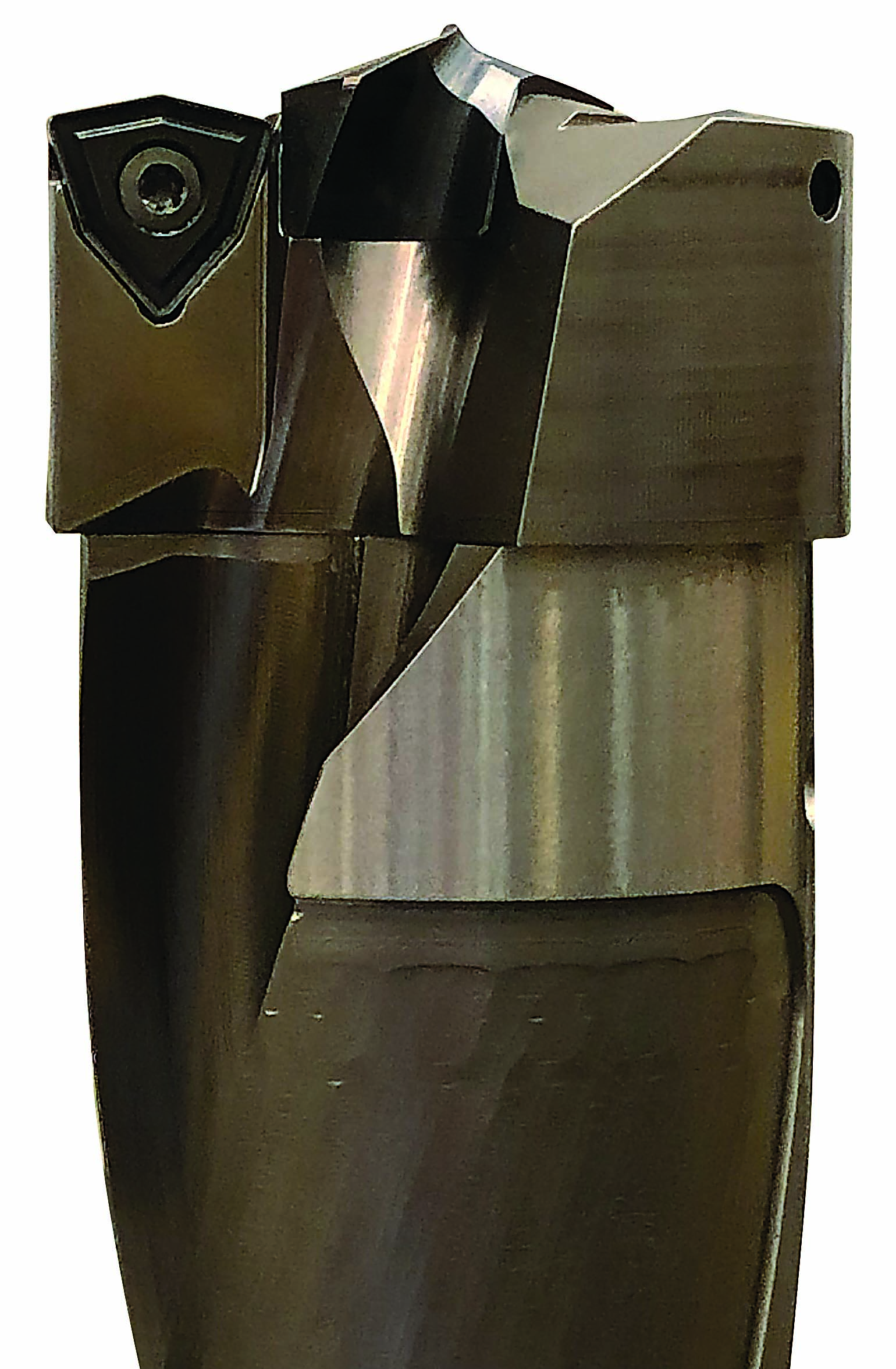
This is one of the largest drills at Mitsubishi Hitachi Power Systems Americas. The drill uses three inserts, and about 10 minutes is needed to change all three. A special piece of grinding equipment and several hours would be required to sharpen an HSS drill this large. Images courtesy of Christopher Tate
Variety is another advantage of carbide inserts. Before, tools were typically solid HSS or had steel shanks with carbide pads brazed on the end. Variation in workpiece materials requires variation in cutting tool materials. So HSS and brazed tools are manufactured with different recipes, thereby producing multiple grades with various levels of hardness and toughness. While many grades of HSS and brazed tools are available, inserts are manufactured in countless grades and new grades are continually added, giving far more options to users than HSS or brazed technologies.
The Incredible Insert
Inserts also provide advanced chip control geometries that can be paired with a specific substrate and coating to further enhance tool performance. Previously, HSS and brazed tools required users to add chip grooves to the rake face if chip control was necessary. This added to the complexity of reconditioning and often was done by hand, which provided varying results. With inserts, users can open a tool manufacturer’s catalog and select from a vast array of geometries. More importantly, when a user develops a machining process, a manufacturer can offer several geometries for testing, making the development process much quicker and easier.
Review the print ads from this magazine to continue
This quick advertiser review unlocks the rest of the article and keeps the full-screen reader focused on the ads instead of the page chrome.
Advertisers included in this article experience
Print placements connected to this article
Slatertools
MAKE YOUR
TM SHAPE Slater Tools offers the industry’s most complete range of tooling to machine and gage precise shapes in seconds. Internal/external rotary & punch broach tools & toolholders Go/No-Go gages Standard and custom tools DESIGN. MANUFACTURE. SUPPORT. 4/10/19 9:59 PM AM.
TM MAKE YOUR SHAPE Slater Tools offers the industry’s most complete range of tooling to machine and gage precise shapes in seconds. Internal/external rotary & punch broach tools & toolholders Go/No-Go gages Standard and custom tools DESIGN. MANUFACTURE. SUPPORT.
Visit Slatertools View this placement in the issue recordPrint ads from this magazine
TM SHAPE Slater Tools offers the industry’s most complete range of tooling to machine and gage precise shapes in seconds. Internal/external rotary & punch broach tools & toolholders Go/No-Go gages Standard and custom tools DESIGN. MANUFACTURE. SUPPORT. 4/10/19 9:59 PM AM.
TM MAKE YOUR SHAPE Slater Tools offers the industry’s most complete range of tooling to machine and gage precise shapes in seconds. Internal/external rotary & punch broach tools & toolholders Go/No-Go gages Standard and custom tools DESIGN. MANUFACTURE. SUPPORT.
Continue reading
July 2019
Indexable-insert tools come standard in many shapes and sizes so users can perform almost any machining operation with off-the-shelf tools. Inserts with diamond, triangle, round, square and thread shapes are common and easily sourced anywhere in the industrialized world. The worst case is next-day delivery on a truck.
On the other hand, HSS turning tools, also known as tool bits, can be ground to any shape imaginable. And brazed tools can be made into any shape that a carbide tip allows, so they may be slightly more universal. However, someone must machine these tools before they can be applied, which is undesirable in today’s manufacturing environment.
Inserts and indexable tools have a distinct cost advantage over other types of cutting tools. Drills and endmills are a good example. Typically, tools that are larger than 1″ in diameter are expensive. Production-oriented shops might need several large HSS drills to ensure that production does not stop when tools become dull, because sharpening is done outside the machine tool and often sent off-site. But change the HSS drill for an indexable-insert drill, and now a shop may need only one tool. When it is dull, a user simply rotates or replaces the insert without removing the tool from the machine and frequently without resetting the machine. The result is less downtime, reduced cost of tool ownership and fewer opportunities for mistakes when resetting the tool. For very large tools, such as the 80mm-dia. × 600mm-long drills we use at Savannah (Georgia) Machinery Works, indexable tools are the only thing available because it does not make economic sense to buy such a large HSS drill.
The Effects of Inserts
Indexable tools have driven changes to machine tool design and vice versa. Although some inserts are up-sharp for nonferrous applications, inserts are typically less sharp than round tools produced by grinding and must operate at higher cutting speeds and chip loads than sharper tools or they will, theoretically, not perform effectively. Machine tool builders started to realize that sales would depend on the ability of a machine to turn at the spindle speed necessary to achieve proper cutting speeds and the rigidity needed to push the tool at the desired feed rates. As CNC machines began to proliferate, they became faster and more rigid to ensure that cutting tool performance would not be limited by the machines, but insert manufacturers also had to catch up with machine tool developments to take advantage of machine advancements and maximize productivity.
Controls also advanced. Most of the early adopters of CNC technology used machines much like old turret lathes and tracer mills, relying on form tools made by hand to create complex geometries. Controls began to progress, and the creation of complex toolpaths became much easier—so easy that many programs today are created on shop floors. Although several factors reduced the need for form tools, the fact that a machine could create almost any desired shape with a single indexable tool significantly drove development of controls. It could be argued that they would have progressed anyway, but the advances most likely would have been slower.
It is impossible to imagine a machine shop without indexable tools. After 80-ish years, I suspect that no one is left who can remember machining without them. CNC machines loaded with indexable tools are the foundation of modern machining and will be well into the future. When additive manufacturing is perfected, the insert will still remain an invaluable tool.
Glossary terms in this article
Related




Subscribers can use MFGAxis notes, saves and discussion tools with their innoNET account.


