

Integrating simulation: General Industry Coverage
It's quite common for CAM software to come with built-in simulation to identify potential collisions and optimize virtual machining. However, most versions don't deliver the experience of programming in the context of the NC machine and instead rely on third-party machine simulation to connect the processes.
It’s quite common for CAM software to come with built-in simulation to identify potential collisions and optimize virtual machining. However, most versions don’t deliver the experience of programming in the context of the NC machine and instead rely on third-party machine simulation to connect the processes. To visualize a toolpath simulation in the context of the NC machine, the programmer must transfer a machine code (ISO or G code) generated from a post-processor to the simulation software.
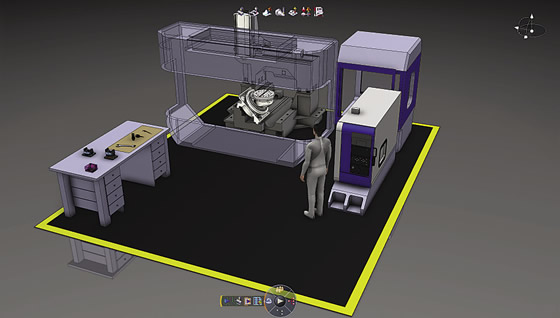
All images courtesy Dassault Systèmes
The NC programmer has access to the entire machine with the kinematics, a virtual controller and the post-processor within the same programming environment.
If the third-party software reveals a problem, the programmer must retrieve the operation in the CAM software, correct the fault and transfer it again for a machine-context simulation. Because an NC program can easily be thousands of lines long, the iterative process can be frustrating and time-consuming, resulting in costly production delays. Aside from dramatically increasing programming lead time, this approach adversely impacts data integrity as it is translated and requires the programmer to learn multiple user interfaces.
The answer is a strategy that integrates NC programming and simulation of an NC machine’s resources. Integrated programming and simulation means the NC programmer has access to the entire machine, with the kinematics, a virtual controller and the post-processor available in the same programming environment. This level of integration provides full associativity between machining operations, G codes and the designed part, effectively ensuring complete traceability of changes. This eliminates the need to translate and transfer data to third-party systems and provides machine simulation within the programming environment.
With integrated machine programming and simulation, programmers can virtually analyze the job setup, machine accessibility and reachability, and all machine accessories, while validating cutting tool assemblies. Compare this to a typical shop floor scenario where, to validate a setup, the programmer typically has to stop the machine, set up the job and determine a way to study the work envelope.
If programmers can simulate the toolpath within the context of the machine tool upfront, they can program faster with fewer errors. This mitigates toolpath rework and iterations. To help reach this goal, Dassault Systèmes’ DELMIA machining application, which is part of the company’s 3DExperience software platform, integrates and manages products, processes and resources as database objects instead of files.
Review the print ads from this magazine to continue
This quick advertiser review unlocks the rest of the article and keeps the full-screen reader focused on the ads instead of the page chrome.
Advertisers included in this article experience
Print placements connected to this article
Mikron
Cool the heat ...
...when tackling tough milling jobs Performance milling with integrated cooling: • faster machining - up to 20 times faster • longer tool life - up to 4 times longer s • better surface quality - up to 3 times better Geometry: • Novel conception, new geometry, special carbide • Diameters from 0.3 to 6 mm (.0118 - .157) • milling depth 1.5 to 5 x D.
Cool the heat ... ...when tackling tough milling jobs Performance milling with integrated cooling: • faster machining - up to 20 times faster • longer tool life - up to 4 times longer s • better surface quality - up to 3 times better Geometry: • Novel conception, new geometry, special carbide • Diameters from 0.3 to 6 mm (.0118 - .157)
Visit Mikron View this placement in the issue recordPrint ads from this magazine
...when tackling tough milling jobs Performance milling with integrated cooling: • faster machining - up to 20 times faster • longer tool life - up to 4 times longer s • better surface quality - up to 3 times better Geometry: • Novel conception, new geometry, special carbide • Diameters from 0.3 to 6 mm (.0118 - .157) • milling depth 1.5 to 5 x D.
Cool the heat ... ...when tackling tough milling jobs Performance milling with integrated cooling: • faster machining - up to 20 times faster • longer tool life - up to 4 times longer s • better surface quality - up to 3 times better Geometry: • Novel conception, new geometry, special carbide • Diameters from 0.3 to 6 mm (.0118 - .157)
Continue reading
January 2015
This single platform allows companies to capture and reuse their machining intellectual property across extended and multiple-site enterprises, providing data security and integrity, accountability and accessibility. This improves the company’s productivity by enabling programmers across the enterprise to collaborate and create valid machine programs in a 3D environment that simulates exactly how machines will behave on the shop floor.
With an integrated approach to programming and simulation, upfront verification during programming can help reduce the programming lead time compared to traditional iterative programming.
The major benefits of an integrated machine programming and simulation strategy include:
■ Time savings. Because there is no need to transfer files to and from third-party machine simulation software, iterative processes and wait times are eliminated.
■ Virtual validation. By resolving issues in the program in the virtual world, programmers can be assured their toolpaths are error-free and that the program will work right the first time on the shop floor.
■ Reduced production time and costs. By reusing optimized toolpaths and associated parameters captured in process knowledge templates, programmers can see increased productivity and sustained quality, while mitigating the risk of programming delays.
With increasingly complex 5-axis and mill/turn machines, integrated simulation can contribute to NC machine programming efficiencies. A recent DELMIA customer noted this approach resulted in faster simulation and machining times, allowing the company to reduce the CNC programming process by 20 percent and mill high-precision molds within 24 hours of software installation. Also, this integrated approach can require fewer prototypes, reduce rework costs and shorten time to market. CTE
Glossary terms in this article
Related




Subscribers can use MFGAxis notes, saves and discussion tools with their innoNET account.


