


Intersection ahead: Drilling Performance
Courtesy of Xebec TechnologyA cross-hole deburring tool from Xebec.Tools for finishing intersecting holes.Every shop eventually faces the prospect of finishing parts with intersecting holes. Many inexpensive solutions exist, but the process begins with a clear definition of the need.For example, Peter Gillespie, engineering manager at Shinn Fu Co. of America Inc., Kansas City, Mo., maker of hydraulic jacks, had the following scenario.
View print ads from this spread
Review the ads on this magazine spread to continue reading. Each ad takes two seconds; a two-page ad counts once.
Advertisers on this magazine spread
Print placements on this magazine spread
©2010 Makino WHERE NEW THINKING TAKES SHAPE.
OUR APPLICATION ENGINEERS LOVE THE SCARY PARTS.
Makino Engineering Services has an unmatched history of creating robust production-ready processes—including machinery, fixtures, tools, programs and documentation—for parts with complex geometries, demanding deadlines, challenging budget constraints and Six Sigma standards. We’ve solved production challenges and engineered tightly integrated manufacturing.
OUR APPLICATION ENGINEERS LOVE THE SCARY PARTS. Makino Engineering Services has an unmatched history of creating robust production-ready processes—including machinery, fixtures, tools, programs and documentation—for parts with complex geometries, demanding deadlines, challenging budget constraints and Six Sigma standards. We’ve solved production challenges and engineered tightly integrated manufacturing systems for hundreds of manufacturers. All with a guaranteed cycle time, lower cost per part and improved quality. Don’t be afraid of the part. Visit us at www.makino.com/engineering or call 1-800-552-3288. ©2010 Makino WHERE NEW THINKING TAKES SHAPE. IS #40
Visit ©2010 Makino WHERE NEW THINKING TAKES SHAPE. View this placement in the issue recordPrint ads from this magazine
Makino Engineering Services has an unmatched history of creating robust production-ready processes—including machinery, fixtures, tools, programs and documentation—for parts with complex geometries, demanding deadlines, challenging budget constraints and Six Sigma standards. We’ve solved production challenges and engineered tightly integrated manufacturing.
OUR APPLICATION ENGINEERS LOVE THE SCARY PARTS. Makino Engineering Services has an unmatched history of creating robust production-ready processes—including machinery, fixtures, tools, programs and documentation—for parts with complex geometries, demanding deadlines, challenging budget constraints and Six Sigma standards. We’ve solved production challenges and engineered tightly integrated manufacturing systems for hundreds of manufacturers. All with a guaranteed cycle time, lower cost per part and improved quality. Don’t be afraid of the part. Visit us at www.makino.com/engineering or call 1-800-552-3288. ©2010 Makino WHERE NEW THINKING TAKES SHAPE. IS #40
Continue reading
March 2010
Courtesy of Xebec Technology
A cross-hole deburring tool from Xebec.
Tools for finishing intersecting holes.
Every shop eventually faces the prospect of finishing parts with intersecting holes. Many inexpensive solutions exist, but the process begins with a clear definition of the need.
For example, Peter Gillespie, engineering manager at Shinn Fu Co. of America Inc., Kansas City, Mo., maker of hydraulic jacks, had the following scenario. A hole in the main jack cylinder and an internal seal passes over the edge of a hole, and sharp edges or burrs can damage the seal. “Is there is an economical way to smooth that edge to prevent or reduce seal damage?” he asked. “Because it’s on a curved surface, most of my ideas are not working.”
Assuming nothing Gillespie does while finishing the interior impacts the exterior, he needs a more complete definition for the intersection requirements.
The two most common requirements for hole intersections are deburring and providing a sealing edge at the intersection. For example, fuel injector holes must have no loose particles, burrs or rough edges that will negatively impact fuel flow, and hydraulic system holes require smooth surfaces for precise flow and minimal leakage around seals.
The author’s experience required finishing miniature holes in stainless steel, removing burrs visible at 30× magnification while assuring that the finished intersection had no more than a 0.001 ” radius. Each requirement necessitated different solutions.
Take it Easy
Normally, the size and tenacity of cross-hole burrs is the problem, but sometimes burrs are merely in the wrong hole. One solution is to create burrs in the most advantageous position. The best solution, however, is to prevent burr formation. If a hole is big enough, drill or punch from the inside out to put burrs in the easiest-to-remove location.
If you cannot prevent them, minimize burr size at cross-holes by slowing the feed rate before a drill’s corners start to exit into the larger or same-size hole. If the burrs are 0.005 ” thick, slow the feed 0.005 ” before the corners exit into the other hole. Drill cross-holes with a gundrill, which uses feed rates of ten thousandths of an inch, but rotates much faster than most drills, so the total cutting rate is still high. The small feed per tooth greatly reduces forces at the breakthrough hole intersection, and the resulting burrs are thin. Sometimes when appropriate based on part requirements, drilling a small hole first allows the larger tool to throw the burr into the smaller hole, so it does not have to be removed from the larger hole.
Simple Tool Solutions
When the object is to remove most of the burr (but not necessarily all of it) and the burrs are not thicker than 0.003 “, the following tools provide quick, low-cost solutions. Most of these tools can be used by hand and in drill presses, and some can be used on CNC equipment. They include swivel-blade tools, countersinks, reversible countersinks, back countersinks, rotary burs, flexible-shank cutters, flexible abrasive ball-tipped brushes, conventional brushes and whisk-style brushes.
Hand-held swivel tools are the simplest and lowest cost option for most deburring. They cost about $10 and blades sell for as little as $1 each. They can deburr and radius hole edges in a few seconds.
Courtesy of Heule Tool
A deburring tool from Heule Tool employs a rocking head to uniformly follow the contour of intersecting holes.
A variety of standard blade sizes and designs exist, including a clothespin style. Specials can also be ordered to fit specific needs. The blades are made of HSS or carbide.
A somewhat similar tool from Heule Tool Corp., Cincinnati, employs a rocking cutting head to uniformly follow the contour of the intersecting holes. It is designed for automated use, but can be applied manually on a drill press.
Inverted-cone rotary burs and stones allow a user to go through a small hole and manually traverse the cross-hole intersection. The backside of rotary burs can also provide that function. While the tools are largely limited to manual use, a 3-axis machining center can be used to boost production. For very small holes, inverted cones for the dental industry can be applied.
When a hole is big enough, 7⁄8 ” in diameter, for example, some shops use a right-angle head with a bur ball to finish an intersection. The right-angle head is also suitable for outward drilling of holes.
Courtesy of J.W. Done
J.W. Done’s Orbitool uses a smooth, round disc with bur-like teeth to finish intersecting holes.
Another cross-hole deburring tool option is the Orbitool from J.W. Done Corp., which uses a smooth, round disc to protect surface finishes in the holes from being damaged by its bur-like teeth. It can be used either manually or on CNC machines, and is reportedly popular for some automotive applications because it selectively targets the hole edge with the burr while preventing scarring of bore surfaces.
The flexible shaft allows the tool to wobble or rotate to accommodate an intersection’s uneven profile. This makes the tool flexible, which runs counter to the general notion that a tool must be rigid to perform. Michael Kapgan, president of the Hayward, Calif., company, noted that most potential users assume the tool is merely a rotary bur on a long stem, but the tool’s flexibility makes it react notably different than more traditional tools. That’s because the tool digs in less as it follows an intersection’s contour.
Courtesy of Brush Research Manufacturing
The Flex-Hone from Brush Research Manufacturing can reach inside parts to deburr intersecting holes.
The Orbitool costs about $125 for a typical 1⁄8 ” size. Part manufacturers report finishing 10,000 to 15,000 holes per tool in stainless steel and 20,000 to 50,000 holes in aluminum, according to the company. Cycle time is generally quick; for one automotive application it is 2 seconds. The finished edges can have a radius from 0.005 ” to 1⁄8 “. Producing a large radius, however, may take several passes.
Honing and Deburring
To both hone the surface and remove reasonable-size burrs, Brush Research Manufacturing Co. Inc., Los Angeles, offers the Flex-Hone tool. It is widely used on automotive engine blocks to create a surface finish texture that aids oil retention in cylinder walls. The tool has abrasive-laden balls on the ends of flexible fibers, which scrub the surface. When the bristles reach a cross-hole, they reach into the hole and drag across the intersection while entering and exiting. That provides deburring and radiusing.
While most users will use the larger hole to perform the deburring when intersecting holes have different diameters, the process can be performed through the smaller hole. The bristles can be short, thick and stiff or long, thin and more flexible. The abrasive balls are made of silicon carbide or diamond, and the various diameter balls are available with varying grit size. The tools are not designed to remove large, thick burrs. For those, use one of the previously mentioned tools first and then follow with the Flex-Hone.
Conventional wire brushes have been used for years when deburring intersecting holes, but they can easily scratch surfaces. Abrasive-filled nylon brushes can also be stiff or flexible, but they generally cut slower than the Flex-Hone.
For removing very light burrs or heavy burrs when surface finish is not an issue, flap wheels can be effective. They are available in many sizes and degrees of coarseness.
Finishing with Fiber Rods
Xebec Deburring Technologies LLC, Huber Heights, Ohio, offers two brush styles for cross-hole deburring and surface and edge smoothing. The ceramic stone types have an alumina fiber abrasive stone at the ends of the flexible shafts. Each tool uses a single stone on the tip, and the stone is shaped into a spherical ball or columnar cylinder configuration. The stone surface has many fiber cutting edges to remove material. The self-sharpening action of the cutting edge provides a stable and continuous grinding performance.
Nori Sumiyoshi, president and CEO of Xebec Technology Co. Ltd., Japan, which manufactures the tools, noted that the ceramic stone types remove burrs as thick as 0.2mm (0.008 “) at intersecting holes. They can be obtained in three different grades of abrasive and are used on metals up to 57 HRC. They can enter holes from 3mm to 6mm and finish intersections up to 40mm deep.
The alumina fiber rod types can remove burrs up to 0.1mm (0.004 “) thick at the intersection of holes from 3.5mm to 20mm in diameter and up to 280mm deep. Each fiber in these brushes is made by binding together 1,000 alumina fiber filaments, and the tip of each fiber has 1,000 high-density cutting edges. Several of these fibers are bound together to make a flexible brush having thousands of cutting edges, which are self-sharpening.
Additional Processes
Several other processes for finishing cross-holes also exist. They include:
• Abrasive micro blasting can effectively remove thin and brittle burrs, and manual and automated systems are available. Finished surfaces have a fine, blasted texture around the intersections. Microblasters can reach into holes as small as 0.056 ” in diameter to deburr hole intersections.
• Electrochemical deburring can deburr dozens of intersecting holes as rapidly as it does one. Cycle times are typically about 20 seconds. When stainless steel is processed, hexavalent chrome is released in the solution, which must be discharged as hazardous waste after filtering. Titanium has not been a particularly good application for this process, but ECD easily finishes aluminum, copper and iron materials. In addition, ECD creates a small radius. Radii are normally from 0.005 ” to 0.010 “, but larger radii can be produced. Cutting action can be tailored to specific portions of the intersection if desired. A carbon deposit adjacent to the intersection requires brushing or cleaning for many applications. The finished intersection can have finishes as fine as 8μin. Ra.
Courtesy of Xebec Technology
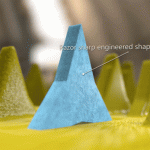
A scanning electron microscope photograph of a fine alumina fiber rod tip on a cross-hole deburring tool from Xebec.
Courtesy of Brush Research Manufacturing
Before-and-after images show a part effectively deburred using Brush Research Manufacturing’s Flex-Hone tool.
• The thermal energy method uses a high-temperature, microsecond flash to deburr and deflash. The action is so fast that burrs literally burn away before the part is affected. It is widely used for removing thin burrs on zinc die castings. It is probably the most effective process for constantly changing edge surfaces, such as those found on automotive ignition key locks. Many parts can be processed simultaneously with TEM. It is normally used for high-volume production. The oxide coating that is left on parts must be removed, usually via a chemical solution.
• Sinker EDMing can be used to deburr intersections. It has the advantage of not normally producing large edge breaks. EDM is a process that many shops already perform, including for electrode production. In addition, today’s EDMs typically leave no significant edge recast material, which would otherwise need to be removed.
• Magnetic abrasive finishing is effective when precision surface finishes are required and burrs are short and thin. It leaves a nearly sharp edge while imparting a finish as fine as 1μin. Ra. Although the equipment is designed for a specific size hole, it can accommodate any size hole. MAF deburrs and polishes hole intersections in about 1 to 15 minutes. It is particularly effective in stainless steel tubing.
There are many potential solutions for finishing intersecting holes, but success depends on compiling detailed requirements, many of which users typically do not explicitly define until after a process is unsuccessfully tried. Assess whether the problem is best attacked by minimizing the burr first or only by removing it.
The cross-hole process is much more effective and time efficient on thin burrs because they allow finer abrasives to be applied for imparting smoother finishes. This reduces cycle time and produces more consistent edges.
Whether it is whirly gig balls flying around, a loose nut traversing the edges or abrasive putty being pushed through holes, a better way can be found. CTE
About the Author: Dr. LaRoux K. Gillespie has a 40-year history with precision part production as an engineer and manager. He is the author of 12 books on deburring and over 220 technical reports and articles on precision machining. He can be e-mailed at laroux1@earthlink.com.
Courtesy of Kennametal Extrude Hone
With AFM, a part is fixtured between two opposed media cylinders. Abrasive media extruded from one cylinder to the other, together with the abrasive media size and viscosity, perform the honing action.
Hole finishing for aerospace applications
Evolving from a simple compressor, a combustor and, usually, a single-stage turbine, today’s aircraft engines continue to combine advances in many engineering disciplines, including mechanical design, aerodynamic design, metallurgy, protective coatings, materials and manufacturing processes.
This includes holemaking and hole finishing. Keeping an aircraft engine turbine together and cool requires holes—thousands of them—that must be precisely sized and aimed, often in hard-to-work alloys.
Fortunately, hole-finishing processes, such as abrasive-flow machining (AFM), have evolved from pure deburring functions to tight-tolerance polishing and radiusing. Add new developments in machine controls, abrasive media and flow targeting, and the process becomes more precise.
Machined holes, including intersecting holes, in aerospace applications require surface improvement, and usually a lot of polishing to achieve the required tolerances. For holes in turbine engine components that rotate at high speeds, for instance, any smeared metal or microcracks at the surfaces increase the risk for diminished performance or failure. Aeronautical engineers specify AFM-imparted surface finishes into many component designs, especially where laminar flow, boundary layer turbulence, compressive residual stresses and edge conditioning are important factors. Even in inaccessible areas, surface-finish improvements from an original 120μin. Ra to 16μin. Ra or finer are possible.
AFM equipment can be stand-alone stations or integrated production systems. Typically, a part is fixtured between two opposed media cylinders. Abrasive media is extruded from one cylinder to the other and the tooling, together with the abrasive media size and viscosity, perform the honing action. When the media is forced into a restrictive passage, media viscosity rises, holding the abrasive media in place. The media abrades only in this restricted state. When it exits the restrictive passage, viscosity returns to normal, meaning no abrasion is produced on threads or seal surfaces.
With MicroFlow AFM, a process Kennametal Extrude Hone developed, lower-viscosity media and smaller abrasive particles allow finishing and edge radiusing of holes down to 50μin. Ra. Fuel-spray nozzles in fuel injectors, for example, can have defined edge radiuses that improve fuel spray distribution for better engine performance.
AFM is also valuable in overhaul and repair applications. Aircraft engine rebuilders use AFM to remove carbon deposits and restore flow characteristics to original specifications.
—Bill Walch, manager, application engineering, Kennametal Extrude Hone, Irwin, Pa.
Contributors
Brush Research Manufacturing Co. Inc.
(323) 261-2193
www.brushresearch.com
Heule Tool Corp.
(513) 860-9900
www.heuletool.com
J.W. Done Co.
(888) 535-3663
www.jwdone.com
Kennametal Extrude Hone
(800) 367-1109
www.extrudehone.com
Shinn Fu Co. of America Inc.
(888) 332-6419
www.shinnfuamerica.com
Xebec Deburring Technologies LLC
www.deburringtechnologies.com
(800) 306-5901
Glossary terms in this article
Related


Subscribers can use MFGAxis notes, saves and discussion tools with their innoNET account.