Intro To Thread Milling
Intro To Thread Milling
Thread milling offers an alternative to tapping, ideal for large diameters and tough materials, with advantages in control and flexibility.
Thread milling is a process for making internal threads that can be the difference between success and failure. In general, tapping is a simpler and often faster way to make threads, but if you have a problem with tap breakage or your major diameter is over 3/4", you owe it to yourself to learn about thread milling. Just be aware that some thread mills cut threads with slightly concave flanks. EMUGE-FRANKEN USA, West Boylston, Massachusetts, makes thread mills that cut 60-degree V threads with flat flanks. This is an important improvement because thread assemblies with concave thread flanks have a greater tendency to gall.
A thread mill has a smaller diameter than the inside diameter of the unthreaded hole, and with thread milling the major diameter of the thread can be adjusted with the milling machine's cutter compensation.
A thread mill has V-shaped cutting edges arranged inside a circle on a plane perpendicular to the center line of the mill's shank. (See image closeup inset.) I call this the "including circle," though this is also known as the cutter diameter.
Cutting a thread with a thread mill is a three-axis operation. My example here is a hole with a center line that is parallel to the Z axis. The rotating tool is moved to the center line of the thread. Then an X or Y move positions the tool so its including circle is touching the major diameter of the hole to be threaded. Now the machine uses helical interpolation to cut the thread. At the bottom of the thread, the tool is moved back to the thread's center line and retracted from the hole. The thread mill makes a lot of small chips so torque on the tool is a fraction of what it would be with a tap. And one huge plus, if the thread mill breaks, just take the junk out of the hole and start over. The only scrap is the broken tool. If the thread has a large pitch, it is a good idea to cut the thread with two or three progressively larger diameter passes.
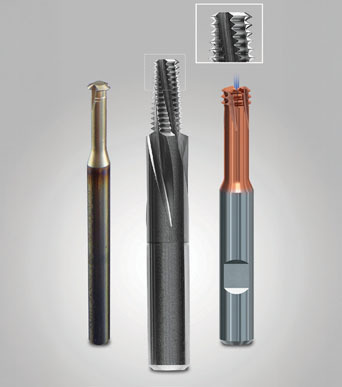
Thread mills are made in a variety of styles (see image). I've already explained the operation of single-plane tools above. With this type of thread mill, each tool can cut a variety of thread pitches and diameters. There are also multiplane tools where each plane, or cutting tooth, has the same cutting diameter. These tools will cut multiple pitches of the thread in one rotation of helical interpolation. Plus, there are tools with three planes that each have different cutting diameters. So, the first plane roughs, the next plane increases the thread diameter and the last plane finishes. Seems to me that such a thread mill would be great in really ornery material like nickel alloys.
Some EMUGE tools have a central port for coolant through the tool, and are made for through the spindle coolant flow. That is a good idea in a blind hole. My shop doesn't have that capability. If you're in a similar situation, here is a trick I have used with blind holes. Move the tool to the center of the hole, then to the bottom. Now, perform the X or Y move and cut the thread while retracting the tool from the hole. This way you won't have trouble with chips packing in the hole under the tool, and you can thread to the bottom of the hole in one pass with one tool.
Thread mills can also be handy for making external threads. I once made some electrical connector bodies from aluminum. The male and female parts went together with a 1 1/2-20 thread. The male part was made from 2"-square stock, and I made it on a bed mill using a thread mill.
Next month I'll go through the machining parameters and programming for thread milling.