Keep machining circle unbroken
Keep machining circle unbroken
High Torque retention knobs keep toolholders in balance.
Demand for titanium, stainless steel and other difficult-to-cut workpiece materials is on the rise for components in vital growth industries, such as aerospace, medical and automotive. To compete, parts manufacturers typically must machine these parts at spindle speeds in excess of 20,000 rpm. Vibration and chatter can occur at these rates of speed, leading to poor surface finishes that require secondary bench operations to meet finish specifications and avoid critical damage to expensive workpieces.
Additional factors, such as an unbalanced toolholder or a toolholder improperly seated within the spindle, can dramatically reduce material-removal rates and increase cycle times. Even minor flaws in toolholder fit or concentricity can reduce part quality and cutting tool and spindle life.
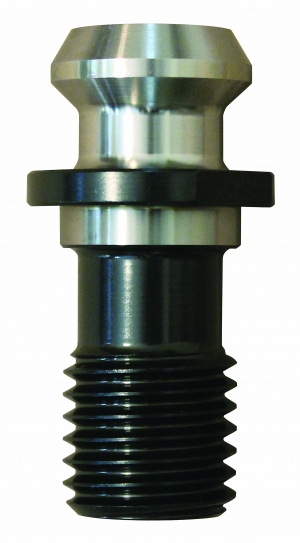
A High Torque retention knob from JM Performance Products. Image courtesy of JM Performance Products
Stability is essential to achieve optimal results when milling challenging materials. The entire machining process must be considered. Any one element could impede the overall effectiveness of the process. The cutting tool, holder, spindle, machine tool, fixturing and workpiece are all part of the interconnected "machining circle."
After investing in a Matsuura H.Plus-405 horizontal machining center, Delta Machine Co. LLC, Gardena, California, realized that one critical factor to not breaking this circle is to have a properly balanced toolholder in the spindle, said President Janos Garaczi. When he purchased the HMC, Garaczi followed the machine builder's recommendation and purchased High Torque retention knobs from JM Performance Products Inc., Fairport Harbor, Ohio. The knobs, which enhance the seating of a holder in the spindle, are longer and reach deeper into the cross section of the holder's threaded bore than standard retention knobs, JMPP reports. As a result, all thread engagement occurs in a region of the toolholder where the cross section is thicker to resist deformation.
Since 1980, Delta has specialized in high-volume production of complex parts. While working as a Delta shop foreman, Garaczi purchased the machine shop from his retiring boss in 2016. "The first thing I did was look for better customers and try to see what kind of equipment we could invest in because we only had old equipment," Garaczi said, noting that his customers include Boeing, Tesla and Chevrolet.
About 80 percent of what Delta machines is titanium, mostly Ti6Al4V, Garaczi said. The rest is stainless steel (15 percent) and aluminum. He wanted to rough-machine as fast as possible, especially when cutting titanium, which consumed about 90 percent of production time.
After purchasing the HMC, "work just started flowing in," Garaczi said, and he began buying more machines: a Matsuura H.Plus-500 HMC, three 5-axis Matsuura MX-520 vertical machining centers and a Toyoda FH550SX HMC. "I just ordered a Makino A7 HMC," he added. "We are extremely busy."
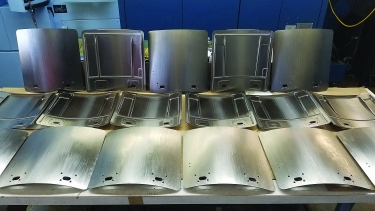
High Torque retention knobs help Delta Machine impart fine surface finishes and eliminate secondary benching operations. Image courtesy of Delta Machine
With the purchase of each machine, Delta continued to buy more High Torque retention knobs. Although they cost about three to four times more than a standard knob, the payback through longer tool life, shorter cycle times and finer surface finishes is quick, Garaczi said. "Even if you pay $4,000 more for 200 knobs, it's going to bring this money back in a couple of months—easily. For us, it's a no-brainer."
He estimates that the retention knobs from JMPP help increase tool life from 20 to 30 percent and eliminate the need for secondary benching operations. One part for the Boeing 737 MAX program, for example, required about 3 hours of bench work to blend the machined surfaces when another machine shop produced it, Garaczi said. After Delta received the job, bench work wasn't necessary.
"One day, the head inspector saw the first article and started touching it," Garaczi said. "The first thing the guy said was, 'You don't need to produce such a good finish.' Without any benching, we can achieve a surface finish of 32 to 40 rms."
He added that the High Torque retention knobs help Delta boost its cutting speeds. "We've been able to cut cycle times by 40 to 50 percent compared to other shops."
On its old milling machines, Delta cut titanium at about 80 ipm. On the newer high-speed machining centers, Delta can reach 200 ipm with the right milling cutter. However, Garaczi emphasized the need to balance tool life and cutting speed to reach the "sweet spot" that maximizes profit. He estimates that tool life is cut in half when going from 100 to 150 ipm in titanium and that tool life drops 40 percent further when going from 150 to 200 ipm.
"The reduction in cycle time did not justify the increase in tool cost," he said. "In titanium, your tooling costs are much higher than when machining aluminum. I would say almost 10 times the cost."
Savings are also potentially realized by avoiding spindle damage when a machine's high torque shears off or breaks the retention knob, which is a scenario Garaczi said he's heard about for standard knobs. Replacement spindles cost $40,000 or more, not including the cost of downtime. "And that's not covered by the manufacturer's warranty."
Although Garaczi pointed out that retention knobs from JMPP help significantly enhance rigidity and minimize vibration when machining difficult-to-cut metals, Delta's use of dual-contact spindles, high-quality tools and toolholders, the right coolant, the best fixtures, high-speed machining centers and efficient toolpaths all play a critical role.