


Look Ahead: Fibrous alloys: General Industry Coverage
Steel is an alloyed material that has long been considered the go-to metal for toolholders and boring bars. Suprock Technologies is trying to change that, having developed prototype toolholders and boring bars made of composites.
Steel is an alloyed material that has long been considered the go-to metal for toolholders and boring bars. Suprock Technologies is trying to change that, having developed prototype toolholders and boring bars made of composites.
Composites are analogous to metal alloys in that component designers can mix different fibers, orientations and ratios of fiber and resin to achieve the desired properties, explained Christopher Suprock, the company’s principal/founder. Suprock uses various composite types, including ones reinforced with carbon, aramid and glass fibers.
“For instance, in an application where stiffness is paramount, you can have a high concentration of carbon fibers at a large radius in the cross section,” Suprock said. A composite designed for stiffness can have a modulus of elasticity up to 379 GPa compared to 200 GPa for steel, he noted. That enables a composite tool to experience nearly twice the cutting force and have the same deflection as steel, thereby allowing users to increase chip loads.
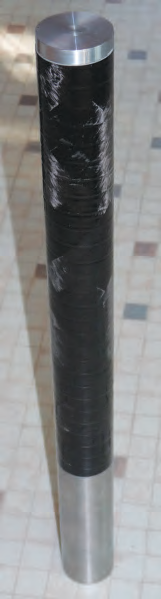
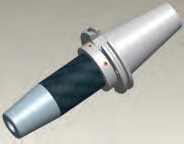
Courtesy of Suprock Technologies
Suprock Technologies has developed composite boring bars and toolholders, where the body is composite while the front end remains steel, as alternatives to entirely steel ones.
Composite tooling also helps reduce vibration and chatter more effectively than steel tooling when machining, according to Suprock. That’s because the polymer bond between the individual fibers is effective at damping energy and dissipating that energy as low-level heat. “Racecars and heavy machinery often utilize carbon-fiber driveshafts to prevent transmission damage,” he said.
Suprock added that composites are generally four to five times lighter than steel, depending on a composite’s composition, and the lower a tool’s mass and the higher its stiffness, the higher its natural frequency. “That’s good because it means we can control chatter more easily,” he said.
By improving the natural frequency, Suprock added that a boring bar with an 8:1 depth-to-diameter ratio, for example, can be replaced with one having a 10:1 ratio without sacrificing performance. “A 10:1 composite bar has a higher natural frequency than an 8:1 steel bar,” he said.
For tunable boring bars, a higher natural frequency dramatically improves performance. “If the bar is lighter, it’s easier to tune,” Suprock said.
The thermal properties of composites are also beneficial for tooling. A composite’s thermal expansion can be controlled to near zero and the material often contracts, Suprock noted. For example, a carbon-fiber composite with a high modulus of elasticity has a thermal expansion on the order of -1×10⁻⁷ in./in. ° F, whereas steel is 6×10⁻⁶ to 7.3×10⁻⁶ in./in. ° F. “This means if the machining envelope warms up during an operation, a composite tool maintains its dimensions 60 times better than steel and does so in a conservative direction—contracting instead of expanding,” he said.
View print ads from this spread
Review the ads on this magazine spread to continue reading. Each ad takes two seconds; a two-page ad counts once.
Advertisers on this magazine spread
Print placements on this magazine spread
further than Toolmex and Palbit
Perfect High Performance
High-performance cutting tools for; Automotive, Aerospace, Die-mold, Medical, or General metal working – look no We hold our own against anyone when it comes to performance and experience 1075 Worcester Street, Natick, MA 01752 IS #78 Scan and Explore © 2011 Toolmex Corporation, Inc. EXCLUSIVELY DISTRIBUTED IN NORTH AMERICA BY TOOLMEX CORPORATION.
Perfect High Performance High-performance cutting tools for; Automotive, Aerospace, Die-mold, Medical, or General metal working – look no further than Toolmex and Palbit We hold our own against anyone when it comes to performance and experience +1-508-653-8897 • 800-992-4766 1075 Worcester Street, Natick, MA 01752 IS #78 www.toolmex.com
Visit further than Toolmex and Palbit View this placement in the issue recordPrint ads from this magazine
High-performance cutting tools for; Automotive, Aerospace, Die-mold, Medical, or General metal working – look no We hold our own against anyone when it comes to performance and experience 1075 Worcester Street, Natick, MA 01752 IS #78 Scan and Explore © 2011 Toolmex Corporation, Inc. EXCLUSIVELY DISTRIBUTED IN NORTH AMERICA BY TOOLMEX CORPORATION.
Perfect High Performance High-performance cutting tools for; Automotive, Aerospace, Die-mold, Medical, or General metal working – look no further than Toolmex and Palbit We hold our own against anyone when it comes to performance and experience +1-508-653-8897 • 800-992-4766 1075 Worcester Street, Natick, MA 01752 IS #78 www.toolmex.com
Continue reading
June 2011
Composites are continually falling in cost as higher production volumes are demanded by the aerospace industry, while steel will remain stable or increase in price. Also, new grades of composites are continually developed in a competitive materials marketplace. In addition, because manufacturing composite tooling is an additive process, production costs will be lower than machining a shank to produce steel tools, especially large ones such as boring bars. Whereas coolant lines must be drilled in steel tools and potentially at odd angles, depending on the front end of the tooling assembly, coolant lines in composite tools can be embedded in the design and plumbed through during additive fabrication or created using a dissolvable material. Also, if sensors are needed, they can be placed inside a tool when laminating a composite and become part of the material. “We don’t have to add material on top of a steel bar, for instance, to protect a sensor because it’s already inside the composite material,” he said.
“We’re finally getting to a point where composite technologies are mature enough that they are becoming a superior option to steel mechanically and physically,” Suprock added.
His company is seeking to partner with a toolmaker and develop the patent-pending technologies as a product line, as well as searching for beta testing partners to help improve real-world processes.
A composite tooling tech brief is available at www.suprocktech.com/files/Composite_Tooling.pdf. For more information about Suprock Technologies, Exeter, N.H., visit www.suprocktech.com.
Glossary terms in this article
Related


Subscribers can use MFGAxis notes, saves and discussion tools with their innoNET account.