

Look Ahead: Hard and sticky
Hydrogen-free diamond-like coatings (tetrahedral-amorphous-carbon DLC) have traditionally had problems adhering to the tool substrate, according to Lucien Peeters, tool product manager for Hauzer Techno Coating BV. To overcome that, he noted that the manufacturer of vapor deposition coating equipment for cutting and forming tools, mold and dies conducted research and developed ta-C coatings that adhere better.
Hydrogen-free diamond-like coatings (tetrahedral-amorphous-carbon DLC) have traditionally had problems adhering to the tool substrate, according to Lucien Peeters, tool product manager for Hauzer Techno Coating BV. To overcome that, he noted that the manufacturer of vapor deposition coating equipment for cutting and forming tools, mold and dies conducted research and developed ta-C coatings that adhere better.
The coating is most effectively deposited with the company’s Flexicoat coating machines using circular arc technology, he added, but filtered arc and laser arc are alternatives when the posttreatment polishing step must be eliminated. “When looking at reproducibility, industrial-acceptable deposition rates and process stability, we see circular arc as a very good solution,” Peeters said.
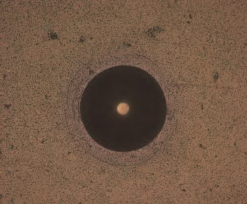
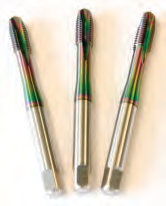
Courtesy of Hauzer Techno Coating
Top: An impact fatigue test of a ta-C coating shows a high level of adhesion with only some small cracks. Below: Taps coated with ta-C.
Review the print ads from this magazine to continue
This quick advertiser review unlocks the rest of the article and keeps the full-screen reader focused on the ads instead of the page chrome.
Advertisers included in this article experience
Print placements connected to this article
800.521.9520 | mscmetalworking.com
MILLING • HOLEMAKING
THREADING • INDEXABLE For over 60 years, Hertel has been providing the metalworking industry with unsurpassed value. Hertel cutting tools are ideal for general machining applications and come in a wide variety of styles and sizes. Available exclusively at MSC Industrial Supply Co.® IS #43.
MILLING • HOLEMAKING THREADING • INDEXABLE For over 60 years, Hertel has been providing the metalworking industry with unsurpassed value. Hertel cutting tools are ideal for general machining applications and come in a wide variety of styles and sizes. Available exclusively at MSC Industrial Supply Co.® 800.521.9520 | mscmetalworking.com
Visit 800.521.9520 | mscmetalworking.com View this placement in the issue recordPrint ads from this magazine
THREADING • INDEXABLE For over 60 years, Hertel has been providing the metalworking industry with unsurpassed value. Hertel cutting tools are ideal for general machining applications and come in a wide variety of styles and sizes. Available exclusively at MSC Industrial Supply Co.® IS #43.
MILLING • HOLEMAKING THREADING • INDEXABLE For over 60 years, Hertel has been providing the metalworking industry with unsurpassed value. Hertel cutting tools are ideal for general machining applications and come in a wide variety of styles and sizes. Available exclusively at MSC Industrial Supply Co.® 800.521.9520 | mscmetalworking.com
Continue reading
June 2011
In connection with the European Nanocoat project, several different DLCs deposited on automotive engine components (tappets) were tested at the Fiat Research Centre, Turin, Italy, and at Hauzer. The tests concluded the ta-C coating had the highest hardness of 40 to 70 Gpa, or up to 7,000 HV, and the lowest friction coefficient of 0.02 to 0.1, which was determined in a pin-on-disc test, according to Hauzer.
Using the knowledge gained from the project, the company reportedly solved the adhesion problem with extensive R&D. During impact fatigue tests conducted by a major U.S. engine manufacturer using an impact load of 2 kN, the ta-C coating did not flake off like other coatings. Additionally, indention tests conducted by Hauzer showed an adhesion value of DB 1 to 2. Daimler-Benz developed the adhesion criteria, which ranges from 1 to 6, where a value of 1 means a coating showed minimal flaking and cracking after a Rockwell indent into the coated surface and 6 means the coating was completely removed.
“If you see the coating breaking out, with some empty spaces where the coating is removed in this test, then you get a higher DB value and the coating does not have good adhesion,” Peeters said. He noted that the coating’s total thickness, including an adhesion layer under the ta-C layer, is about 1µm.
Because it’s a hydrogen-free DLC, ta-C has more diamond-like sp3 bonds than softer graphite sp2 bonds and is therefore more wear-resistant than a hydrogen-containing DLC, Peeters explained.
Although Hauzer optimized these coatings with its equipment, ta-C-coated tools are available from toolmakers in several continents, including North America, he noted.
For more information about Hauzer Techno Coating BV, Venlo, The Netherlands, call +31 77 355 97 77 or visit www.hauzer.nl.
Glossary terms in this article
Related




Subscribers can use MFGAxis notes, saves and discussion tools with their innoNET account.


