

Machine monitoring morphs
Advances in software, sensors and connectivity create more choices and greater accessibility for machine monitoring.
The ability to remotely access monitoring data on machine tools was initially a means of discerning machine status, problems, downtime and other factors in near real time, enabling them to be quickly addressed. Basic monitoring systems remain a valuable option for individual shops, while machine monitoring on a larger scale, such as across multiple sites, requires a more comprehensive approach, typically involving an equipment monitoring system coupled with enterprise manufacturing intelligence. These systems work autonomously to continually monitor and provide visibility to equipment performance. This information can then be converted into intelligence that is fed continuously into a comprehensive enterprise resource planning (ERP) system to track overall company performance.

The advances that have melded multiple discrete systems, including monitoring and management of tools, raw materials and maintenance, have led to a growing number of offerings, from the basic to the highly complex. The challenge, however, is identifying the right system or collection of systems for an operation.
The rapid growth of these systems is due to a number of factors, including advances in Wi-Fi and radio frequency technology, sensor systems and standards such as MTConnect that facilitate connectivity between machine controls and reporting networks.
No-Frills Monitoring
As monitoring systems began to come online, Productivity Inc., Minneapolis, saw a marketing opportunity. “We realized that the little guy needs a monitoring system the most,” said Don Engles, manager of the machine tool distributor’s automation group. Productivity created Uptime-Pro, which manages monitoring from an operational and a business perspective.
The system is a real-time dashboard capable of remotely monitoring a machine and reporting such transition states as in use, loading/unloading or down. Using network connectible devices, the on/off function can detect an emergency stop or nonresponse.
“Uptime-PRO is basic production management in its simplest form,” Engles said. “You don’t need an IT specialist to keep track of things. We also realized that many of our customers operate with legacy machines—older units with less-sophisticated controls. Uptime-PRO can handle these machines, as well as the newest configurations.”
Uptime-PRO is priced like a service. “Subscribers pay a monthly fee and, for that, they can add as many machines as they wish, up to its 50-machine limit,” Engles said.
The lack of frills have not detracted from the system’s monitoring capabilities, according to Engles. “As our customers grow or expand, the system can easily work with them. We are monitoring machines for companies with plants in Ireland, as well as several Canadian facilities.”
Although the system can be accessed through a smartphone, most users employ tablets or office PCs for readability and connectivity considerations. “One of the main reasons for tighter monitoring is that mobile data is not closed-loop,” he said. “In effect, you’re dependent on your service provider, and you can encounter periods when service is down or you can travel to areas where it’s poor or nonexistent.”
The role of MTConnect is growing in the system, but, at present, only a small percentage of the market takes advantage of it, according to Engles. “This is especially true among small shops. Most of our customers are just seeking basic monitoring and regular report generation at a reasonable price.”
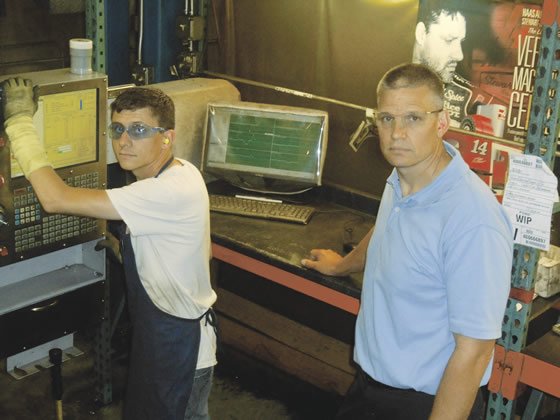
Courtesy of Olympic Steel
Curt Olsen of Olympic Steel (right) with an operator at a machine tool using Uptime-PRO.
Curt Olsen, operations project manager at steel service center Olympic Steel Inc., Minneapolis, agrees. “We like all of the features of Uptime-PRO, but certainly the best part is the price.”
Olympic Steel installed Uptime-PRO 2 years ago to monitor and improve performance in six machining centers hard-wired together. The most important benefit is Uptime-PRO’s reporting capability. “We don’t have that many machines, so if something goes wrong, one of our people will notice it right away,” Olsen said. “We generate reports every 24 hours, which have helped us analyze information and find the reasons for delays causing lost running time. This has given us a better understanding of our business. Uptime-PRO is now a key component of a Six Sigma project I’m working on.”
Learning to interpret the reports is vital. “We had one report that showed just 15 percent machine efficiency, which really put our people on edge,” Olsen said. “But the reality is that spindle running time is only part of the equation. In this case, we were dealing with two 2,400-lb. parts per run that take half an hour to load and another half hour to unload. As a result, the machine was not running for more than an hour. What’s important to us is discovering why the machine isn’t operating and what the team can do to minimize the downtime.”
Olsen would like to see a feature requiring the operator to enter an incident report explaining any lapse in run time of more than 60 minutes before the machine could be started again.
Midsize Monitoring
In 2002, CNC Computer Integration LLC was founded to develop wireless programmable logic controllers for older machines. This required software to monitor machine performance that, in turn, evolved into a system with multiple tracking capabilities, including machine parts, fixtures and ancillary equipment.
The initial challenge was developing a wireless capability that would be affected by electrical interference on the shop floor, according to John Carpenter, founder and president of the Somers, Conn.-based company, which created the WireFreeCNC system. Today, the system monitors machine status and performance, provides remote diagnostics and cycle monitoring, detects emergency situations and determines operator and equipment efficiency and work-in-process time. It can also track and locate manufacturing accessories, including fixtures, tools, gages and maintenance items.
Two new features, G-Time Saver and G-Edit allow users to optimize NC data and simulate G code remotely or at the machine.
The primary market for WireFreeCNC is medium-sized shops. The wireless feature allows rearrangement of the shop floor, which would be difficult with a hard-wired network. Pricing is typically from $2,000 to $4,000 per machine. Real-time reporting and records maintenance allows shop managers to cost-justify improvements, including new machine purchases, according to Carpenter. The monitoring system is accessible through mobile devices.
When Brett Wilkinson, engineering manager for Ballco Manufacturing Inc., began searching for a monitoring system, he established specific parameters. The Aurora, Ill.-based company was searching for a way to track data, rather than just monitor machines. “We knew that no ‘out-of-the-box’ system would have the specialized applications that we needed,” he said. The answer was a system developed by WireFreeCNC that integrates with JobBOSS, Ballco’s ERP system.
A manufacturer of valve components ranging from ½ ” to 60 ” (12.7mm to 1,524mm), Ballco operates 75 CNC machines. The plant layout changes frequently, making the wireless feature essential. The company installed WireFreeCNC 3 years ago as part of an overall equipment efficiency program.
“We were looking for metrics that could assist us in tracking and defining trends, rather than just measuring machine performance,” Wilkinson said. “The system helps us define our workflow in both a macro and micro sense.”
When raw material arrives at the plant, it is identified on a bar code with an inventory control number and printed large enough to be scanned from a distance by a forklift operator. When the material is needed, it moves to the first operation and is checked onto the machine via the bar code. The time and setup details appear on the operator’s tablet when he logs in. Once setup is completed, all aspects are measured and inspected before the job is run. If necessary, the material is moved to another machine for subsequent operations. At the end of the shift, the operator and the system have a complete record of all the parts that have been processed.
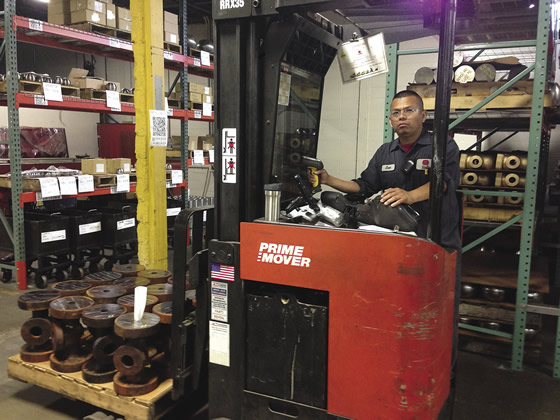
Courtesy of Ballco Manufacturing
A forklift operator in Ballco Manufacturing’s plant in Aurora, Ill., uses a bar code scanner to identify stock in inventory, as well as work-in-process, using WireFreeCNC.
A key metric is the exception report. Each part processed must meet a predetermined profit margin and reports are reviewed daily. Any part that misses its profit goal is examined to determine the reason. “The problem often comes from the job being estimated some time ago, and prices for materials or other inputs have changed,” Wilkinson said. “In that case, the customer is informed of the price increase. If the customer disagrees, we drop the part.” Another report goes to the toolcrib to monitor the cost of the tooling for any particular job.
The Web-based system is accessible via smartphones and tablets. While mobile devices frequently identify jobs and materials within the shop (often through custom apps), they are rarely used from external locales because of the in-house capabilities.
“Thanks to the comprehensive near real-time metrics that we receive, the system gives us a clear vision for improvement,” Wilkinson said. “When we started, our overall equipment efficiency level was roughly 32.5 percent. Since then, we’ve managed to double it, and we’re working upward from there.”
Review the print ads from this magazine to continue
This quick advertiser review unlocks the rest of the article and keeps the full-screen reader focused on the ads instead of the page chrome.
Advertisers included in this article experience
Print placements connected to this article
Fax+1 817 258 3221, [email protected]
No T ti m
! e! me n for D o w i ISCAR METALS INC. 7/10/14 9:52 AM.
! e! No T ti m me n for D o w i ISCAR METALS INC. Tel + 1 817 258 3200, Tech Tel 1-877-BY-ISCAR, Fax+1 817 258 3221, [email protected] www.iscarmetals.com 7/10/14 9:52 AM
Visit Fax+1 817 258 3221, [email protected] View this placement in the issue recordPrint ads from this magazine
! e! me n for D o w i ISCAR METALS INC. 7/10/14 9:52 AM.
! e! No T ti m me n for D o w i ISCAR METALS INC. Tel + 1 817 258 3200, Tech Tel 1-877-BY-ISCAR, Fax+1 817 258 3221, [email protected] www.iscarmetals.com 7/10/14 9:52 AM
Continue reading
August 2014
Multifacility Monitoring
Large manufacturers have different monitoring needs. They need systems to manage visibility into, control over and synchronization across manufacturing operations and equipment performance. One such system is Dassault Systèmes’ DELMIA Apriso.
According to Michal Piatkowski, product manager of Apriso Mobility Solutions, Long Beach, Calif., Apriso is an open system that enables users to execute tasks and synchronize activities without having to write code. Users can modify the system, which is critical for manufacturers that make frequent process changes. In July, Apriso was given the 2014 Global Frost & Sullivan Award for New Product Innovation Leadership.
Unlike job shops or smaller manufacturers, which typically concentrate on individual part runs, large manufacturers continually reengineer products and components. Modifications must be reported to and evaluated by management groups, including cost accounting.
This is accomplished by dividing the Apriso software into modules that can be implemented individually or together. These include production, warehouse, QC, maintenance and time and labor. Also available is an analytics layer that can be accessed by supervisors and management through Excel or an “executive intelligence center,” which keeps senior management advised in near real time.
“The system permits manufacturers to replicate changes they make across numerous sites,” Piatkowski said. “This lets top-level management monitor and control operational processes from what we call a ‘center of excellence.’ “
Apriso’s cost depends on the number of resources, including workstations, machines and plants involved, as well as the number of modules to cover various functionalities. It can range from $200,000 to $2 million per plant. Payback is 2 years or less, according to the company.
The Belfort, France, plant of Alstom Transport, a manufacturer of railcars and related systems, uses Apriso. Guillaume Vendroux, vice president of industrial strategy and development at Alstom Transport, said in a video, “We are constantly striving to improve our industrial performance. In that context, some time ago, we launched our initiative around the Apriso manufacturing execution system. The idea was to integrate in the solution some of our key principles of lean manufacturing and widely diffuse our solutions within our workshop.”
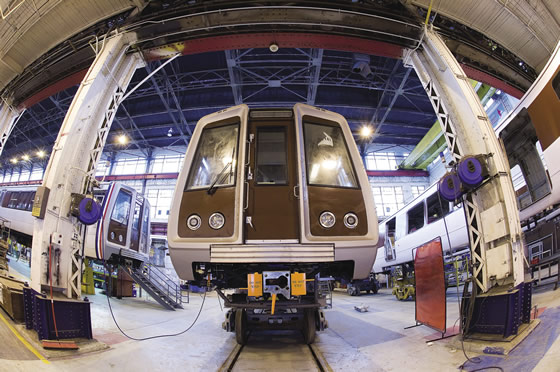
Courtesy of Alstom, M. Czamanske
Metro trains under construction at Alstom Transport.
At the daily meeting of production directors, the latest modifications and their availability on the plant floor are discussed. Once any changes have been validated, they are integrated into the ERP system, and the routines are updated at operator level.
Every morning, Alstom’s electronic program update (EPU) manager reviews the previous day’s performance and meets with his team. Any modifications to the system appear on a screen as an alert sent to team members.
On the plant floor, a large electronic access information board briefs employees about the most immediate changes. Task sequencing and prioritization is clearly visible. The status of each specific task is color-coded to determine priorities, such as red for tasks on hold, blue for ongoing tasks and green for finalized tasks.
All operators are provided with individual electronic tablets. At their workstations, operators log in with an individual bar code. Assigned tasks appear on a screen in their desired sequence. When a task is selected, the operator must validate that he is aware of any changes. The screen then provides step-by-step instructions for the completion of the task, as well as any documentation or references needed. Using the individual tablet, the operator can report the status of the task or note any difficulties, such as missing parts or tool problems. Any alerts or exceptions are transmitted to the EPU manager, who is responsible for solving the problem.
On completion of the task, the operator utilizes data on the screen to perform a final inspection. He can also be instructed to save specific manufacturing information, such as serial numbers of key parts.
At the end of the shift, the production director can check the status of all completed operations and whether they have been performed within the allocated time frame.
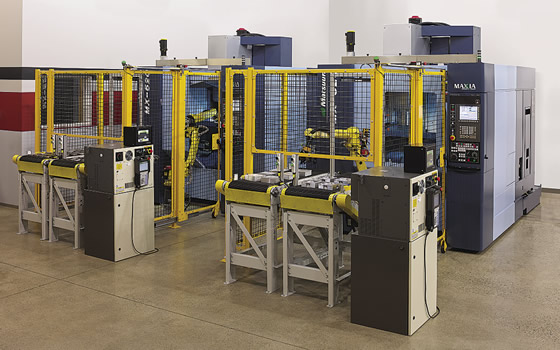
Courtesy of Productivity
Uptime-PRO monitors a robotic manufacturing station.
“We are now able to have consistent data, as well as monitoring of activity,” said Vincent Lecat, site managing director of Alstom’s Belfort plant, in the video. “We see also the potential benefit of improving our quality control. Clearly, this will bring added value for us and our customer.”
Originally installed at the company’s Belfort plant, the system is operational in other Alstom locales and is credited with advancing the company’s lean manufacturing program, according to the company.
Evaluating the Pros and Cons
Although the technology exists for remote capabilities, liability laws and other considerations preclude most system providers from offering full remote control. In short, don’t count on running your manufacturing operation from a beach on the Riviera any time soon.
Second, for the system to generate true operating efficiencies, an infrastructure is required that is capable of immediate response. Knowing about a malfunction does little good if there is no way to immediately respond to it. Fast response requires a redundancy factor among critical supplies and materials, and this comes at a cost. Although monitoring systems are frequently sold on the premise of problem detection or reporting of machine status, the daily or longer-term reports that they are capable of generating can be of equal or greater importance in detailing operational shortcomings that, when addressed, greatly assist in improving work flow and profit.
Third, as with any IT-related system, software, and sometimes hardware, is continually changing. As with office computers, a monitoring system will require ongoing updates and retraining for personnel. You will want to be sure that the vendor you select not only has the capability to meet your needs, both at present and as you progress, but the resources to provide ongoing support. Remember that your system is a long-term investment that requires not just a vendor but a partner.
Machine and process monitoring systems have become sophisticated and powerful. Properly evaluated, installed and used, they not only can improve your bottom line but literally change your business model. CTE
Contributors
Alstom Transport
(212) 692-5320
www.alstom.com/transport
Ballco Manufacturing Inc.
(630) 898-1600
CNC Computer Integration LLC
(860) 870-5544
www.wirefreecnc.com
Dassault Systèmes
(888) 400-7587
www.apriso.com
Olympic Steel Inc., Minneapolis
(763) 544-7100
www.olysteel.com
Productivity Inc.
(800) 328-3272
www.productivity.com
Glossary terms in this article
Related



Subscribers can use MFGAxis notes, saves and discussion tools with their innoNET account.


