

Machine Tool product review for June 2012
Multitask turning center has three turrets
Multitask turning center has three turrets
The Nakamura-Tome NTY3-250 multitask turning center from METHODS MACHINE TOOLS INC., Sudbury, Mass., (www.methodsmachine.com) has three rigid turrets, each with a 4.4″ Y-axis. Each turret holds 12 driven or 24 stationary tools, for a maximum of 72 tool stations. The X- and Z-axis speeds are 1,181 and 1,574 ipm, respectively. To accommodate these speeds and ensure stable performance, the machine weighs 31,807 lbs., the company reports. The distance between spindles is 47.24″. The machine has a 60° slant bed for enhanced chip flow and easy access to the work and tooling. The maximum turning diameter is 8.86″ and the maximum turning length is 35.65″.
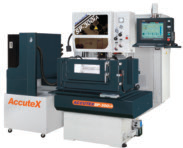
5-axis wire EDM imparts fine finishes,uses new ‘microsparking’ technology
ACCUTEX EDM, Mason, Ohio, (www.accutexedm.com) has introduced the SP-300iA 5-axis wire EDM with its latest “microsparking” technology to impart fine surface finishes. The machine has a Meehanite cast honeycomb base, ribbed column and reinforced lower arm for added stiffness. The working range for the X, Y and Z axes is 13.8″×9.8″×8.7″, respectively. The U and V axes each travel 3.15″. The mechanism for the U and V axes is placed in a cabinet above the working area to provide protection from humidity and other physical damage. The axes are driven by closed-loop AC servomotors with 0.000004″ resolution and controlled by a linear glass feedback system.
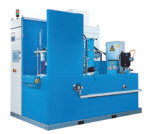
Electrochemical machines available to North American market
Electrochemical machines from EMAG LLC, Farmington Hills, Mich., (www.emag.com) provide a noncontact machining process that does not put heat into a workpiece. Electrochemical machining is characterized by stress-free stock removal, burr-free surfaces and smooth and precise transitions when producing contours, according to the company. Standard features include a Siemens S7 control with graphics display, current relay and voltage monitor, pH control and conductance monitor, temperature control module and 42.27″×37.40″ machining area. Precise ECMs operate on the same basic principle of electrolytic dissolution, but include a mechanical oscillation mechanism for making more intricate 2-D and 3-D microstructures.
Review the print ads from this magazine to continue
This quick advertiser review unlocks the rest of the article and keeps the full-screen reader focused on the ads instead of the page chrome.
Advertisers included in this article experience
Print placements connected to this article
The Star PTG-1 hob
PTG-1 Tool & Cutter Grinder
System technology from one source sharpening and tool reconditioning grinder is an affordable solution for hob sharpening and in-house tool maintenance. The PTG-1 sharpens: • straight and spiral gash hob designs up to 8” OD x 10” OAL • disk, shank and helical type shaper cutters • wide range of round tools For more information or to.
PTG-1 Tool & Cutter Grinder System technology from one source The Star PTG-1 hob sharpening and tool reconditioning grinder is an affordable solution for hob sharpening and in-house tool maintenance. The PTG-1 sharpens: • straight and spiral gash
Visit The Star PTG-1 hob View this placement in the issue recordPrint ads from this magazine
System technology from one source sharpening and tool reconditioning grinder is an affordable solution for hob sharpening and in-house tool maintenance. The PTG-1 sharpens: • straight and spiral gash hob designs up to 8” OD x 10” OAL • disk, shank and helical type shaper cutters • wide range of round tools For more information or to.
PTG-1 Tool & Cutter Grinder System technology from one source The Star PTG-1 hob sharpening and tool reconditioning grinder is an affordable solution for hob sharpening and in-house tool maintenance. The PTG-1 sharpens: • straight and spiral gash
Continue reading
June 2012
Vertical machining center is accessible, has 20,000-rpm spindle
OKK USA CORP., Glendale Heights, Ill., (www.okkcorp.com) offers the VB53 vertical machining center, which combines high-speed operation and enhanced operator accessibility. The machine comes standard with a 20,000-rpm spindle. The X-, Y- and Z-axis travels are 41.34″, 20.87″ and 20.08″, respectively. The company says its Fine Pitch ballscrew reduces the maximum rapid speed, but increases overall system precision. A coolant shelter prevents the casting from being exposed to coolant and chips. Coil-type conveyors efficiently move chips outside of the machine, according to the company. A 0.05µm feedback linear scale enhances positioning accuracy. The machine comes standard with an automatic grease lubrication system, which has a cartridge-based design. This system prevents waste oil from contaminating the coolant.
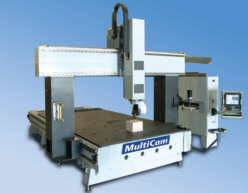
Five axes broadens CNC router applications
The 8000 series CNC router from MULTICAM INC., Dallas, (www.multicam.com) can provide simultaneous 5-axis routing. In addition, the 4th and 5th axes can be programmed separately or the router can operate as a standard 3-axis machine. Applications include deep-cavity moldmaking, machining spiral staircase components and producing plastic and composite parts. The end of the Z-axis has a 440° rotational axis and a 150° swing axis.
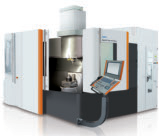
Machine streamlines 5-axis machining
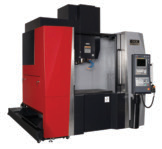
The Mikron HPM 450U milling machine from GF AGIECHARMILLES, Lincolnshire, Ill., (www.gfac.com) has a torque rotary/tilt table for interference-free 5-axis machining. The rotary table speed is 140 rpm. The X- and Y-axis traverse paths measure 23.62″ and 17.2″, respectively, and the Z-axis provides 17.72″ of clearance between the table surface and spindle nose. The machine’s Step-Tec spindle is available in a 12,000-rpm version with a 40 taper or a 20,000-rpm version with an HSK-A63 taper. Both versions use a controlled internal coolant system to maintain consistent temperatures. An internal toolchanger, which integrates into the machine’s base, has a 60-tool storage capacity. An external circular magazine increases the capacity to 200 tools. The company reports that coupling the external magazine with an optional automatic pallet-changing magazine creates a flexible manufacturing cell capable of lights-out production.
Glossary terms in this article
Related

 MFGAxis Discussion
Be part of the shop-floor conversation
Like, save, or comment on this CTE story.
MFGAxis Discussion
Be part of the shop-floor conversation
Like, save, or comment on this CTE story.


MFGAxis Discussion