

Machine tools tap AI
No doubt you've been hearing a lot about artificial intelligence lately. But you may not have heard about the impact AI is having on machining operations—and how that impact may grow in the near future. According to Technavio analysts, the automation-as-a-service market will register a CAGR of close to 20% by 2022, with AI being a major driving force behind this growth.
No doubt you’ve been hearing a lot about artificial intelligence lately. But you may not have heard about the impact AI is having on machining operations—and how that impact may grow in the near future. According to Technavio analysts, the automation-as-a-service market will register a CAGR of close to 20% by 2022, with AI being a major driving force behind this growth.
Today, most AI applications in machining focus on condition monitoring and predictive maintenance, said Jörg Krüger, head of the industrial automation technology department at the Technical University of Berlin in Germany.
“These fields seem to be most popular because the algorithms for pattern recognition are easiest to adapt to data from sensors” that measure process values, such as force and acceleration, he said. “These are also applications where machine learning’s potential for value creation is most obvious for machine tools.”
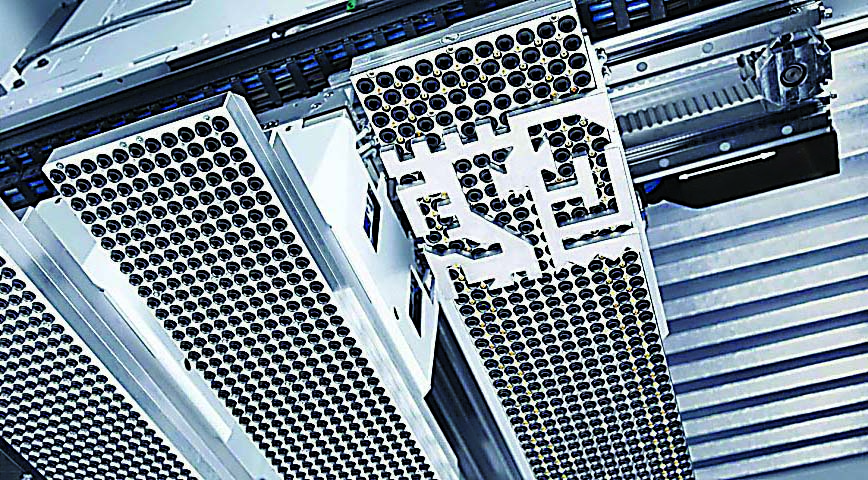
Trumpf’s AI uses a fully automatic laser system to analyze the removal of cut metal sheets. Image courtesy of Trumpf
For machining processes, AI algorithms can create value by monitoring the wear of key components like cutting tools and bearings and predicting when they need replacement. Such applications date back at least 30 years, when the first AI algorithms were installed to process signals from cutting operations, such as turning and milling, said Krüger, who researched machining AI as early as 1991.
More recent developments in this area include those announced by Ditzingen, Germany-based Trumpf GmbH + Co. KG, which plans to employ AI to improve the performance of its laser-cutting machines. One example will affect the unloading unit of Trumpf’s TruLaser Center 7030. To lift cut sheets out of a scrap skeleton, the unit uses 180 pins and more than 2,500 suction cups. If the pins fail to properly perform the removal process the first time, the machine initiates a new removal cycle without operator intervention. If the second attempt fails, the unit continues to try automatic removal approaches until it succeeds.
Review the print ads from this magazine to continue
This quick advertiser review unlocks the rest of the article and keeps the full-screen reader focused on the ads instead of the page chrome.
Advertisers included in this article experience
Print placements connected to this article
New LXN Design, proprietary PCT technology
BE BOTH DYNAMIC & EFFICIENT WHEN
MILLING TITANIUM & EXOTIC ALLOYS NEW! proven in ȤɅɃɄȡͳȿɅɁɊȿɕȩɅɈɈɅɊɃ. 7 Flute Variable pitch - helps reduce harmonics and increase metal removal rates. �mproved with our X�� Carbide grade. ��ers maximum protection against edge chipping which ensures consistent performance. Coated with Varianta Supral for wear resistance.
BE BOTH DYNAMIC & EFFICIENT WHEN MILLING TITANIUM & EXOTIC ALLOYS NEW! New LXN Design, proprietary PCT technology proven in ȤɅɃɄȡͳȿɅɁɊȿɕȩɅɈɈɅɊɃ. 7 Flute Variable pitch - helps reduce harmonics and increase metal removal rates. �mproved with our X�� Carbide grade. ��ers maximum protection against edge chipping
Visit New LXN Design, proprietary PCT technology View this placement in the issue recordPrint ads from this magazine
MILLING TITANIUM & EXOTIC ALLOYS NEW! proven in ȤɅɃɄȡͳȿɅɁɊȿɕȩɅɈɈɅɊɃ. 7 Flute Variable pitch - helps reduce harmonics and increase metal removal rates. �mproved with our X�� Carbide grade. ��ers maximum protection against edge chipping which ensures consistent performance. Coated with Varianta Supral for wear resistance.
BE BOTH DYNAMIC & EFFICIENT WHEN MILLING TITANIUM & EXOTIC ALLOYS NEW! New LXN Design, proprietary PCT technology proven in ȤɅɃɄȡͳȿɅɁɊȿɕȩɅɈɈɅɊɃ. 7 Flute Variable pitch - helps reduce harmonics and increase metal removal rates. �mproved with our X�� Carbide grade. ��ers maximum protection against edge chipping
Continue reading
June 2019

Trumpf’s TruLaser Center 7030 repeats part removal cycles to get the task right. The retry data will be fed to a machine learning system to improve the unloading process in the future. Image courtesy of Trumpf
In real time, AI will not play a role in the retry approaches, which follow a scripted sequence. But Trumpf plans to collect unloading data from TruLaser Center 7030 machines in the field, then feed this information to a machine learning system to create more effective unloading strategies for future use.
In research settings, AI shows promise in other machining-related applications, said Krüger, who analyzes AI’s industrial potential for the German Academic Society for Production Engineering. One of these applications is the automated prediction of surface quality by neural networks, which are computer systems modeled on the human brain and nervous system. Surface quality predictions come from cutting parameters. The parameters are automatically identified by a neural network based on signals received from drives or information from a CNC. When a cutting operation starts, data is collected at a high sampling rate and the neural network learns the process in a few milliseconds, he said.

Trumpf’s TruLaser Center 7030 repeats part removal cycles to get the task right. The retry data will be fed to a machine learning system to improve the unloading process in the future. Image courtesy of Trumpf
No matter what advances AI researchers make, however, he pointed out that the success of AI in machining operations depends on the operators who must interpret the predictions of AI algorithms and set the right parameters for the production processes in which the algorithms operate. Although he sees rapid progress in the development of AI algorithms, he does not see anything close to corresponding progress in operator education about AI.
“Until this gap is closed,” he said, “I don’t think the huge progress in research can be transferred to real applications in most cases.”






