


From machines to putting greens
Part Time column for the October 2011 issue of Cutting Tool Engineering magazine visits with an Indianapolis shop that machines robotic mower components.
Not many machine shops serve as broad a variety of customers as Rayco Machine & Engineering Group Inc., Indianapolis. Rayco makes parts for Indianapolis racecars, builds assemblies for U.S. troops overseas, machines aerospace components and manufactures 292 part numbers for Allison Transmission Inc.
The shop’s work also includes oddball one-offs. “A chocolatier brought a broken brass piece to us from an old German chocolate-making machine,” said Greg Cox, company president. “We reverse-engineered the part, made it and got their machine back up and running. It never ceases to amaze me how many different projects we get into.”
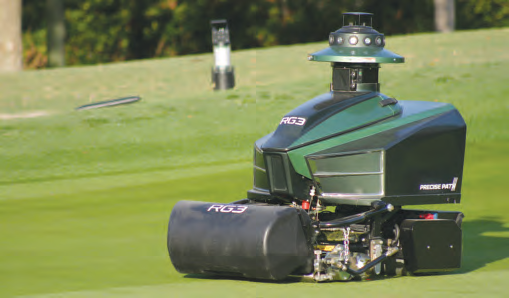
One out-of-the-ordinary project evolved from prototype work to production. Rayco machines more than half the components for the RG3 robotic greens mower from Precise Path Robotics, which is engineered to boost golf course labor productivity.
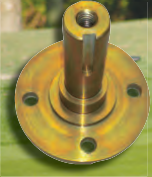
A typical part is a roller drive rear spindle. More than 3 ” long with a major diameter less than 3 “, the part is machined from 3 “-dia. 4140 steel bar prehardened to 28 to 32 HRC and sawed to 3.560 ” lengths.
To begin the machining process, the sawed bar is chucked in a 4 “-dia. Hardinge step chuck in a Hardinge Talent SV 150 lathe. Facing is the first step, using a Sumitomo CNMG 432 coated carbide insert, followed by axial drilling with a No. 2 center drill. The part is roughed via a V71 canned cycle at a 0.075 ” DOC, 0.012-ipr feed rate and 600-sfm cutting speed. The operation cuts three diameters, leaving 0.010 ” of excess stock for finishing.
The first 2.198 ” of bar length is turned to a diameter of 0.760 “, the 0.484 ” length is turned to 1.010 ” and the 0.130 ” length is turned to 1.450 “. “We blend off of the part at that point to create a radius at a 2.950 ” diameter,” Cox said, explaining that when the part is later flipped in the chuck and finished, blending into the radius assures there will be no sharp edge on that corner.
The finishing insert that’s applied next is a CNMG 431, which has a smaller nose radius than the CNMG 432 to make the resulting shoulders as small as possible. For the 0.010 “-deep finish pass, Rayco increases the speed to 750 sfm. Finished diameters of the segments are 0.750 “, 1.00 ” and 1.440 “. Cox said the pass produces a finish of 37 µin. Ra. This first set of operations consumes 2 minutes and 36 seconds.
After the tailstock is removed and a 0.257 “-dia. cobalt tap drill makes a 0.910 “-deep axial hole, a 90° countersink puts a chamfer on the hole mouth. Then a 5⁄16-18 tap threads the hole 5⁄8 ” deep. These four operations take 1 minute. The part is then turned in the chuck and gripped on the 1.00 “-OD segment, locating against the face of the 1.440 “-dia. segment.
Courtesy of Rayco Machine & Engineering Group
Among the parts that Rayco Machine & Engineering Group machines for the Precise Path RG3 robotic greens mower is this steel roller drive rear spindle (above). Below: The Precise Path RG3 robotic greens mower, with a guidance beacon in the background.
Courtesy of Precise Path Robotics
The next operation employs a G72 canned cycle to face the part and rough turn a 0.248 “-long 1.260 ” diameter, again leaving 0.010 ” of excess material. A Kennametal NG2031 RK Top Notch grooving tool then puts an undercut at the back of the 1.260 ” diameter next to the part face to provide a place to turn into during finishing.
After a ¾ “-dia. drill creates a 0.625 “-deep hole in the end of the bar, a Sumitomo ½ “-dia. boring bar, tooled with a TCNP221 coated carbide insert, bores the hole to a diameter of 0.644 “. The CNMG 431 turning tool with a 0.015 ” nose radius is again employed to finish bore the back face, the 1.250 ” diameter and the part’s overall length. Final size of the large diameter is 2.940 “, and part length is 3.331 “. These three operations consume 1 minute and 35 seconds.
Then Rayco moves the part to its Hurco VM20 vertical machining center, chucking it vertically on the 1.0 ” OD in a Hardinge indexer, to drill four bolt through-holes. Before a standard cobalt jobber drill produces the 0.332 “-dia. holes, a 90° spotfacer cuts a 0.350 “-dia. chamfer at each hole site.
When the holes are done, the indexing head is tilted 90° and the bar is clamped horizontally in a collet that has locating pins located to match two of the bolt holes. The pins assure the keyway to be machined next will be positioned correctly in relation to the holes.
A 4-flute, 3⁄16 “-dia., solid-carbide endmill then machines a 1.090 “-long, 0.106 “-deep, 0.118 “-wide keyway, beginning at the 0.750 “-dia. end of the bar. The operations on the VMC take 3 minutes and 30 seconds. With machining completed, the shaft is sent out for zinc plating with yellow hexavalent chromate.
“This is a pretty simple part,” Cox said, noting that Rayco’s participation in the project began about 2 years ago with the machining of prototype parts. Many of the parts were changed during the product development process, and Rayco provided engineering and design-for-manufacturing assistance during that time. First-year production quantities for the RG3 mower are targeted at 250 units, Cox noted, with volume expected to increase.
For more information about Rayco Machine & Engineering Group Inc., visit www.ray comachine.com or call (317) 291-7848. To learn more about the Precise Path RG3 Robotic greens mower and its manufacturer, visit www.precisepath.com. CTE
About the Author: Bill Kennedy, based in Latrobe, Pa., is a contributing editor for CTE. He has an extensive background as a technical writer. Contact him at (724) 537-6182 or billk@jwr.com.
Glossary terms in this article
Related


Subscribers can use MFGAxis notes, saves and discussion tools with their innoNET account.