

Machining strategies for difficult materials
Machine Technology column from the February 2011 issue of Cutting Tool Engineering magazine offers machining strategies for difficult-to-cut materials.
Toolpath strategies for efficient milling should consider much more than part geometry. Cuts should be selected that will not cause chatter, stall the spindle, break the teeth or tool shank or separate the tool from the spindle. A good toolpath strategy should also impart specified surface finishes and achieve acceptable metal-removal rates and tool life.
Typically, tool life has been considered independently of the toolpath. Tabular data listing recommended chip loads and surface speeds for various tool and workpiece material combinations—typically developed through measurements during a large number of turning tests—are widely available.
Tool wear mechanisms such as diffusion and oxidation are strongly temperature-dependent, and temperatures in the cutting zone are often quite high. The temperature rises in the shear plane, where the majority of chip deformation occurs. Then, as the chip slides along the rake face of the tool with high pressure, the resulting frictional forces raise the temperature even more.
When the temperature gets high enough to activate thermal wear mechanisms, a “thermal barrier” is crossed and tool wear increases rapidly. However, milling is substantially different than the turning typically performed in tests to create the data. Toolpath choice can change wear conditions dramatically.
For some combinations of tool and workpiece material, tool life is not a critical factor. Solid-carbide tools, for example, can tolerate the melting temperature of aluminum. For that reason, permissible surface speed when endmilling aluminum is almost unlimited.
In other workpiece materials, such as titanium and nickel-base alloys, tool life is decisive. These materials produce much higher cutting temperatures than aluminum, and they are chemically active with respect to the tool materials. As a result, these difficult-to-machine workpiece materials are typically machined at low surface speeds and low mrr.
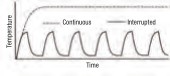
However, because milling cuts are inherently interrupted, they provide an opportunity to change the game. If the radial DOC is selected to be a small fraction of the tool diameter, say 10 percent, then each individual tooth is only cutting for a short time. Before the temperature can rise to the thermal barrier, the tooth is out of the cut. The tooth has time to cool before it re-enters the cut on the next revolution.
All images courtesy of S. Smith
Review the print ads from this magazine to continue
This quick advertiser review unlocks the rest of the article and keeps the full-screen reader focused on the ads instead of the page chrome.
Advertisers included in this article experience
Print placements connected to this article
Hornusa
HORN - THE LEADERS IN GROOVING TECHNOLOGY
FOCUS ON THE ESSENTIAL SYSTEM DR Urma licence Sensitivity instead of gross motor skills – this is the motto of the new HORN “System DR” reaming tools. Very narrow cutters, simple handling, and high repeatability when replacing inserts. A large selection of base material, coatings, and cutting geometries make the DR from HORN the perfect tool system for high precision bore machining
HORN - THE LEADERS IN GROOVING TECHNOLOGY FOCUS ON THE ESSENTIAL SYSTEM DR Urma licence Sensitivity instead of gross motor skills – this is the motto of the new HORN “System DR” reaming tools. Very narrow cutters, simple handling, and high repeatability when replacing inserts. A large selection of base material, coatings, and cutting geometries make the DR from HORN the perfect tool system for high precision bore machining. HORN – INTELLIGENT TOOL DESIGN AT WORK. IS #32 HORN
Visit Hornusa View this placement in the issue recordAtistellram
3OLUTIONS FOR DIFlCULT TO MACHINE MATERIALS
CUT TITANIUM LIKE BUTTER! Stellram 7792VX high feed milling cutters can increase metal removal rates up to 5 times, substantially reducing part costs. s #UTTING FORCES DIRECTED AXIALLY INTO THE SPINDLE REDUCING spindle wear, improving machining stability s 0RODUCTIVE MACHINING ON OLDER EQUIPMENT s &ACE MILLING POCKETING SLOTTING AND PLUNGING.
3OLUTIONS FOR DIFlCULT TO MACHINE MATERIALS CUT TITANIUM LIKE BUTTER! Stellram 7792VX high feed milling cutters can increase metal removal rates up to 5 times, substantially reducing part costs. s #UTTING FORCES DIRECTED AXIALLY INTO THE SPINDLE REDUCING spindle wear, improving machining stability s 0RODUCTIVE MACHINING ON OLDER EQUIPMENT s &ACE MILLING POCKETING SLOTTING AND PLUNGING
Visit Atistellram View this placement in the issue recordPrint ads from this magazine
FOCUS ON THE ESSENTIAL SYSTEM DR Urma licence Sensitivity instead of gross motor skills – this is the motto of the new HORN “System DR” reaming tools. Very narrow cutters, simple handling, and high repeatability when replacing inserts. A large selection of base material, coatings, and cutting geometries make the DR from HORN the perfect tool system for high precision bore machining
HORN - THE LEADERS IN GROOVING TECHNOLOGY FOCUS ON THE ESSENTIAL SYSTEM DR Urma licence Sensitivity instead of gross motor skills – this is the motto of the new HORN “System DR” reaming tools. Very narrow cutters, simple handling, and high repeatability when replacing inserts. A large selection of base material, coatings, and cutting geometries make the DR from HORN the perfect tool system for high precision bore machining. HORN – INTELLIGENT TOOL DESIGN AT WORK. IS #32 HORN
Continue reading
February 2011
Figure 1. Low radial immersion milling leads to lower average temperature in the cut and longer tool life.
Figure 1 illustrates the idea. The dashed line represents the temperature created during turning. The temperature rises quickly and reaches a high equilibrium temperature, where it remains. When milling, the temperature rises at the same rate, but the tooth loses contact with the workpiece long before the temperature reaches the level seen in turning. Smaller radial DOCs would lead to even shorter contact times and lower average temperatures.
It’s easy to see how low radial immersions could be maintained when finishing, but there are times when large radial DOCs are required when roughing. When milling an internal corner, the radial DOC is often quite large. However, even in these cases, it’s almost always possible to choose a toolpath that maintains the radial DOC below a given limit.

Figure 2. A trochoidal toolpath.
For example, instead of making a slot with a large-diameter tool rotating at a slow speed, the slot can be made with a smaller-diameter tool using a trochoidal motion at a much higher speed. Trochoidal milling superposes circular motion and translation (Figure 2). If the translation is small compared to the circular motion, the radial DOC can be arbitrarily small.
Some NC programming packages have tools like trochoidal motion to help the programmer control the radial DOC. However, a small radial DOC when milling can permit surface speed to be increased by a factor of two or more over the tabular data. Light, fast machines making light, fast cuts provide an attractive option for machining difficult materials. CTE
 About the Author: Dr. Scott Smith is a professor and chair of the Department of Mechanical Engineering at the William States Lee College of Engineering, University of North Carolina at Charlotte, specializing in machine tool structural dynamics. Contact him via e-mail at kssmith@uncc.edu.
Glossary terms in this article
Related




Subscribers can use MFGAxis notes, saves and discussion tools with their innoNET account.


