

Machining the ‘unmachinable’
Tom Lipton, the author of Cutting Tool Engineering's Shop Operations column, shares a trick he learned that reveals an interesting use of relatively crash-proof soft metal or plastic bed plates on a milling machine.
A trick I gleamed from a friend reveals an interesting use of relatively crash-proof soft metal or plastic bed plates on a milling machine. In the shop where my friend works, they prepare the part blanks and secure them to the bed plate with Permacel double-sided tape. Plastic locating pins are used to index the part for the second-side operations. This technique, used along with hot-melt glue filling (see the August 2013 “Shop Operations” column), allows the “unmachinable” to be machined with ease, such as delicate parts that cannot tolerate any clamping force without distortion.
For example, hot-melt glue supports a difficult-to-hold part for two-sided machining, and the part is held with double-sided tape to a freshly surfaced subplate. The first side of the part is faced and then surface contoured to the part’s halfway point. Be sure to slightly overlap the parting line if applying a ballnose endmill.
After machining the first side, spray the machined cavity and part with a little mold release and fill with hot-melt glue. For a large volume of glue, fill an inexpensive Teflon-coated pan on a hot plate to make quick work of melting the glue.
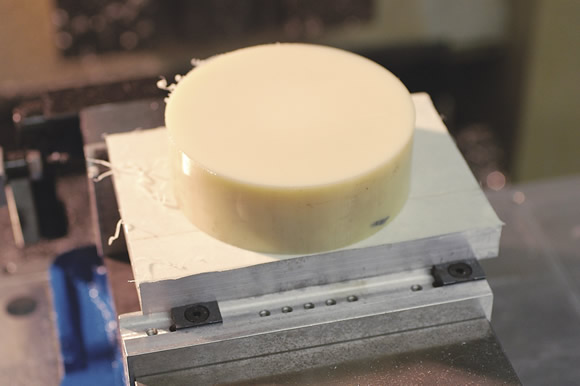
Courtesy of All images: T. Lipton
Double-sided tape holds this workpiece to a freshly surfaced subplate.
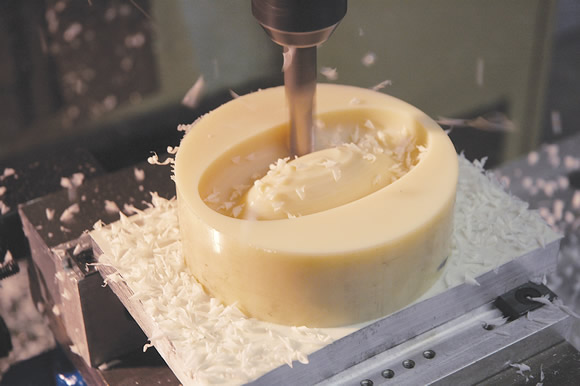
Facing and contouring to the halfway point of the first side of the part.
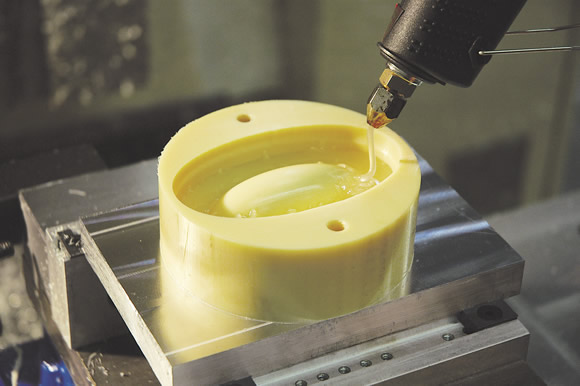
Filling the cavity around the part with hot-melt glue.
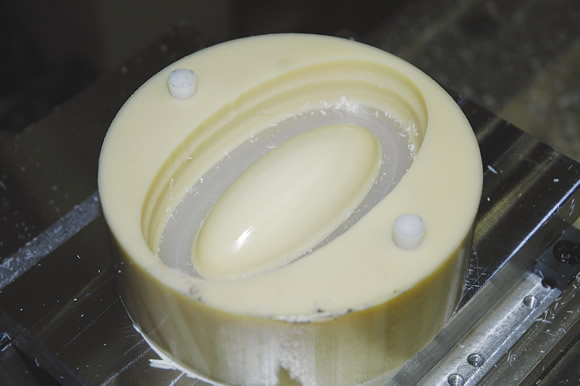
Review the print ads from this magazine to continue
This quick advertiser review unlocks the rest of the article and keeps the full-screen reader focused on the ads instead of the page chrome.
Advertisers included in this article experience
Print placements connected to this article
Need Technical
GRINDING SUPPORT
At Abrasive Technology, we not only manufacture superior diamond grinding wheels and tools, but provide the customized support to ensure each application works to improve efficiencies and the overall bottom line. Our team of product and application specialists collaborates with customers to determine the best solutions for.
NEED TECHNICAL GRINDING SUPPORT At Abrasive Technology, we not only manufacture superior diamond grinding wheels and tools, but provide the customized support to ensure each application works to improve efficiencies and the overall bottom line. Our team of product and application specialists collaborates with customers
Visit Need Technical View this placement in the issue recordPrint ads from this magazine
At Abrasive Technology, we not only manufacture superior diamond grinding wheels and tools, but provide the customized support to ensure each application works to improve efficiencies and the overall bottom line. Our team of product and application specialists collaborates with customers to determine the best solutions for.
NEED TECHNICAL GRINDING SUPPORT At Abrasive Technology, we not only manufacture superior diamond grinding wheels and tools, but provide the customized support to ensure each application works to improve efficiencies and the overall bottom line. Our team of product and application specialists collaborates with customers
Continue reading
September 2013
Surfacing the second side of the part exposes the hot-melt glue the first side was filled with.
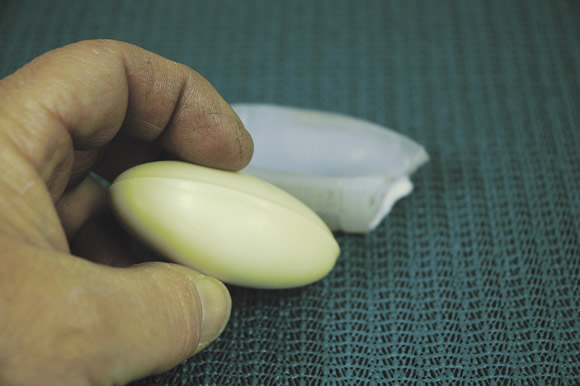
An example of a difficult-to-hold part. When the last hunk of hot-melt glue is pulled off the part, the finished part is exposed.
Add the locating pins at this point so the second side of the part is perfectly indexed. Plastic pins are used in case the contouring tool bumps into the pin while the part is being cut. They are only needed when the part is indexed and secured with the double-sided tape. I leave them in because it’s easier and I’m paranoid about a workpiece not remaining perfectly secure when using double-sided tape.
After the glue solidifies, reface the first side of the part to the Z-axis zero point. Use a low rpm, or spindle speed, to prevent the glue from remelting. You need a smooth, solid surface for the second side of the part so the double-sided tape has enough surface area to hold it. This method is great for the delicate parts that cannot tolerate any clamping force without distortion.
Surfacing of the second side of the part exposes the hot-melt glue that the first side is filled with. Technically, the part is floating in space, with no connection to the original blank other than the glue.
For the next step, I simply use a bandsaw to remove the excess material to get close to the part. Be sure to run the saw slowly because otherwise it will remelt the glue and make a mess of the saw. When the last hunk of hot-melt glue is pulled off the part, the finished part is exposed.
For thin-shelled or other difficult-to-hold parts, this method can produce fantastic results. CTE
About the Author: Tom Lipton is a career metalworker who has worked at various job shops that produce parts for the consumer product development, laboratory equipment, medical services and custom machinery design industries. He has received six U.S. patents and lives in Alamo, Calif. For more information, visit his blog at oxtool.blogspot.com and video channel at www.youtube.com/user/oxtoolco. Lipton’s column is adapted from information in his book “Metalworking Sink or Swim: Tips and Tricks for Machinists, Welders, and Fabricators,” published by Industrial Press Inc., South Norwalk, Conn. The publisher can be reached by calling (888) 528-7852 or visiting www.industrialpress.com. By indicating the code CTE-2013 when ordering, CTE readers will receive a 20 percent discount off the book’s list price of $44.95.
QR codes and videos from this issue
Print QR codes, video callouts, and in-magazine links for this article now point to the CTE video hub in the HTML version.
Related




Subscribers can use MFGAxis notes, saves and discussion tools with their innoNET account.


