

Maintaining the productivity party
END USER: North America Clutch Corp., (414) 267-4000, www.noram-clutch.com. CHALLENGE: Lower manufacturing costs. SOLUTION: An automated turning center.
—————
END USER: North America Clutch Corp., (414) 267-4000, www.noram-clutch.com. CHALLENGE: Lower manufacturing costs. SOLUTION: An automated turning center. SOLUTION PROVIDERS: Amada Machine Tools America Inc., (847) 797-8700, www.amadamt.com; Progressive Machinery Inc., (414) 577-3200, www.progressivemachinerywi.com
—————-
Precision metal parts manufacturing is on the up-and-up: labor costs are going up, the expense of worker benefits is going up and raw material prices are going up. “None of that can get passed onto the customer,” said Jeff Hargarten, president of North American Clutch Corp., a Milwaukee manufacturer of primarily power transmission products for outdoor equipment producers. “If you try to ram through a price increase, you’re just opening yourself up to possibly losing that business.”
To keep manufacturing costs in check, NORAM reduced the number of employees in its CNC machining department from nine to three during the recent economic downturn. However, part volumes started to increase and the company wanted to avoid bringing back two or three people. The solution was to invest in one of the rare areas of manufacturing in which, according to Hargarten, prices seem to be coming down: automation equipment.
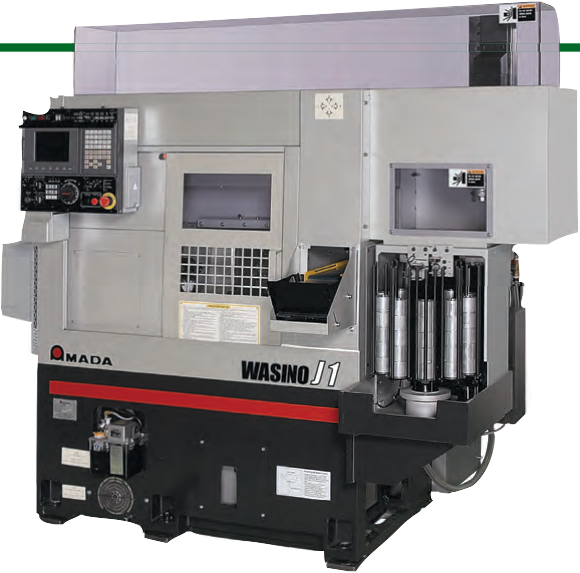
Based on an Amada Wasino-developed time study and process, Progressive Machinery Inc., Amada’s Milwaukee-based Wisconsin distributor, proposed an automated solution. NORAM evaluated purchasing the J1 turret-type turning center with integrated part autoloader and rotary part supply device from Amada Machine Tools America Inc., Rolling Meadows, Ill. Initially, the equipment appeared to have an unacceptable return on investment determined by the projected cycle time reduction for the highest-volume job. “It did not meet our 1-year payback criteria,” said Guy Campbell, the company’s manufacturing engineer and quality manager. NORAM had found a similar scenario when evaluating other automation equipment. “My average lot size of 25 pieces meant that the additional setup time for the automated cell was larger than the labor savings when the jobs ran,” he said.
Nonetheless, Hargarten wasn’t convinced by the company’s payback calculations this time and felt that acquiring the equipment, which NORAM did last fall, was an opportunity for the company to learn about the pros and cons of automation. “The machine just seemed like it was a good fit, and my gut was telling me it made a lot of sense to buy it,” he recalled. “I just said, ‘We’re getting the machine.’ “
That decision proved to be the correct one. “This is the first automated machine we have found that had a payback because it is such a simple and straightforward machine,” Campbell said. “It turned out the investment in automation improved the capability of the machine so well we were able to take other things out of the process, which made it a tremendous cost saver.”
Previously, the company brazed two parts together, tapped two holes in each workpiece on a vertical machining center, which was part of a work cell, and then painted each part’s tapered bore with a nitriding stop-off coating so bore hardness did not increase during heat treatment. After heat treating, NORAM rough and finished bored using ceramic inserts. One insert corner typically lasted through a 1,000-piece lot size run.
Review the print ads from this magazine to continue
This quick advertiser review unlocks the rest of the article and keeps the full-screen reader focused on the ads instead of the page chrome.
Advertisers included in this article experience
Print placements connected to this article
Sumicarbide
r b i d e
li d C a S o GS Series Drill • RUN FASTER – with the new wear resistant DEXTM coating! • BETTER CHIP CONTROL – due to our new flute geometry! • HIGH ACCURACY – great precision with an excellent finish! • QUALITY REGRINDS – demand a factory-made regrind! SMD ceable Replarills Tip D WDX able Index V Deep Drills XH Drills.
r b i d e li d C a S o GS Series Drill • RUN FASTER – with the new wear resistant DEXTM coating! • BETTER CHIP CONTROL – due to our new flute geometry! • HIGH ACCURACY – great precision with an excellent finish! • QUALITY REGRINDS – demand a factory-made regrind! SMD ceable
Visit Sumicarbide View this placement in the issue recordPrint ads from this magazine
li d C a S o GS Series Drill • RUN FASTER – with the new wear resistant DEXTM coating! • BETTER CHIP CONTROL – due to our new flute geometry! • HIGH ACCURACY – great precision with an excellent finish! • QUALITY REGRINDS – demand a factory-made regrind! SMD ceable Replarills Tip D WDX able Index V Deep Drills XH Drills.
r b i d e li d C a S o GS Series Drill • RUN FASTER – with the new wear resistant DEXTM coating! • BETTER CHIP CONTROL – due to our new flute geometry! • HIGH ACCURACY – great precision with an excellent finish! • QUALITY REGRINDS – demand a factory-made regrind! SMD ceable
Continue reading
May 2010
Courtesy of Amada Machine Tools America
NORAM purchased an Amada J1 turret-type turning center with a turntable to stage parts and a part load/unload mechanism to lower manufacturing costs.
As part of the turnkey project, Amada developed a part-specific jaw configuration for clamping directly on the part. This increased clamping stiffness and allowed machining at higher speeds and feeds, according to Campbell. In addition, Amada specified polycrystalline cubic boron nitride inserts from Shape-Master Tool Co. for use on the machine.
NORAM integrated the Amada machine into a work cell run by one operator that includes another lathe and two VMCs.
The switch to the automated lathe reduced cycle time for boring from 3.74 minutes to 33 seconds, and tool life averages 7,500 pieces per corner. Total labor per piece went from 0.064 hours to 0.016 hours, and the production rate for the cell went from 30 pieces per hour to 110—10 percent more than forecast.
In addition, the new machine’s enhanced capability enables NORAM to bore the parts prior to heat treating and eliminate the bore precoat cleaning, coating and coating-removal processes. “Even with variation that’s added by the heat-treat process, I still end up with better parts than before we got the Amada,” Campbell said.
“Once the part is heat treated, it is done,” Hargarten added. “It doesn’t have to be touched after that. We didn’t even anticipate that when we bought the machine.”
The J1 turning center takes 6 to 8 hours to set up vs. an hour to an hour and a half for a typical job on a CNC machine, but Hargarten noted that is currently not an issue because the Amada machine was only purchased and is only used to produce one specific parts family. Running additional jobs on the machine would require investing in new end-of-arm tooling for the pick-and-place robot, and most of the parts NORAM produces are too large for the machine. As it turns out, what used to require a month to produce, the automated machine does in 2 days. That means the machine sits idle most of the time.
Nonetheless, the J1 turning center is well on its way to realizing NORAM’s desired ROI. “A 9-month payback wouldn’t surprise me,” Hargarten said.
Glossary terms in this article
Related




Subscribers can use MFGAxis notes, saves and discussion tools with their innoNET account.


