Making the grade: Drilling Performance
Using the right carbide inserts helps overcome any issues that might arise when rough turning steel.
Despite a growing trend of lightweighting vehicles, as well as products produced by other industries, steel parts still represent a sizable share of the market, and a large percentage of those parts must be turned.
“Machining of steels is quite common,” said Sarang Garud, product manager for turning, drilling and boring at Walter USA LLC in Greer, South Carolina. “However, many well-known challenges exist.”
For example, he said steel with a low carbon content, such as AISI 1018 carbon steel, often produces long, stringy chips that are difficult to control when turned. To overcome that, Walter USA offers a variety of chipbreaker options like FP5 and MP3.
In addition, Garud noted that steel workpieces tend to be abrasive, and a hard insert grade, such as WPP10G, can resist the resultant flank wear. Crater wear is another possible pitfall, especially when a parts manufacturer turns at a high cutting speed to boost productivity.
“Walter’s WPP05S and WPP10G might be the best grades to combat crater wear,” he said.
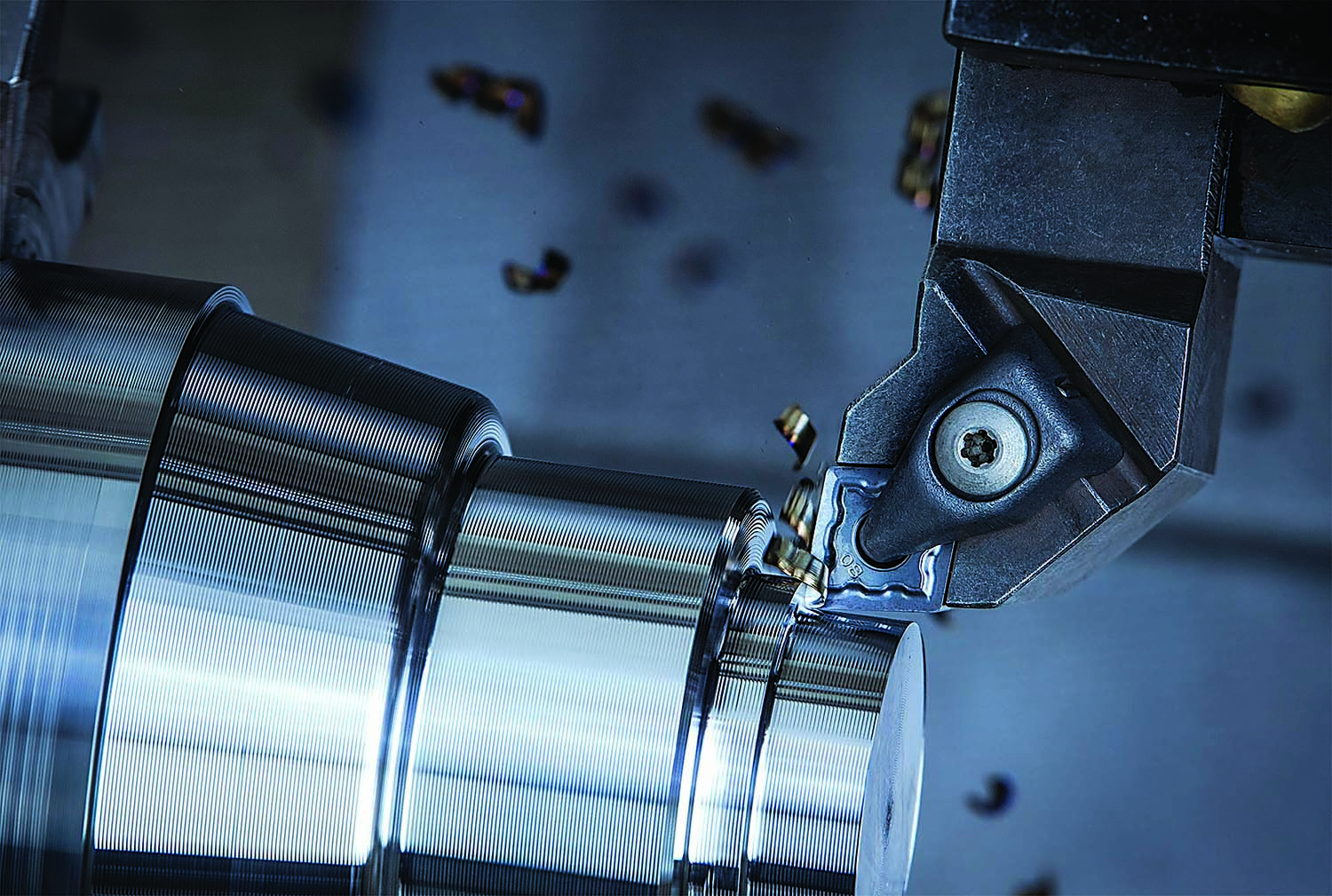
As workpiece materials and machining operations have become more complex, so have the tools and coatings to boost metalcutting productivity for manufacturers. Image courtesy of Ceratizit USA
Instead of a hard grade, Garud said a tough grade can do the trick when turning steel with a potentially problematic forging skin or casting scale. He recommends WPP30G or WKP30S grades for those applications.
Another common issue when rough turning steel is notching at the depth of cut when a workpiece has a poor surface condition because of the presence of scale, contaminants or welds, said Robert Bokram, product manager of cutting tools for Schaumburg, Illinois-based Ceratizit USA Inc., who’s based in Warren, Michigan.
“Proper insert edge design is critical to help mitigate this,” he said, “but a common strategy is to vary the depth of cut over time to disperse the effect across the cutting edge.”
However, Martin Dillaman, global manager of engineering/applications and project manager for Greenleaf Corp., emphasized that chip control is the biggest challenge when turning steel.
“If chips are not evacuated properly,” he said, “they can end up being re-cut, fracturing the cutting edge and causing shortened tool life.”
Grade Selection
Although the Saegertown, Pennsylvania-based company is traditionally known for its ceramic grades, Dillaman said Greenleaf recommends its GA5035 and G5125+ carbide grades as the primary choices for rough turning steel. When better wear resistance is required, the toolmaker offers its GA5025, GA5026 and G-9230 grades. For enhanced toughness, G-5135, GA5125 and G-915 grades are available.
“There is a commitment to continually developing our carbide grades using the latest technology to help advance the capabilities of our customers,” he said. “Depending on the alloy of steel, requirements of the application and machine capabilities, we have many options available to help find the best solution for the customer.”
Bokram added that grade selection is driven by machining parameters and part configuration, and the goal is to select the hardest grade that can be used without experiencing edge breakage or other premature failure mechanisms that shorten tool life.
“With a possible application range from P05 to P40, the P05 grade would be ideal,” he said. “However, in the real world machining conditions rarely allow for this ideal. P15 to P35 is a more typical range for steel roughing applications.”
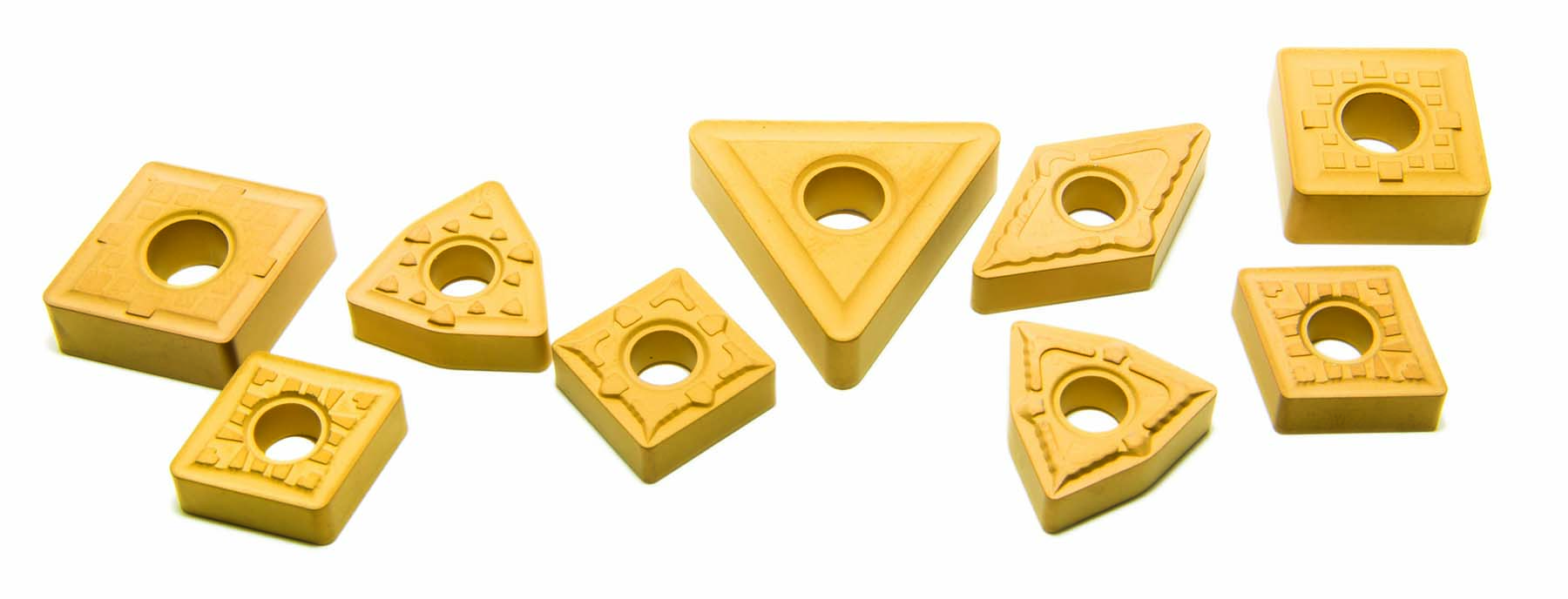
A selection of G5125+ inserts is shown. Image courtesy of Greenleaf
For medium roughing applications, Bokram recommends a double-sided insert with Ceratizit USA’s -M70 chipbreaker, which is available in three grades: CTCP115-P, CTCP125-P and CTCP135-P. CTCP115-P is for continuous turning at elevated surface speeds, CTCP125-P is a universal grade that covers a broad range of machining conditions, including slight interruptions, and CTCP135-P is for challenging conditions, such as interrupted cutting or turning surfaces with scale or welds. All the grades enable wear detection so an operator can visually determine which edges are used and the level of tool wear.
“This assures that all edges are used and inserts are rotated prior to edge failure,” he said.
Protective Shell
Although uncoated insert grades are still widely applied to machine heat-resistant superalloys and titanium alloys, Garud said uncoated grades are not recommended for cutting steel. Typically, CVD-coated grades are most effective for steel, such as Walter USA’s WPP20G.
Advances in coating technologies have enabled coated carbide to be nearly as smooth as uncoated polished carbide, Bokram said, so there are very few cases in which it is not beneficial to use coatings to extend tool life.
He concurred that CVD coatings, which are usually 10-µm-to-20-µm thick (0.0004″ to 0.0008″), are more effective for rough turning steel than PVD coatings, which are limited to about 10-µm thick.
“This translates directly to longer tool life,” Bokram said.
In addition, a roughing insert tends to run at a moderate surface speed, which he said doesn’t generate enough heat to oxidize a PVD coating and activate its wear- and heat-resistant configurations.
“CVD coatings are already oxidized,” Bokram said. “They don’t need heat to transform their structures.”
To resist heat deformation when turning at high cutting speeds, Garud said Walter USA’s WPP05S grade has a coating with a high aluminum-oxide content and a TigerTec Silver coating.
“This grade allows speeds in excess of 1,200 to 1,300 sfm (366 to 396 m/min.) in some steels,” he said.
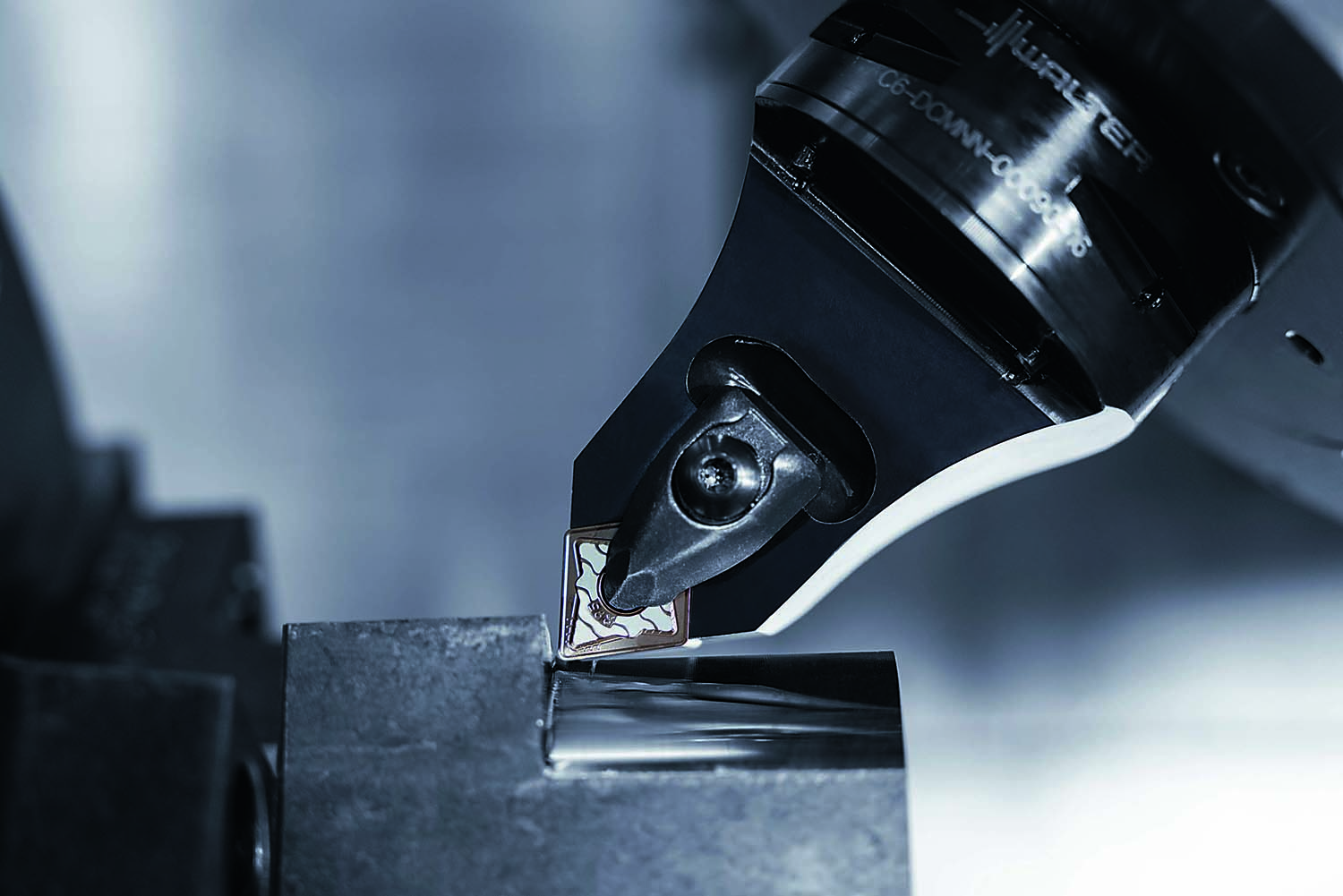
A CNMG insert turns a steel part. Image courtesy of Walter USA
Review the print ads from this magazine to continue
This quick advertiser review unlocks the rest of the article and keeps the full-screen reader focused on the ads instead of the page chrome.
Advertisers included in this article experience
Print placements connected to this article
Ceratizit
Search for efficiency, find flexibility
Ceratizit promotes the MaxiMill 271 and its eight usable cutting edges for economical, flexible milling.
Search for efficiency, find flexibility Ceratizit promotes the MaxiMill 271 and its eight usable cutting edges for economical, flexible milling. Visit cuttingtools.ceratizit.com to learn more.
Visit Ceratizit View this placement in the issue recordPrint ads from this magazine
Ceratizit promotes the MaxiMill 271 and its eight usable cutting edges for economical, flexible milling.
Search for efficiency, find flexibility Ceratizit promotes the MaxiMill 271 and its eight usable cutting edges for economical, flexible milling. Visit cuttingtools.ceratizit.com to learn more.
Continue reading
April 2023
For abrasion resistance, Garud said grades with hard and refined substrates, such as WPP10G with the latest TigerTec Gold coating, are suitable. For thermal shock resistance, a tough grade with a relatively large-grain substrate and a high cobalt content, such as WPP30G or WKP30S, works best.
“The toughness is able to withstand the cracking tendency that is introduced by thermal shocking,” he said.
Garud said those grades for thermal shock are also suitable for interrupted turning, in which an insert is hammered and punished. When faced with exceptionally interrupted cuts, end users should consider single-sided negative inserts.
“They provide (a) robust and high-precision seating surface, along with a wide-open chip groove and robust cutting edge,” he said “This combination tends to withstand the interrupted cuts very well.”
Dillaman said in addition to using an insert with a tough substrate, reducing the speed and feed through the interruptions is helpful. Also, taking a maximum DOC and having rigid workholding help reduce vibration.
It’s important to stabilize the cutting edge during interrupted cutting. Therefore, Bokram recommends using an insert with a corner radius that is as large as possible.
“Additionally,” he said, “look for chipbreaker designs with substantial protected edges.”
Geometries at Work
Various insert geometries come into play when rough turning steel.
“In all cases,” Bokram said, “a protected edge is required for stability.”
Typically, a flat or slightly positive land provides that protection, which can range from 0.254-mm-to-0.356-mm wide (0.01″ to 0.014″) for medium roughing and 0.356-mm-to-0.508-mm wide (0.014″ to 0.02″) for heavy roughing.
Bokram added that the feed rate must equal or exceed the land width to form chips properly.
“Chip formation is also heavily influenced by the chipbreaker design behind the land,” he said, “and much time is spent optimizing these designs based on the range of materials that might be machined and the range of feeds and speeds that are desired for that design.”
An effective rake angle is also required, which Bokram said should range from 12 degrees to 20 degrees depending on the size of the insert and
chipbreaker and the application.
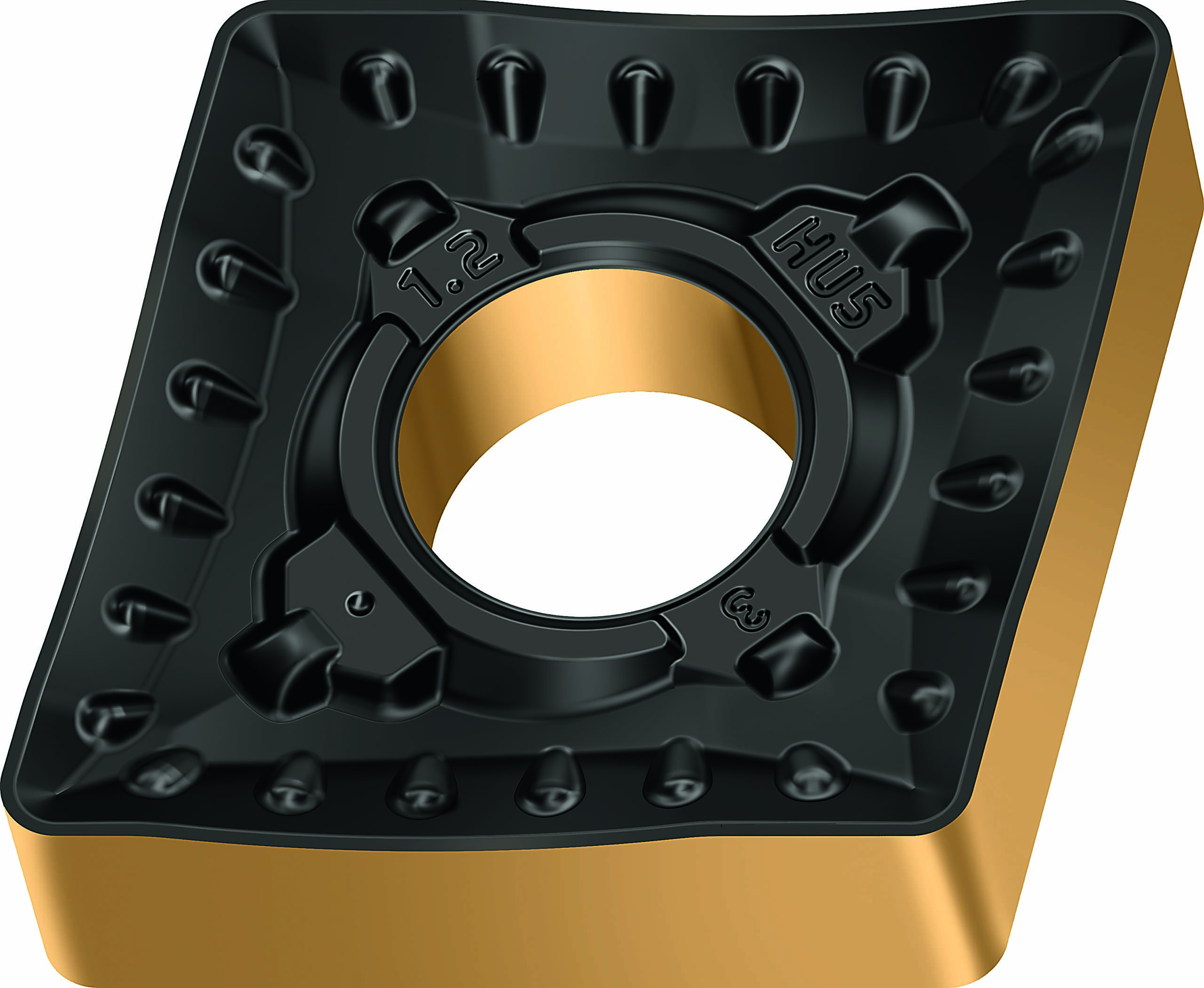
The HU5 is a single-sided, heavy-duty roughing geometry that also has a sharp, positive rake angle. Image courtesy of Walter USA
“The critical performance characteristic is to be able to curl and break the chips across the entire application range of that chipbreaker design,” he said.
Dillaman added that if the rake is not steep enough or the chipbreaker groove is too shallow or wide, the workpiece material will not break and may create long, stringy chips.
For CVD-coated inserts turning conventional steel, Garud said Walter USA labels the geometries RP (R for roughing and P for the ISO P material group, which is steel). HU geometries (H for heavy duty and U for universal ISO P and M material groups, in which M is stainless steel) are suitable for turning stainless as well. Turning stainless, however, might require a PVD coating, and the HU5 geometry is available in both CVD and PVD grades.
“Typically, stainless steels need sharper geometries to shear the metal better and also higher positive rakes,” he said. “Both of these functions are complemented by PVD grades.”
In addition, Garud said HU5 is a single-sided, heavy-duty roughing geometry that also has a sharp, positive rake angle.
“This makes it a ‘low cutting pressure’ geometry ideal for both stainless steels and steels,” he said.
Garud said another HU geometry that’s effective is the HU7, which has a varying thickness of the protective chamfer to not only reinforce the cutting edge but help control chips and reduce cutting forces.
In general, he noted that protective chamfers to reinforce cutting edges make the cutting geometries robust.
“Wavy cutting edges and higher rake angles make the same geometries shear the material better,” Garud said, “thus reducing cutting forces and allowing a weaker machine tool to perform heavier-duty cuts for the same horsepower.”
When it comes to carbide insert designation, Dillaman said the 80-degree insert, CNMG, is the most common, followed by the trigon style, WNMG.
“These geometries offer the capabilities of a larger depth of cut while still providing relief along the face and turned diameters when machining to square shoulders,” he said.
Whether for automotive, aerospace, railroad, mold and die or a host of other applications, heavy rough turning of steel will continue to be commonly performed and manufacturers with properly designed carbide inserts in their toolrooms will continue to reap the rewards.
Glossary terms in this article