



Metal on metal: General Industry Coverage
A pump on a waterjet machine generates the high-pressure water needed for cutting by taking low-pressure water into a cylinder, compressing the water with a plunger and then pushing the high-pressure water out of the cylinder.
A pump on a waterjet machine generates the high-pressure water needed for cutting by taking low-pressure water into a cylinder, compressing the water with a plunger and then pushing the high-pressure water out of the cylinder. During a pressure cycle of intake, compression and expulsion, high-pressure components and polymer seals see the water pressure jump from two-digit inlet pressures to outlet pressures in the tens of thousands of psi.
According to Michael Wheeler, R&D engineer for waterjet machine builder Jet Edge Inc., there are 40 to 60 pressure cycles per minute in an intensifier waterjet pump and 800 to 1,000 per minute in a direct-drive waterjet pump. “These constant, frequent and dramatic changes in pressure are the reason most waterjet components eventually fail from fatigue,” he said.
To extend seal life, Wheeler designed a metal-on-metal, high-pressure, fluid sealing mechanism for static pressures up to 130,000 psi and received a patent for it. He noted the concept was initially tested using finite element analysis, and once the R&D group was confident the concept was viable, they built a prototype and validated the FEA results.
The seal is created by two convex curved surfaces, which contact each other tangentially along a single circular line, Wheeler explained. The curves minimize contact between the mating components of the seal and eliminate the surface damage typically associated with traditional metal-on-metal, high-pressure seals. He noted a traditional metal-on-metal seal usually consists of two cones. To create the seal, a convex cone is forced into a concave cone. The two cones slide against one another as the load is applied. About a third of each cone’s surface is in contact with the other cone, which can lead to cold welding and damage to the surfaces. “This damage can make the seal a one-time use item or require more force to create a seal on subsequent assemblies,” he said.
Courtesy of Jet Edge
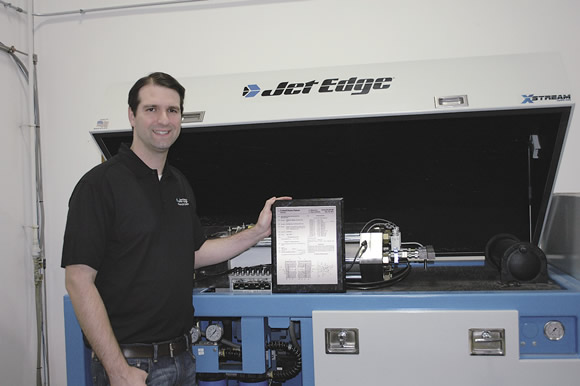
Jet Edge R&D Engineer Michael Wheeler holds the patent for an ultrahigh-pressure, metal-on-metal fluid sealing mechanism for waterjet machines.
Wheeler added that a traditional static sealing mechanism consists of a cylinder, a check tube and a polymer sealing element. At 55,000 psi, cylinders and check tubes usually last for thousands of hours, while polymer sealing elements typically have lives in the hundreds of hours. “A metal-on-metal seal eliminates the polymer sealing elements, so the seal lasts as long as the cylinder and check tube,” he said. “The metal-on-metal seal is integrated into the cylinders and check tubes, so it’s made of the same proprietary materials.”
The metal-on-metal seals in the company’s R&D ECO-JET direct-drive pumps have been through at least 40 million pressure cycles, Wheeler noted.
In addition to a static seal, every cylinder on a high-pressure waterjet pump typically has a dynamic seal, which either moves over something or has something move over it, Wheeler pointed out. For example, a dual-intensifier pump has eight seals: four static seals and four dynamic seals. “By replacing the static seals on the pump with metal-on-metal seals, half of the conventional seals are eliminated,” he said, noting that metal-on-metal seals cannot replace dynamic seals. “This means half as many points of failure and half the number of seals that need to be changed.”
For more information, contact Jet Edge Inc., St. Michael, Minn., at (800) JET-EDGE or www.jetedge.com.
Related


Subscribers can use MFGAxis notes, saves and discussion tools with their innoNET account.


