



Multisoft: Turning Performance
CAM and simulation software packages enable productive programming of multitasking machines—particularly as they become 'ultratasking' machines.
CAM and simulation software packages enable productive programming of multitasking machines—particularly as they become ‘ultratasking’ machines.
Multitasking machines have been around for years, and even though they haven’t taken the machine tool market by storm, as some predicted, sales remain relatively robust.
The reason, of course, is the machines’ ability to make complex parts complete in one setup. This capability is enabled by complicated machine layouts that may include multiple spindles, turrets and toolchangers. Counting variations within model lines, there are hundreds if not thousands of MTM configurations.
“New functionality in MTMs evolves quickly,” said Ann Mazakas, manager of technical communications for DP Technology Corp., Camarillo, Calif. “From the earliest multihead and multiturret configurations, new variations in kinematics are constantly being added—B-axis heads, indexing turrets on a B-axis, tilting spindles and so on. And now, machine tool builders are working on ‘ultratasking’ machines that perform even more special functions and can accommodate large, heavy parts.”
Programming Tools
The machines’ complex capabilities and the variety of available layouts and options can be challenging for users. According to Hanan Fishman, president of the PartMaker Inc. division of DelCam Plc, Fort Washington, Pa., it’s a challenge that’s best addressed with software developed specifically for programming MTMs. The company develops only CAM software for multitasking and Swiss-style machines.
“PartMaker employs two patented technologies for automating the programming of these machines,” Fishman said. “The first addresses how the software automates the programming of turning with live tooling. It breaks down a complex part with a number of turned and milled features into a series of simpler operations. In essence, the software lets the programmer see the part the way the machine sees it.”
The second is a visual synchronization approach to allow users to optimize cycle time across multiple spindles and tool stations on machines with simultaneous machining capability, he noted.
According to Bill Gibbs, president of Gibbs and Associates, Moorpark, Calif., CAM software for programming MTMs highlights a basic difference among various CAM software developers. “There are two basic philosophies in NC programming,” Gibbs said. “One is, make decisions for the user and strive to be maximally automatic. We strongly believe that the goal of maximum automation is illusory because, if everyone programs a part the same way, what value does a shop offer? They’re just commodity brokers of machine time.”
Gibbs said software should be a “power tool” for the machinist. “We want to enable his methodologies, his tooling, his cuts,” he said. “So we make it very simple for programmers to move tools around, move operations from one turret to another and other tasks. As he interacts with the software, it’s telling him what overall run times and the cycle times of individual operations are going to be.”
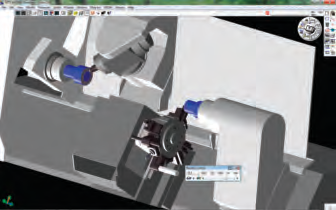
Courtesy of Gibbs and Associates
The multispindle, multiturret, multiaxis simultaneous machining capabilities of MTMs make programming without the right tools a challenge.
DP Technology is more a proponent of the “more automation is better” approach, according to Mazakas. “A key for programming productivity is automation,” she said. “An automated CAM system can guide the programmer in choosing the best machining strategies, or it can be set up to automatically get the optimal process.”
To help automate programming, DP’s Esprit CAM system offers knowledge-based machining, which Mazakas said enables the use of predefined processes and tooling that auto-adapt to part geometry. “Esprit can interrogate a solid model and organize the geometry into machinable features,” she explained. “The programmer can then either manually associate machining operations to the features or let the software pick appropriate machining processes based on work previously done.”
According to Mazakas, this approach develops a growing database of programming and machining knowledge. “As time goes by, the programmer increases and optimizes the machining library based on shop feedback,” she said. “The knowledge becomes embedded in the software by capturing best practices. The more automated the process is, the more time and attention the programmer can focus on higher level tasks, such as optimizing the program or improving machine productivity.”
The Post Problem
Programming is one thing, and getting the program out of the CAM system and into a format the machine can use to cut parts is another. That’s the job of post-processors, and the software developers interviewed for this article had varying opinions of their importance.
According to PartMaker’s Fishman, new MTM users often blame the lack of a good post-processor for their programming challenges. “The issue is much bigger than just a post-processor,” he said. “A post-processor is merely a filter to format the geometric and process data from a CAM system into a program the machine can understand. But, if the CAM system doesn’t have the fundamental architecture to support the capabilities of the MTM, no post-processor on earth will help.”
For post-processor development, DP Technology maintains relationships with machine tool manufacturers, according to Mazakas. “Cooperation between the machine tool builder and DP offers significant benefits for shops purchasing MTMs, because the solution offered saves a significant amount of software setup time,” she said. “For example, customers are assured of having a working post-processor because we have developed the post-processors together [with the machine builder] and tested them on real-world parts.”
Gibbs and Associates emphasizes developing post-processors tailored to the user’s exact machine configuration. “We employ eight or nine people who do nothing but develop post-processors for multitasking machines because we find that the complexity of the post-processor for an MTM grows by several orders of magnitude compared with, say, a 3-axis machine. It’s not just that there are more details, it’s that they need to be handled more precisely.”
The company starts by building what Gibbs called a “kinematic model” of the machine. “The model describes the exact and precise motions a machine makes,” he explained. “And we need it to do that for everything that moves in the machine, not just the things that cut.”
The company also spends a large part of post-processor development time on research. “We have to find the manuals, sample G code, and, most importantly, we have to look into how the parameters are set,” Gibbs said. “Most people don’t realize that modern CNCs have dozens of parameter-customizable G-code formats.”
Gibbs & Associates is developing what Gibbs called a “universal kinematic model” that will help speed development of future MTM post-processors. “The majority of multitasking machines are based on a lathe architecture,” he said. “That means they started as a lathe, then they became a mill/turn machine, then they got a subspindle, an extra turret, a B-axis rotating head—all these add-ons—but at the end of the day they all still kind of look like a lathe. Our universal kinematic model would eliminate any bias toward any specific machine architecture.”
The idea is to give the company’s developers a neutral way to define any machine. “It will make it simpler and easier for us to handle the increasing variety of machine configurations,” he said.
View print ads from this spread
Review the ads on this magazine spread to continue reading. Each ad takes two seconds; a two-page ad counts once.
Advertisers on this magazine spread
Print placements on this magazine spread
Mscmetalworking
THE BEST VALUE
IN METALWORKING For over 60 years, Hertel has been providing the metalworking industry with unsurpassed value. Hertel taps are ideal for general machining applications and come in a wide variety of styles and sizes. Available exclusively at MSC Industrial Supply Co.® IS #41.
THE BEST VALUE IN METALWORKING For over 60 years, Hertel has been providing the metalworking industry with unsurpassed value. Hertel taps are ideal for general machining applications and come in a wide variety of styles and sizes. Available exclusively at MSC Industrial Supply Co.® IS #41
Visit Mscmetalworking View this placement in the issue recordPrint ads from this magazine
IN METALWORKING For over 60 years, Hertel has been providing the metalworking industry with unsurpassed value. Hertel taps are ideal for general machining applications and come in a wide variety of styles and sizes. Available exclusively at MSC Industrial Supply Co.® IS #41.
THE BEST VALUE IN METALWORKING For over 60 years, Hertel has been providing the metalworking industry with unsurpassed value. Hertel taps are ideal for general machining applications and come in a wide variety of styles and sizes. Available exclusively at MSC Industrial Supply Co.® IS #41
Continue reading
February 2011
The biggest post-processor issue may be overcoming user expectations, according to Gibbs. “There is almost no way a post-processor is going to work perfectly the first time. It will take a few test cuts and some back-and-forth between us and the customer.”
Stand-Alone Simulation
All the CAM software developers interviewed for this article count machining simulation among the tools they provide and agreed on its importance in MTM programming. One company that specializes in machine simulation and verification software is CGTech, Irvine, Calif.
According to Product Manager Bill Hasenjaeger, the company’s Vericut simulation and verification package has supported simulation of mill/turn multitasking machines since August 2001. Hasenjaeger said CGTech views any machine capable of simultaneously performing more than one different machining operation as an MTM.
“This separates MTMs from traditional 4-axis lathes, multispindle milling machines or ‘single-tasking’ mill/turn machines,” he said. “Multitasking machines tend to cram many tool and part mounting stations on different axes into a relatively small space. With several things moving at once, the chance for collisions between machine components, tools and parts is very high. For this reason, offline simulation prior to committing the NC program to the machine is practically mandatory.”
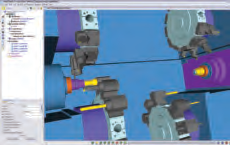
Courtesy of CGTech
The high probability of collisions between machine components, tools and parts in MTMs makes offline simulation practically mandatory, according to CGTech.
Hasenjaeger said CGTech’s “virtual machine” has been organized for the past several years into multiple subsystems, each a small, independent machine that can be synchronized with other subsystems via NC program commands. The company has configured the software’s synchronization to mimic the behavior of controls from Fanuc, Siemens, Mitsubishi and others, and has supported specific machines from Mazak, Index, Citizen, WFL and other builders.
According to Hasenjaeger, one of the keys to simulating machining processes on a MTM is tracking spindle status. “Knowing when the part spindle is spinning or when it is indexing or stopped, when the tool spindle is spinning, assuring that they spin in the correct direction for proper cutting and so on becomes a significant problem area on machines with many tools and spindles that require intricate timing,” he said.
The program can also account for auxiliary components—such as programmable tailstocks, steady rests, part catchers or exchange mechanisms and automatic head or tool attachment changers—that are commonly found on MTMs. “These can all be simulated, including complex behavior such as the mechanical advancement of the tailstock or steady rest until it touches the workpiece,” Hasenjaeger said.
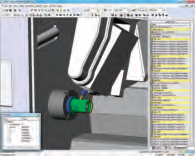
Courtesy of DP Technology
The variety of MTM architectures in the market—in this case, Okuma’s Multus, which features a tilting/swiveling main spindle and a subspindle—makes developing packages for multitasking machines a challenge for CAM software suppliers.
Recent releases have contained multiple features that can improve verification of multitask machining, according to Hasenjaeger. Examples include the ability to display synchronized subsystem simulation, axis jog buttons, graphical tool positioning and support for “flash” tools, which can function as either a turning tool when stationary or a milling tool when rotating.
He also touts what CGTech calls a “call stack” window as well as a simplified turret setup capability. “The call stack allows the user to monitor the state of each input channel of the MTM, as well as multiple levels of subroutines,” Hasenjaeger explained. “For multitasking machines with turrets, a turret setup wizard enables the user to load, change tools or change tool positions in a turret.”
Regardless of the machine builder or configuration, MTMs may well be the future for many shops. Those shops will need sophisticated programming and simulation tools to take full advantage of their new machines’ capabilities. CTE
About the Author: Jim Destefani, a senior editor of CTE and MICROmanufacturing magazines, has written extensively about various manufacturing technologies. Contact him at (734) 528-9717 or by e-mail at jimd@jwr.com.
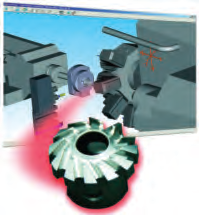
Courtesy of PartMaker
The architecture of bar-fed mills allows continuous production while also offering tooling carousels, high-speed milling and other attributes normally ascribed to VMCs.
Is bar-fed milling in your future?
“Let me make a bold statement: Bar-fed mills represent the future of machining of complex, small parts,” said Delcam-Partmaker’s Hanan Fishman. He offers as anecdotal evidence last September’s IMTS, where a number of builders displayed such machines.
As the name implies, a bar-fed mill is, at its heart, a vertical machining center. The difference is, a bar feeder similar to that found on a production lathe is used to introduce the stock into the machine’s work envelope. On such machines, the table found on conventional VMCs is usually replaced by a second spindle that can perform secondary operations on parts handed off from the primary spindle. According to Fishman, this architecture allows bar-fed mills to achieve continuous production like a bar-fed mill/turn machine or a Swiss-style lathe while also offering large tooling carousels, high-speed milling capability and other attributes normally ascribed to VMCs.
Fishman said such machines will require another level of programming sophistication beyond that used for today’s MTMs. “Even the approach required for programming mill/turn centers won’t just carry over seamlessly to bar-fed mills,” he said. “In practice, these machines will generally perform turning interspersed with a variety of milling possibilities, from indexing on the face and diameter of the part to polar and cylindrical interpolation.”
Fishman said the company’s CAM software addresses programming of bar-fed mills in two ways. “First, from a toolpath processing perspective, PartMaker employs a ‘divide and conquer’ programming approach that allows the programmer to automatically consider individual operations in both the coordinate system in which they will occur and the tool motions they will require,” he explained.
Second, Fishman believes the complexity of bar-fed mills may lead users to postpone decisions on the exact order of operations until the end of the programming process. “To make this nonsequential way of working easier, PartMaker employs a process table, which allows a user to quickly shuffle operations into the exact sequence he wants to see them executed, irrespective of which order he has actually created the operations,” he said.
—J. Destefani
Contributors
CGTech
(949) 753-1050
www.cgtech.com
DP Technology
(800) 627-8479
www.dptechnology.com
Gibbs and Associates
(800) 654-9399
www.gibbscam.com
PartMaker Inc.
(888) 270-6878
www.partmaker.com
Glossary terms in this article
Related



Subscribers can use MFGAxis notes, saves and discussion tools with their innoNET account.


