


New shape-memory alloy: Research & Innovation
Funded by the National Science Foundation's Designing Materials to Revolutionize and Engineer Our Future program, researchers from the department of materials science and engineering at Texas A&M University used an artificial intelligence materials selection framework to discover a new shape-memory alloy. It showed the highest operational efficiency thus far for nickel-titanium-base materials.
Funded by the National Science Foundation’s Designing Materials to Revolutionize and Engineer Our Future program, researchers from the department of materials science and engineering at Texas A&M University used an artificial intelligence materials selection framework to discover a new shape-memory alloy. It showed the highest operational efficiency thus far for nickel-titanium-base materials. In addition, the data-driven framework offers proof of concept for future materials development.
Shape-memory alloys are utilized in various fields when compact, lightweight and solid-state actuations are needed, replacing hydraulic or pneumatic actuators because the alloys can deform when cold and then return to their original shapes when heated. This unique property is critical for applications, such as airplane wings, jet engines and automotive components, that must withstand repeated, recoverable large-shape changes.
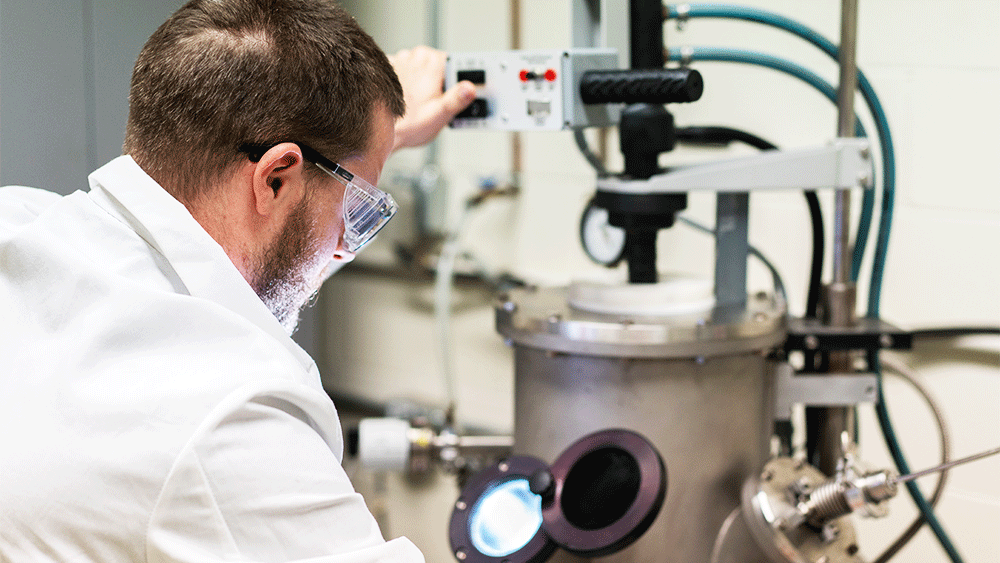
Doctoral student William Trehern operates a vacuum arc melter, a synthesis method commonly used to create high-purity alloys of various compositions. Image courtesy of Texas A&M University
There have been advancements in shape-memory alloys since their beginnings in the mid-1960s but at a cost. The understanding and discovery of new shape-memory alloys has required extensive research through experimentation and ad hoc trial and error. About every decade, a significant shape-memory alloy composition or system has been discovered. But even with advances, the alloys are hindered by their low energy efficiency caused by incompatibilities in their microstructures during large-shape changes. They also are notoriously difficult to design from scratch.
To address these shortcomings, Texas A&M researchers combined experimental data to create an artificial intelligence materials selection computational framework capable of determining optimal material compositions and processing them, which led to the discovery of a new shape-memory alloy composition.
“When designing materials, sometimes you have multiple objectives or constraints that conflict, which is very difficult to work around,” said Ibrahim Karaman, Chevron professor I and head of the materials science and engineering department. “Using our machine-learning framework, we can use experimental data to find hidden correlations between different materials’ features to see if we can design new materials.”
The shape-memory alloy found during the study was predicted and proven to achieve the narrowest hysteresis ever recorded. In other words, the material showed the lowest energy loss when converting thermal energy to mechanical work. Due to its extremely small transformation temperature window, the material showcased high efficiency when subjected to thermal cycling. The material also exhibited excellent cyclic stability under repeated actuation.
A nickel-titanium-copper composition is typical for shape-memory alloys. Nickel-titanium-copper alloys usually have titanium equal to 50% and form a single-phase material. Using machine learning, researchers predicted a different composition with titanium equal to 47% and copper equal to 21%. While this composition is in the two-phase region and forms particles, they help enhance the properties of the material, explained doctoral student William Trehern, graduate research assistant and first author of the publication.
“It is a revelation to use machine learning to find connections that our brain or known physical principles may not be able to explain,” Karaman said. “We can use data science and machine learning to accelerate the rate of materials discovery.”
— Michelle Revels
Glossary terms in this article
Related


Subscribers can use MFGAxis notes, saves and discussion tools with their innoNET account.