

Nonthreaded fasteners: General Industry Coverage
Last month's column focused on threaded fastening methods. This month, we explore nonthreaded fasteners, the most common of which are solid and blind rivets. In addition, a variety of nonthread pins are used for fastening.
Last month’s column focused on threaded fastening methods. This month, we explore nonthreaded fasteners, the most common of which are solid and blind rivets. In addition, a variety of nonthread pins are used for fastening.
• Solid rivets are available in steel, copper, aluminum, brass and stainless steel in various sizes and shapes. They are inexpensive and easy to install with simple tools. Properly applied, solid rivets are strong, provide a finished appearance and resist vibration. In critical aerospace applications, rivet holes are drilled and reamed to size so stresses are evenly distributed.
• Blind rivets are for applications where there is access to only one side of the part. They are available in a range of styles, sizes and materials, including steel, aluminum and stainless steel. Blind rivets are strong and resist vibration and tampering. They draw together the layers of materials being fastened as the rivets are pulled up. Installation requires an inexpensive special tool. Both manual and air-actuated blind rivet pullers are available.
Courtesy of Pamela J. Tallman
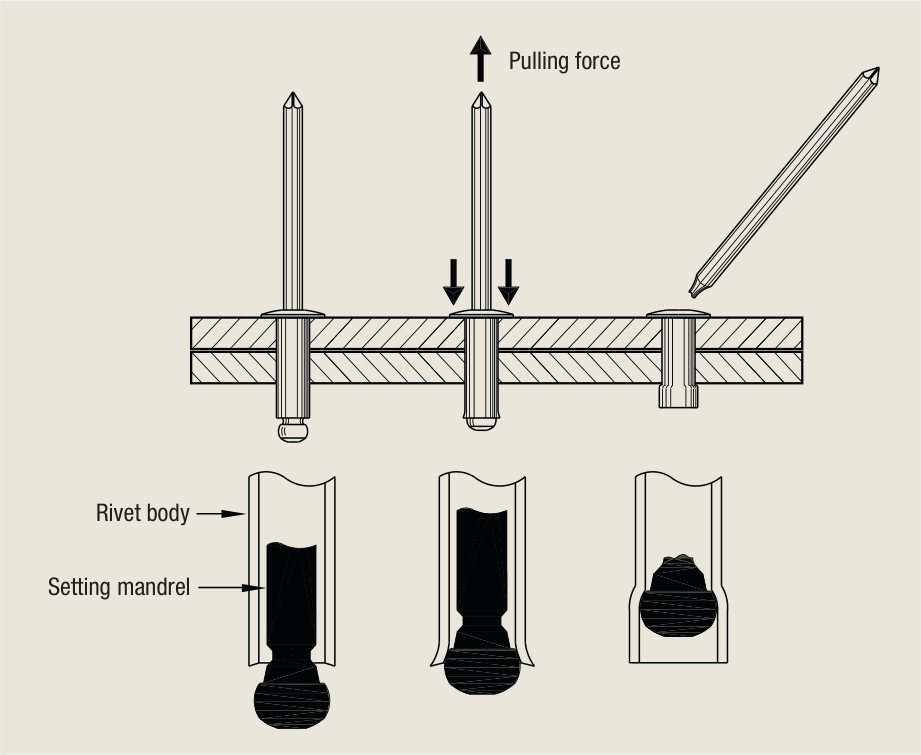
The blind rivet joining process.
A blind rivet consists of two parts: the rivet body and the setting mandrel, which is inside the rivet body. The following describes how they work.
1. The rivet body is inserted into a predrilled hole through the materials to be joined.
Review the print ads from this magazine to continue
This quick advertiser review unlocks the rest of the article and keeps the full-screen reader focused on the ads instead of the page chrome.
Advertisers included in this article experience
Print placements connected to this article
[email protected], www.iscarmetals.com
ISCAR METALS INC. 300 Westway Place, Arlington,
TX 76018-1021 Tel+1 817 258 3200, Fax+1 817 258 3221,Tech Tel 1-877-BY-ISCAR.
ISCAR METALS INC. 300 Westway Place, Arlington, TX 76018-1021 Tel+1 817 258 3200, Fax+1 817 258 3221,Tech Tel 1-877-BY-ISCAR [email protected], www.iscarmetals.com
Visit [email protected], www.iscarmetals.com View this placement in the issue recordPrint ads from this magazine
TX 76018-1021 Tel+1 817 258 3200, Fax+1 817 258 3221,Tech Tel 1-877-BY-ISCAR.
ISCAR METALS INC. 300 Westway Place, Arlington, TX 76018-1021 Tel+1 817 258 3200, Fax+1 817 258 3221,Tech Tel 1-877-BY-ISCAR [email protected], www.iscarmetals.com
Continue reading
February 2010
2. The rivet insertion tool is actuated and the jaws of the manual or power- operated riveting tool firmly grip the rivet mandrel.
3. The rivet is set by pulling the mandrel head into the rivet body, which expands it, forming a strong, tight, reliable joint. At a predetermined setting force, the mandrel breaks and falls away.
• Dowel pins retain parts in a fixed position or preserve their alignment. The most common dowel pins are 1⁄8 ” to 1 ” in diameter, but larger and smaller ones are available along with metric sizes. Usually only two pins are required. In applications where frequent pin removal would subject the pins to wear, taper pins should be used. Use an undersized hole on one end of the dowel to retain it and a tight slip fit on the other. If both dowel ends are a press-fit, separating the doweled parts will be difficult if not impossible. A rule of thumb is that dowel length should be 1½ to 2 times its diameter in each doweled plate. Dowels are typically supplied 0.002 ” to -0.0000 ” of their nominal diameter. Dowel holes must be reamed or lapped in precision applications.
• Taper pins require more installation time, but are not as subject to wear as dowel pins and are easily removed with a punch. They lock two components together more accurately than a dowel pin. Taper pins are hardened and ground, and have a ¼ in./ft. uniform taper. Their ends are slightly rounded. Both steel and stainless steel taper pins are available. Larger taper pins require a step-drilled hole, which is then reamed to final size. Reamers are made specifically for this purpose.
• Grooved pins are nonthreaded press-fit fasteners, usually made of carbon steel. The material displaced from the three parallel longitudinal grooves is displaced beyond the nominal diameter of the pin and secures the pin in place through an interference fit. The mounting hole must never be smaller than the nominal pin diameter. They are less expensive than either dowel or taper pins and are used in less critical applications where the end load is minimal.
• Knurled pins have one or more knurls parallel to their longitudinal axis that form an interference fit, which locks the pin in place. These inexpensive and nonreusable pins work well in both metals and plastics.
• Coiled spring pins and roll pins—also called slotted pins, spring pins and split pins—are installed in holes slightly smaller than their nominal diameter. When pins are pressed into place, radial forces hold them in position and resist shock and vibration. Coiled spring pins are superior to roll pins as forces are more evenly distributed (through the cross section of the fastener) and better resist shearing forces. Roll pins compress by closing the gap. These stresses concentrate opposite the gap and compression is not uniform around the circumference of the pin. They are inexpensive and are typically used as dowels, spacers, stop pins, T-handles and hinge pins. When installed in a blind-hole, they add tamper resistance to the parts. CTE
About the Author: Frank Marlow, P.E., has a background in electronic circuit design, industrial power supplies and electrical safety and has worked for Avco Missile Systems, Boeing, Raytheon, DuPont and Emerson Electric. He can be e-mailed at orders@MetalArtsPress.com. Marlow’s column is adapted from information in his book, “Machine Shop Essentials: Questions and Answers,” published by the Metal Arts Press, Huntington Beach, Calif.
Glossary terms in this article
Related




Subscribers can use MFGAxis notes, saves and discussion tools with their innoNET account.


