


Organic molecules help cutting: Drilling Performance
By Chris Adam
By Chris Adam
Cutting “gummy” metals can be difficult. Researchers at Purdue University have come up with a solution, and their findings may help with manufacturing products and reducing component failures.
The researchers previously showed that the application of a permanent marker, glue or an adhesive film made it easier to cut metals, such as aluminum, stainless steel, nickel, copper and tantalum, for industrial purposes. Marking a metal surface beforehand with ink or an adhesive dramatically reduced the force of cutting, allowing a clean cut in seconds. The researchers now have discovered how these films produce the effect.
“We have found that you only need the organic film from the markers or glue to be one molecule thick for it to work,” said Srinivasan Chandrasekar, professor of industrial engineering. “This ultrathin film helps achieve smoother, cleaner and faster cuts than current machining processes. It also reduces the cutting forces and energy and improves the outcomes for manufacturing across industries, such as biomedical, energy, defense and aerospace.”
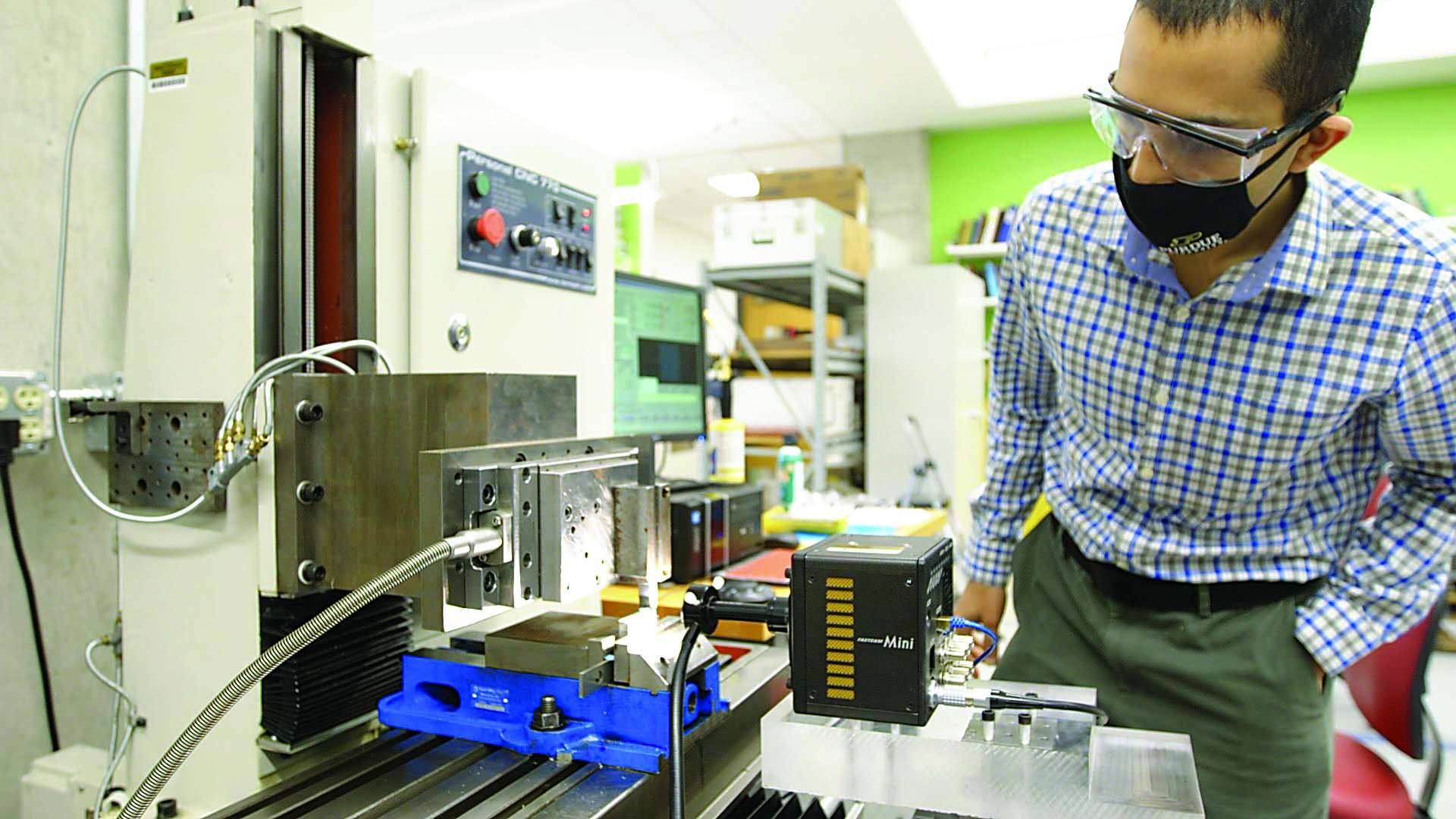
Purdue University researcher Anirudh Udupa tests the cutting forces on metals coated with various materials. Image courtesy of Erin Easterling
The work is a collaboration among researchers at Purdue, Osaka University and Indian Institute of Science. The research is supported by the National Science Foundation and U.S. Department of Energy.
If a significant improvement can be made to the machinability of gummy metals or alloys — that is, for cutting, drilling or grinding — then there is potential to lower the cost of products, better their performance or improve product designs.
Using organic monolayer films created by molecular self-assembly, researchers found that the molecule chain length and its adsorption to the metal surface are key to realizing these improvements. Through the use of certain organic molecules, metal is embrittled locally, resulting in improved machining.
“We are also learning through our discovery more about how environmental factors influence failure of metals,” said Anirudh Udupa, a lead author of the study and a researcher at Purdue’s School of Industrial Engineering. “As we decipher how the organic molecular films improve the machinability of these metals, the better also is our understanding of common environment-assisted failures in metals, such as stress corrosion cracking, hydrogen embrittlement and liquid metal embrittlement.”
Purdue’s researchers worked with the Purdue Research Foundation Office of Technology Commercialization to patent this technology.
The researchers are looking for partners to continue developing the technology.
For more information about the research, view a video presentation at www.ctemag.com by scanning the QR code with your smartphone or entering this URL on your web browser: cteplus.delivr.com/2s3h6
Glossary terms in this article
QR codes and videos from this issue
Print QR codes, video callouts, and in-magazine links for this article now point to the CTE video hub in the HTML version.
Related



Subscribers can use MFGAxis notes, saves and discussion tools with their innoNET account.