


Part marking the traditional way
Ink coders are for simple, low-cost printing on all types of flat materials.
Marking parts is a critical function at many manufacturing facilities. It informs and tracks QC, regulatory compliance, supply chain management, marketing initiatives and more. Not to mention that many customers require it.
But what is the best way to mark a product? The options include dot peening, laser marking, chemical engraving and continuous inkjet printing. All are impressive technologies that do the job and have many benefits.
Within this grouping of technologies is a traditional, simple, low-cost and easy-to-implement option: ink coders.
Wet-ink marking, which is also called contact-ink marking or reciprocating coders, involves low-cost devices, typically around $2,000 each, that are easy to maintain. They usually have small footprints and are robust enough for shop floor environments. They can be ganged together to do multiple jobs, and ink and colors are easy and inexpensive to change.
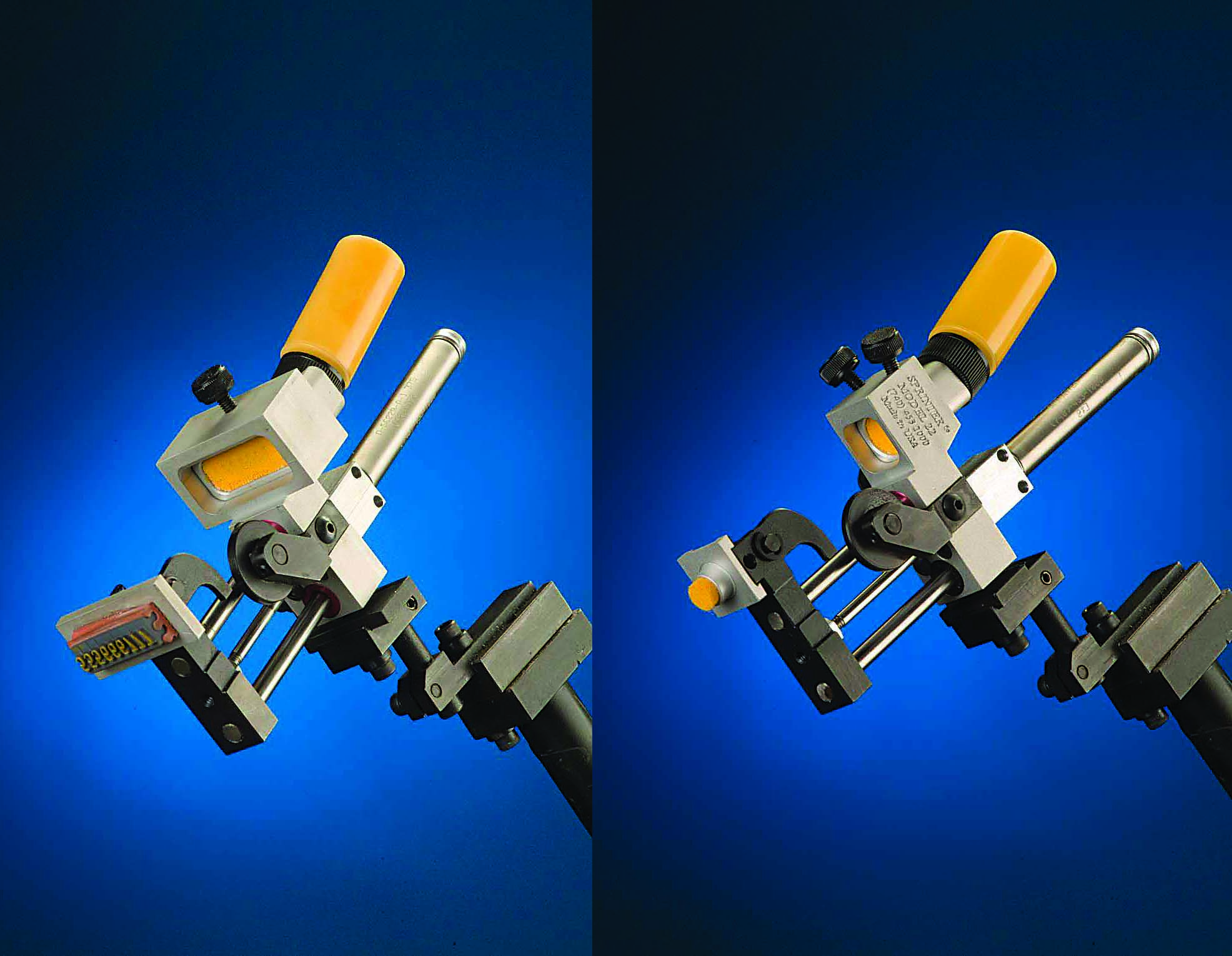
Sprinter Marking has a roster of standard marking machines and can customize depending on the application. Shown are the Model 28 (left), which has a maximum marking area of 3⁄8″×1″, and Model 22, which can imprint a dot symbol that measures up to ¼”. Image courtesy of Sprinter Marking
A reciprocating coder marking head moves from the ink supply reservoir and extends to an ink marking position where it contacts the part. The head then returns and waits for a signal to initiate action, said John Bishop, principal at Sprinter Marking Inc., Zanesville, Ohio. These pneumatic-powered devices use a wet-ink cartridge and rubber type to print an image on a substrate. The coders use interchangeable rubber dies to quickly change the printed message. Dies can be ordered in custom strips, in standard strips, as single characters and in kits so customers can mix and match character sizes, symbols, logos and other characters.
“Ninety percent of the machines that are made in our category are used in line where customers are actually manufacturing parts,” Bishop said.
In this scenario, the marking station is in a fixed position where a specific mark, part number, symbol or other character is required. Part manufacturers that mark metal typically require a date code or part number on it for traceability, Bishop said.
While reciprocating coders are typically limited somewhat by line speed and character size, they often play a role in industrial processes. These applications, however, can be challenging, said Lee Myers, manager at Greenville, South Carolina-based Southern Marking Systems, a distributor of marking machines, inks and marking services. “When people need to mark something,” he added, “we try and find the best way to do it.”
QC is an example in which ink marking can play a role. One Southern Marking customer tracks good versus bad parts through the use of circular symbols of differing colors that visibly highlight whether a part meets specifications.
Another customer prints product information on brake cylinders to better track parts throughout the production process. “In this case,” Myers said, “the part would go through a wash station, and the ink would need to stay on. That required us to ensure that there was enough time for the ink to dry.”
One benefit of ink marking compared with other types of marking technologies is that ink doesn’t change the product itself. “It isn’t destructive or doesn’t change the characteristics of the product,” Bishop said. “It uses the lightest amount of contact when it transfers the ink so there is no deformation or degradation of the product.”
Challenging Environments
Manufacturing facilities can present unique challenges. For one, production lines, especially those that have machining centers and other cutting equipment, often use metalworking fluids. To help ensure a quality imprint, it might be best to clean and dry the part before marking it, but that might not always be possible. Many companies, including Sprinter, offer inks that can mark wet surfaces, but it still might be problematic.
Coolant may interfere with the marking process. The ink may have trouble penetrating the coolant, or coolant may be transferred to the ink pad, which could affect transferring ink from the ink pad to the rubber dies.
“In those cases, we often tell customers that they can set up and make a trial run and see if the ink will go through the fluids, but they need to do that testing over some period of time because it can be an accumulation problem that can show up over time,” Bishop said.
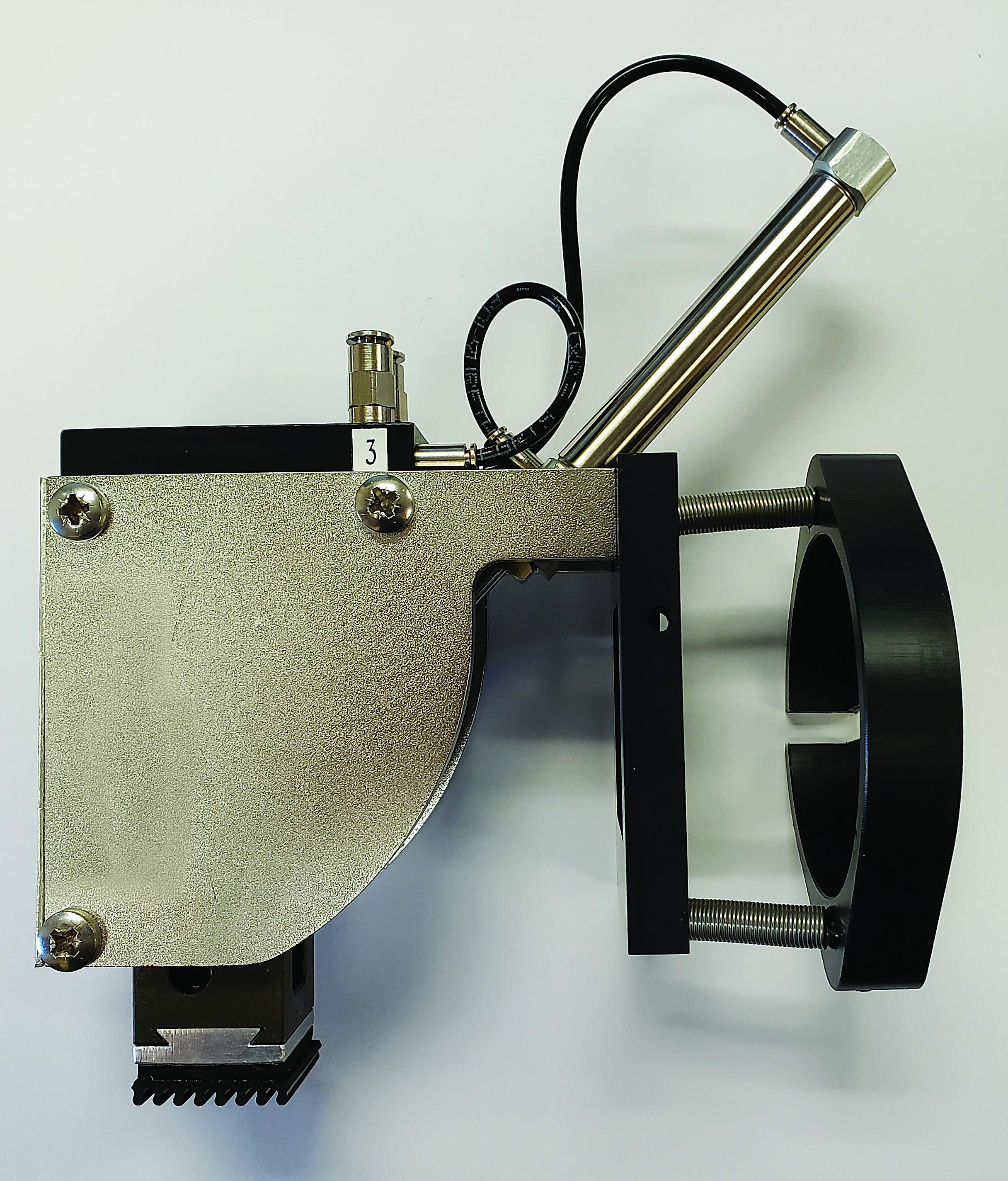
Marvel’s Model CC100 parts marker can utilize characters from 1⁄16″ to ½” depending on the character required. Image courtesy of Marvel Marking Products
Porosity is also an issue that can affect ink marking, especially porous materials, such as paper and wood. Metal parts are generally not porous and accept the pigments on their surfaces. Some metal materials, however, might have porosity issues, such as sintered ones and metal foams.
“If you have a porosity issue with the metal, what happens in marking, the ink will recede into those small porous spots, and that will decrease visibility,” Bishop said. “In those small applications where you are working with metal that is porous, you can improve the visibility of the mark by repeated applications of ink.”
Another consideration is marking thin-walled products, metal films or otherwise flexible metal parts and assemblies. While reciprocating coders use a light touch—and often the lighter the touch the better the impression—backer plates can be employed to provide support. When marking metal films that have thicknesses in the thousandths of an inch, for example, backer plates are recommended to ensure that marks are fully defined.
Ink code marking machines utilize pressure that can be as low as 20 psi and up to about 60 psi. “That is the highest that any manufacturer will recommend,” Bishop said.
A general rule is that bigger messages might require a higher psi to fully deposit an impression on the whole surface. “If you have a 2″ by 2″ message, it often takes a higher operating pressure to deliver that full message as compared to a ¼” by ¼” single character,” he added.
Pressure per square inch, however, does not quite tell the whole story. Ink coders actually use low pressure when contacting the part. Greater pressure is needed only at the start of the process to overcome the initial inertia of the marking head. When the head contacts the surface, pressure drops to a few psi. “You want the lightest amount of pressure to apply the message,” Bishop said. “You get a clearer message because the rubber is not distorting.”
Sizing the Job
Choosing a system depends on the application or future message requirements.
The size of the achievable message is governed by the ink reservoir, as well as the characters themselves. Wide characters, such as a W or an M, will affect message size.
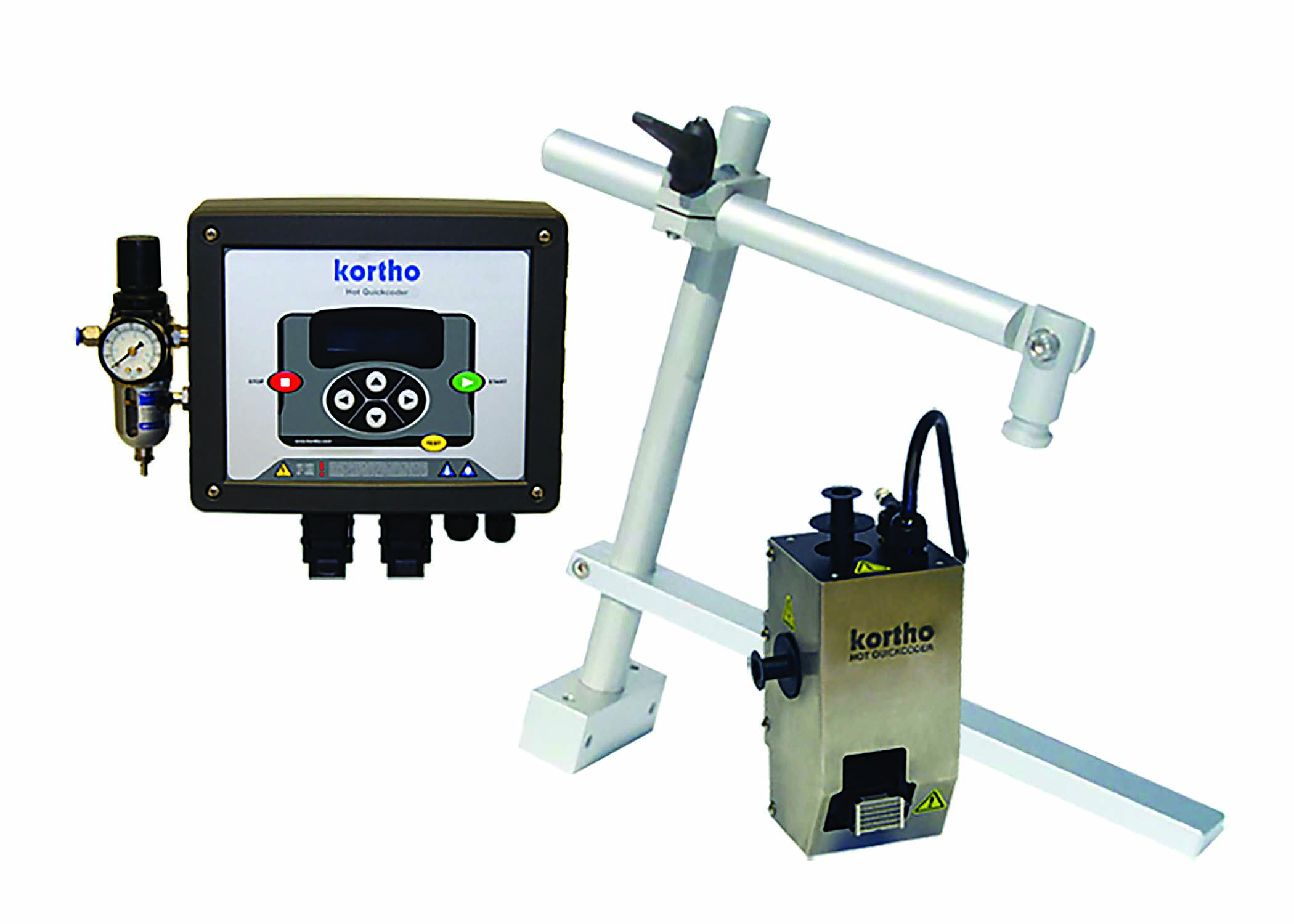
The Kortho Hot Quick Coder, left, can mark products in motion at speeds up to 60 m/min. and at cycle rates up to 300 prints per minute. Image courtesy of Universal Stenciling & Marking Systems
Most marking machine manufacturers offer a range of machines with a variety of message sizes. For instance, Marvel Marking Products LLC, Valencia, Pennsylvania, offers several common sizes of type chases, which determine the marking area, that are typically used in inspection applications for automotive parts, plastic products and packaged items. These chases are 24mm × 24mm, 24mm × 48mm, 48mm × 24mm and 37mm × 37mm. Depending on the character quantity required by the customer, the end user may be able to utilize characters anywhere from 1⁄16″ through ½” that will make a maximum message of 24mm x 48mm or 37mm x 37mm, according to the company.
Sprinter Marking offers nine standard machine models that have message sizes from dots as small as ¼”×¼” to 2″×2″. “We tell customers to begin to first look at what machine size would be useful for their application, and we like to size customers’ message size to the maximum message size that they need. If they are only putting down a 1⁄8″-dia. dot, our Model 22 can be mounted in confined, constricted spaces. It weighs only a few ounces and fits in a shirt pocket. The largest machine, the 2″×2″ (Model 1010), weighs about 2 to 3 lbs., and it offers the biggest message that we make in a standard machine.”
Larger machines can be custom-built if required. “We would need to see what the customer wants to do, because as the message gets bigger, it gets more and more difficult to ensure that that rubber is fully contacting the surface,” Bishop said. “Even if the part is flat, it is still more difficult and requires higher pressure.”
On the Line
These machines are for production uses. They don’t need to sit in a pristine lab. Reciprocating coders print 50 to 300 characters per minute. However, in a typical production line operation, the product traditionally needs to be stationary or moving slowly. If the surface speed is high and the marking head contacts the surface, it can distort the image.
There are ways around that, Bishop said. Sprinter Marking offers a micropilot actuator switch that senses a pressure drop when the marking head touches a part surface. The actuator signals a four-way valve that directs the marking head to immediately return so the marking head doesn’t sit too long on the surface.
Marvel Marking says its CC100 contact coder can be integrated into automated manufacturing lines and linked to standard programmable logic controller systems. This can help direct the marking process.
Another product is the Kortho Hot Quick Coder from Universal Stenciling & Marking Systems Inc., St. Petersburg, Florida. The device uses dry-ink rolls that are heated prior to use in a self-contained heating system to make them fluid, said Don Wright, president of Universal Stenciling. “Once the ink is transferred to the part surface, it dries immediately. You can pick it up immediately after the transfer, and the ink is dry.”
The unit operates at line speeds up to 196 sfm. The Hot Quick Coder is pneumatically operated, Wright noted, but the type face itself is mounted using four shoulder screws with compression springs under them and rests about 1mm to 2mm off the surface. “When it comes out under high speed, the type contacts the product, and it bounces off so quickly that it doesn’t allow the imprint to smear.”
Despite these advances, parts to be marked in a fast production line in a challenging manufacturing environment might need testing, Myers said. “Either the customer has to do it or I will test-imprint it to see how it does.”
Still, these manufacturers feel that ink coders could be the best choice for an application.
“It has the lowest cost, it is the easiest to maintain and the most reliable (technology) out there,” Bishop said. “You don’t need to have an army of technicians or maintenance people. The technology is different, but the cost per code mark is the lowest out there.”
Related


Subscribers can use MFGAxis notes, saves and discussion tools with their innoNET account.