

Plastic Prescription: Medical Manufacturing
The use of plastic medical parts is growing, and in certain applications machining them is advantageous and even essential.
Courtesy of B. Kennedy
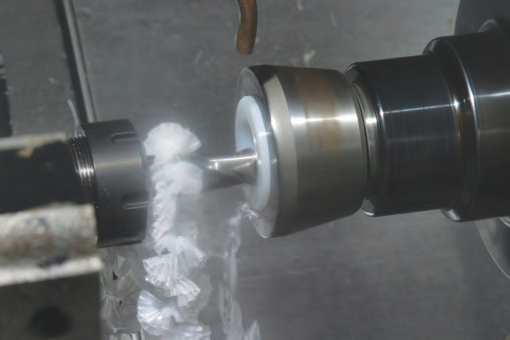
Ribbon-like chips characterize machining of a 1.8 “-dia. UHMWPE hip implant liner at Orchid MACDEE. The process imparted a surface finish of 15 µin. Ra right off the machine. To view a video of parts being inspected at MACDEE, click here.
The use of plastic medical parts is growing, and in certain applications machining them is advantageous and even essential.
There’s a good chance plastic will play a part in your future. Literally a part, that is. The Freedonia Group, Cleveland, a market research firm, estimates that in 2012 U.S. manufacturers of medical devices, components and packaging will use 5 billion pounds—$6.5 billion worth—of plastics.
One of the main drivers of plastics in medical applications is the trend towards single-use, disposable medical products and devices, according to Venkat Rajan, industry manager, medical devices, for business research firm Frost & Sullivan, San Antonio. “There are concerns about infection-related issues,” he said. “It does make more sense if you use a device that you are going to take straight out of the package, use it and throw it away.”
The possibility of new excise taxes on the medical device industry and caps on Medicare reimbursements for procedures such as surgeries are also motivating health care providers to minimize costs by using plastic parts when they are less expensive than metal equivalents.
Changing demographics also affect the use of plastics in medical applications. Mike Ulanowicz, director of sales for the Orchid MACDEE Div. of Orchid Orthopedic Solutions, Chelsea, Mich., said the market for plastic medical parts like the ones machined at MACDEE is growing close to 10 percent a year. “I would estimate that 75 percent of orthopedic implants have a plastic component, like those used in knee and hip replacement. If you look at the demographics, we are an aging and overweight society. Both of these contribute to a growing need for the type of products we produce.”
In a report, The Freedonia Group noted that the market growth of smaller-volume, engineered plastics exceeds that of commodity plastics, with medical application of the more advanced materials expected to reach 630 million pounds, worth $2 billion, in 2012.
That growth is based on needs for higher-performing advanced materials in devices and instruments for surgery, diagnostic testing, drug delivery, geriatric care and preventive medicine. The research company cited growth opportunities “in areas such as prosthetic devices and invasive surgical instruments, which are currently dominated by metal but open to penetration by advanced thermoplastic materials.”
Courtesy of B. Kennedy
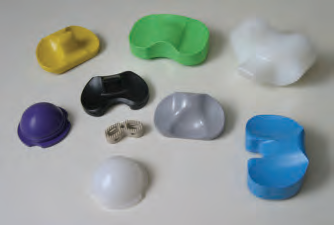
A selection of permanent and trial orthopedic implants machined at Orchid MACDEE. Permanent implants generally are white, but trial implants are machined in different colors, often to designate the different implant sizes.
Machine vs. Mold
Injection molding is the most common manufacturing method for plastic parts. However, production levels and other requirements for specialized medical parts, as well the properties of some plastic materials, make machining the preferred method to produce many of these parts, such as trial implants, prototypes and items whose contours or tolerances don’t allow them to be molded.
A major factor for machining plastic parts is their relatively low production volumes. “In the majority of cases, the reason a part is machined instead of molded is that the production volume is not high enough to justify the expense of creating mold tooling,” said Dan Coleman, president of Plastic Machining Inc., Orange, Texas.
Doug Wetzel, vice president and general manager of Protomatic Inc., Dexter, Mich., noted that the injection molding machines for making medical parts often must operate in a clean room because the air that surrounds them could be injected into the part. “It doesn’t make sense to design and make a mold and run it in a clean room if you are making 50 or even 1,000 parts,” he said.
At MACDEE, production of orthopedic implant components usually involves machining small lots representing variations within product families. “In a family, there might be eight or nine different millimeter thicknesses,” Ulano- wicz said. “Depending on the product, we can turn over a mill three or four times a day. I might be running three different styles of knees for three different customers on the same mill, but their lot sizes can be anywhere from five pieces up to 100 pieces. If someone is going to order 500 of a part for a year, it doesn’t lend itself to being injection molded and putting $35,000 to $40,000 worth of tooling into it.”
Courtesy of B. Kennedy
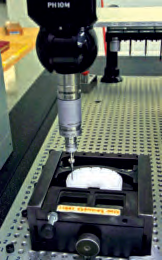
Because plastic parts have a thermal coefficient of expansion 10 times or more that of metal components, inspection must take place under controlled temperatures. Here, an UHMWPE orthopedic implant is measured at Orchid MACDEE.
Ulanowicz said MACDEE regularly produces long-term supplies of customer parts and releases them in small batches, Kanban-style, to ensure the customer has a reliable component supply.
In addition to the volume requirements for injection molding, the heat present in the process can negatively impact some plastics. According to Ulanowicz, the ultrahigh molecular weight polyethylene (UHMWPE) widely used in orthopedic implants will not hold its critical properties when injection molded. As a result, UHMWPE is either extruded or compression-molded into bar stock or slab stock, then machined to shape.
Ulanowicz noted that, depending on the materials involved, injection molded parts may cost only 2 to 3 percent of what machined parts do. That is because machining plastic is neither simple nor easy. “I used to work in metals before I came here, and cutting plastic is, in many ways, harder than cutting metal,” he said. “You can cut plastic quicker, but there are a lot of different things that go along with it.”
For one, plastic is not necessarily a low-cost material. Ulanowicz said, “Take PEEK (polyetheretherketone) materials, which they make spinal cages out of. It can cost $2,500 to $5,000 per meter of length, depending on the diameter.”
Much of the high cost of medical-grade plastics is derived from the expense of the Food and Drug Administration certification and traceability practices required of the manufacturers.
Certain medical applications require that parts be manufactured in more than one material. For example, some versions of implants are considered trial devices. During a joint replacement operation, the surgeon test-fits a range of trial implants to determine which size is best for the patient and, when the correct size is determined, the trial is replaced immediately with the permanent implant. The reason is that the trial items can easily be sterilized for reuse in another procedure while permanent implants cannot.
Courtesy of B. Kennedy
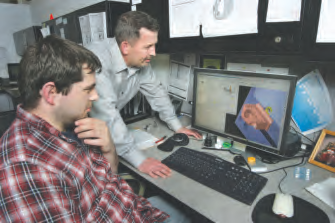
Programmer Nic Haroney (left) and Sales Manager Mike Ulanowicz discuss the CAM program for a spinal cage component to be machined from PEEK polymer at Orchid MACDEE.
Don Cramer, MACDEE lead engineer, said permanent UHMWPE implants will distort if subjected to the heat of an autoclave during sterilization. “UHMWPE is a magical material inside the body—it is 10 to 15 times more wear-resistant than nylon. But it doesn’t like to get hot,” he said. “At over 150° F, it will start going all different directions. It’s the same when you are machining UHMWPE implants; you have to make sure that you are not applying a lot of heat because you can distort the material and actually burn it.”
Before use, permanent UHMWPE implants are sterilized via radiation. Cramer said trial implants are made instead from plastics like Radel, which can be autoclave-sterilized and reused. Permanent implants generally are white, but the trial-implant materials are different colors, often to designate the different implant sizes. In addition, the color makes it clear that the implant is for trial purposes only.
Machining Processes
At Plastic Machining, Coleman said much machining is performed on general-purpose CNC machines featuring live tooling “where you are doing multiple operations on the part. The goal is to minimize setups and isolate as much work as you can to one machine, instead of going across multiple machines. It makes you more competitive.”
It’s a challenge to balance workholding pressures with cutting forces when machining plastics, Coleman noted. “Your clamping pressures are minimal, compared to holding steel. We use 10 percent of the clamping pressure.” However, the impact of cutting forces depends on part geometry, length and material. “If you are trying to turn a long part between centers, it will flex on you. You can’t have a lot of material hanging out of the chuck, either.”
Courtesy of B. Kennedy
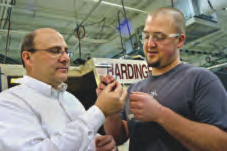
Doug Wetzel, vice president and general manager of Protomatic (left), and Rusty Buchanan, assistant supervisor, discuss machining a tiny part made of Teflon PTFE.
It helps to have an understanding of different materials, he said. “UHMWPE will flex more than PEEK; you will get more push off.” But, because PEEK is more rigid than UHMWPE, PEEK parts can have tighter tolerances, Coleman added.
Review the print ads from this magazine to continue
This quick advertiser review unlocks the rest of the article and keeps the full-screen reader focused on the ads instead of the page chrome.
Advertisers included in this article experience
Print placements connected to this article
Hornusa
HORN - THE LEADERS IN GROOVING TECHNOLOGY
FOCUS ON THE ESSENTIAL SYSTEM DR Urma licence Sensitivity instead of gross motor skills – this is the motto of the new HORN “System DR” reaming tools. Very narrow cutters, simple handling, and high repeatability when replacing inserts. A large selection of base material, coatings, and cutting geometries make the DR from HORN the perfect tool system for high precision bore machining
HORN - THE LEADERS IN GROOVING TECHNOLOGY FOCUS ON THE ESSENTIAL SYSTEM DR Urma licence Sensitivity instead of gross motor skills – this is the motto of the new HORN “System DR” reaming tools. Very narrow cutters, simple handling, and high repeatability when replacing inserts. A large selection of base material, coatings, and cutting geometries make the DR from HORN the perfect tool system for high precision bore machining. HORN – INTELLIGENT TOOL DESIGN AT WORK. IS #32 HORN
Visit Hornusa View this placement in the issue recordPrint ads from this magazine
FOCUS ON THE ESSENTIAL SYSTEM DR Urma licence Sensitivity instead of gross motor skills – this is the motto of the new HORN “System DR” reaming tools. Very narrow cutters, simple handling, and high repeatability when replacing inserts. A large selection of base material, coatings, and cutting geometries make the DR from HORN the perfect tool system for high precision bore machining
HORN - THE LEADERS IN GROOVING TECHNOLOGY FOCUS ON THE ESSENTIAL SYSTEM DR Urma licence Sensitivity instead of gross motor skills – this is the motto of the new HORN “System DR” reaming tools. Very narrow cutters, simple handling, and high repeatability when replacing inserts. A large selection of base material, coatings, and cutting geometries make the DR from HORN the perfect tool system for high precision bore machining. HORN – INTELLIGENT TOOL DESIGN AT WORK. IS #32 HORN
Continue reading
June 2011
The ability to maintain tight tolerances is another advantage of machining compared to molding, Coleman said, noting that his shop typically makes parts with tolerances tighter than ±0.005 “. “Depending on the material, we have gotten as low as ±0.0002 ” tolerance.” Machining is also required when the draft angle features that enable parts to be removed from a mold can’t be included in a medical component.
Measuring tight tolerances is another consideration in plastic part production. MACDEE’sUlanowicz pointed out that the temperature sensitivity of plastics makes it difficult to correlate results between different inspection locations. “Making sure you align your inspection processes and temperature of the inspection area with your customer is critical,” he said. “The type of products we machine will grow in diameter with increases in temperatures. You must have a climate-controlled facility, or you’re fighting an uphill battle. A 5° F change in temperature can make the difference between a product that is in or out of spec. Our environment is controlled here, 70° F ±3°. If I have customers who are checking a part in an 80° or 65° F lab, our correlation on a ±0.001 ” dimension is going to be way off.” Depending on the wall thickness of the part, Ulanowicz said, the measured dimensions of a UHMWPE product can change by 0.002 ” to 0.003 ” just through exposure to the heat of a human hand.
Cramer said plastic generally “has a very high thermal coefficient of expansion compared to metal—at least 10 times as much and sometimes higher.”
Fine Finish
Ulanowicz said the basic approach to turning, milling and drilling plastic parts is similar to metal machining. “It’s all about tooling and sharpness of those tools.” However, he said, “Drilling is the most difficult due to the heat generated in the process and how it affects tolerances.”
Cramer said, “Sometimes we are drilling holes 3½ ” or 4 ” deep, and trying to maintain ±0.001 ” in plastic is very difficult. Through-drill air cooling doesn’t work very well. We just have air pointed at it, and we have to play around with it a lot,” including a proprietary method of pecking. Thin parts are always a challenge, he added. “The plastic has a tendency to bow. We can’t go back through in a secondary operation and straighten it out.”
Ulanowicz pointed out that surface finish of a machined plastic part usually must be imparted during machining. “Unlike metal components where you can blast or polish the surface after machining, with plastics you have one chance.” As an example of a fine finish, he cited a UHMWPE hip liner cup with 15 µin. Ra finish right off the machine. He said the shop applies standard tools but also modifies standards and makes its own cutters.
To minimize burrs and impart fine surface finishes when machining plastics, tools engineered for those purposes are often required. According to Jeff Davis, vice president of engineering at Harvey Tool Co., Rowley, Mass., cutters to mill plastics and impart fine surface finishes have geometries engineered to cut cleanly and minimize heat generation. The tools have sharp edges, acute relief on the back of the cutter and flute depths much larger—to facilitate chip flow—than those common in metalworking.
Plastic machining strategies also differ from those common in metalworking. On a typical metal workpiece, it is routine to rough a contour and leave a few thousandths of an inch excess material for a finishing pass. “You cannot do that in plastics, because in the finish cut you are taking very little material, and most of the heat either stays in the tool or the part because the chip can only absorb so much,” Davis said. “You want to take just one pass with as big a chip as possible and with the most feed and the least speed.” Overall, he said, chip clearing and cooling are critical issues in plastic machining.
Cool Running
Cooling is critical because the melting points of most plastics are far below those of metals. For example, the acetal plastic Delrin has a melting point of about 350° F, while the melting point of aluminum is 2,000° F. And plastic materials have different melting points. UHMWPE, for example, has a melting point of about 300° F, while PEEK melts at about 660° F.
Unfortunately, clearing chips and cooling the workpiece with traditional coolant is not typically an alternative when machining plastic medical parts. For example, MACDEE does not use any coolant due to possible contamination of implantable parts. “Every aspect of the manufacturing process is under scrutiny,” Ulanowicz said. “When we start a project for a customer, they don’t only want a list of what is actually in the machine, but everything that is on the shop floor. For example, we can’t chew gum or use a throat lozenge on the factory floor.”
At PMI, Coleman said, “There are very few applications where we do use coolant, and it’s all water-base coolant now.”
Courtesy of B. Kennedy
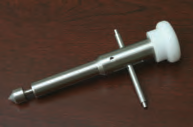
Protomatic machined both the Delrin 150 plastic cap and the 316L stainless-steel components of this cardiac trocar device.
Wetzel of Protomatic said, “In many cases we have to machine dry, or we use a virgin coolant, such as CO2 (see sidebar on page 41).” For machining of some medical-related parts used outside the body, such as fluid control components in diagnostic equipment, use of coolant is acceptable. Wetzel gave the example of a fluid damper used in medical diagnostic equipment, made of virgin polycarbonate plastic, which the shop mills with water-soluble synthetic coolant.
Rules and Regulations
Makers of parts used in medical applications deal with multiple regulations and rules issued by both government and customers.
The FDA classifies medical devices in three categories: Class I items are medical related but do not contact the patient, Class II devices contact the patient but not on a permanent basis, and Class III devices, such as orthopedic and other implants, become a permanent part of the patient’s body. Regulatory requirements are strictest for Class III devices. They require premarket approval awarded by the FDA after it determines that the manufacturer’s application for approval contains sufficient valid scientific evidence to assure that the device is safe and effective for its intended use.
Ulanowicz said MACDEE is certified under ISO 13485, the medical version of ISO certifications. “We are audited yearly by most of our customers, and twice a year by our registrar to the FDA requirements,” he said.
The FDA standard for medical manufacturers is 21 CFR (Code of Federal Regulations) part 820 rev. 2010, also known as the quality system regulation. The QSR outlines current good manufacturing practice regulations that govern the methods used in, and the facilities and controls used for, the design, manufacture, packaging, labeling, storage, installation and servicing of all finished devices intended for human use, with the intent of assuring that the medical devices are safe and effective.
Ulanowicz said both customers and the FDA require validation not only of specific processes, but also of the machines that produce the products. “Once we have established our process flow and the machinery to be used for a certain product, we cannot move that product to a different cell without permission from our customer. If permission is granted, we have to revalidate the machinery and do capability studies to ensure the repeatability of the changes made. The way it’s starting to go, when we put together our process flow, some of our customers require the specific machine tool numbers that we use to run the process.”
Medical part manufacturers do operate under much different requirements than makers of more general parts. However, there are commonalities with other industry segments. Protomatic also machines military and aerospace parts. “Aircraft and medical are almost identical,” Wetzel said. “From our perspective, we treat them very similarly. They are all mission-critical or safety-critical components. Recording and serializing parts is common in both industries. The training and mindset of employees is in line, too. They are used to stringent control plans and recording inspections as they manufacture parts. It’s a really good fit.”
Even so, combining the process precision and compliance required for manufacturing medical parts with the special approaches involved in machining plastic workpieces presents a continuing challenge. CTE
About the Author: Bill Kennedy, based in Latrobe, Pa., is a contributing editor for CTE. He has an extensive background as a technical writer. Contact him at (724) 537-6182 or at billk@jwr.com.
Courtesy of B. Kennedy
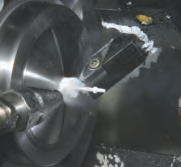
Protomatic machines a proprietary part from ¼ “-dia. Teflon PTFE rod stock that when completed is only 0.475 ” long, with an OD of 0.075 ” and ID of 0.063 “, resulting in a wall thickness of 0.006 “. A flow of ice-crystal-like liquid CO2 provided by a system from CoolClean Technologies cools the part during machining.
Keeping a tiny part cool and clean
Machining plastic parts presents a singular set of challenges. Protomatic’s Doug Wetzel cited the production of a Teflon polytetrafluoroethylene (PTFE) part only 0.475 ” long, with an OD of 0.075 ” and ID of 0.063 ” that resulted in a wall thickness of 0.006 “. The exact application is proprietary, but typically such components act as bearings for tiny shafts in precision equipment.
Protomatic Assistant Supervisor Rusty Buchanan said it took him about 6 hours to write the part program. The main challenge was dealing with a wall thickness that makes the part nearly transparent, a factor further complicated by the plastic workpiece material’s tendency to stretch when machined. Beginning with ¼ “-dia. Teflon stock, Buchanan drills the part’s 0.063 ” ID, stops the machine and inserts a 0.0625 “-dia. brass pin for support during turning at about 3,200 rpm and a light feed rate of 0.002 ipr. Buchanan said the feed is fairly slow considering the amount of material being removed, but a faster rate would cause the part to heat up and expand. Heat buildup during the operation is controlled with a ChilAire Lite system from CoolClean Technologies, Eagan, Minn., that employs a flow of ice-crystal-like liquid CO2. As the CO2 sublimates from a solid to a gas, it pulls heat from the tool/workpiece interface. In addition to cooling the part, use of CO2 eliminates concerns about contamination of the plastic part by traditional coolant.
—B. Kennedy
Contributors
Freedonia Group
(440) 684-9600
www.freedoniagroup.com
Frost & Sullivan
(877) 463-7878
www.frost.com
Harvey Tool Co.
(800) 645-5609
www.harveytool.com
Orchid MACDEE
(734) 475-9165
www.orchid-orthopedics.com/macdee
Protomatic Inc.
(734) 426-3655
www.protomaticmedical.com
Plastic Machining Inc.
(888) 761-4262
www.plasticmachininginc.com
Glossary terms in this article
Related



Subscribers can use MFGAxis notes, saves and discussion tools with their innoNET account.


