


Precision prescriptions: Medical Manufacturing
Ensuring optimal grinding of stainless steel medical instruments.
Ensuring optimal grinding of stainless steel medical instruments.
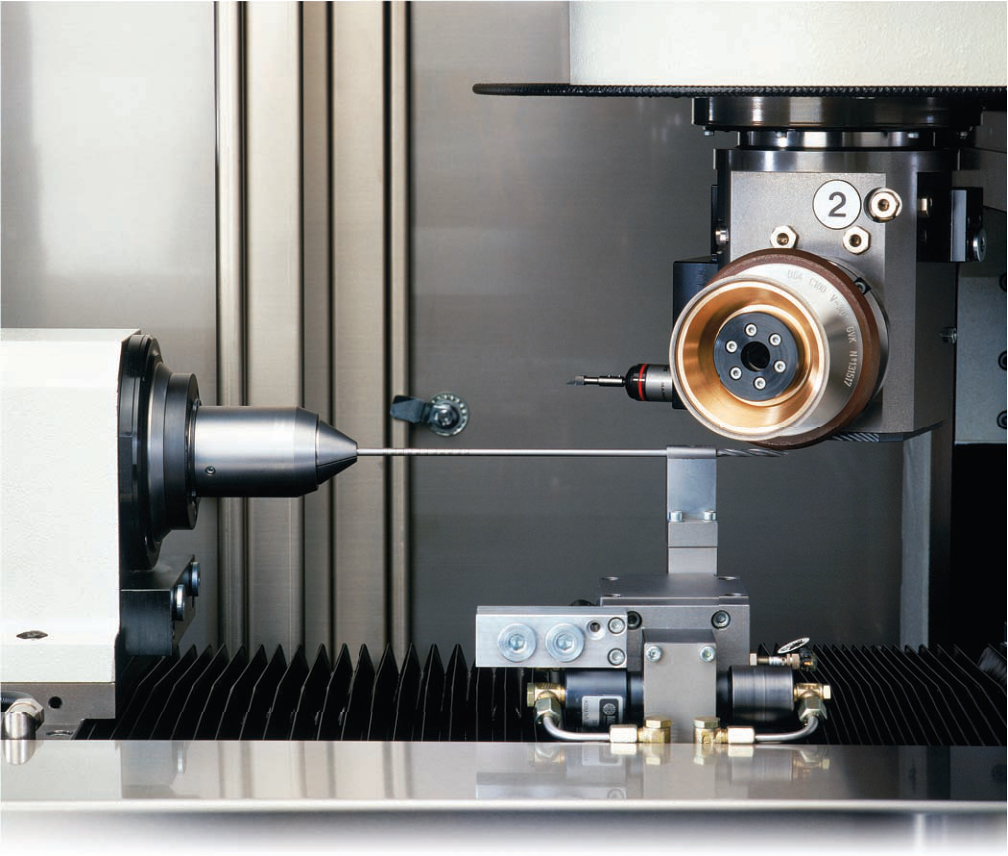
Courtesy of United Grinding Technologies
A surgical drill being ground on an EWAG Rotoline machine.
There’s no way around it, said Brian McKahan. When you talk about making the jump from grinding conventional carbide tools to grinding stainless steel medical instruments, you face an array of new hurdles.
McKahan and his wife, Christina, own True Tool Innovations, Craydon, N.H., where they make medical devices such as burs, reamers and saw blades along with standard carbide cutting tools like endmills, drills and routers. They’re at once well-versed in the manufacturing requirements of both stainless and carbide and well aware of their peers’ growing interest in adding medical parts to their product offerings. “You have a lot of companies that have been riding the carbide wagon for a long time making cutting tools, and I know of some that are trying to switch into the medical field, but it’s difficult,” said Brian McKahan.
The technological challenges newcomers and veterans alike face when grinding stainless medical instruments range from keeping the grinding wheel clean when working with the soft, gummy material to fixturing, surface measurement and minimizing burns and burs.
For McKahan, the strategy to head-off burning is three-fold. “We have three Rollomatic CNC tool and cutter grinders that use a full synthetic oil coolant,” he said. “Critical to our operation is the Transor filter system. We filter cutting oil to 1μm and chill the oil to within ±1° F. All of our machines are run on the filter system to help [prevent] burning.”
In addition, he uses advanced coolant nozzle technology with orifices that bar the introduction of oxygen into the stream, and thereby deliver a concentrated flow of fluid. Unlike nozzles that spray coolant, the focused stream can break the air barrier created by the rotating grinding wheel, and effectively cool the wheel/workpiece interface.
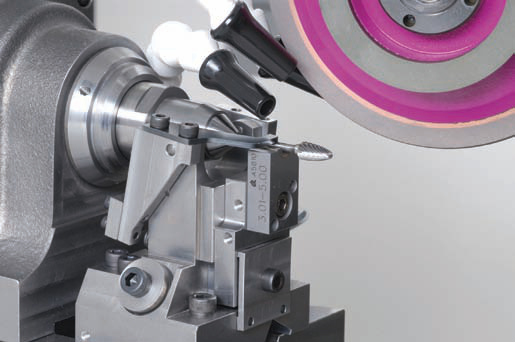
Courtesy of Rollomatic
Rollomatic Nano5 grinding of a tree-shaped rotary carbide bur with brazed shank using five CNC axes.
“We also use Regal Diamond Products’ copper-bond grinding wheels for all of our medical applications,” Mc- Kahan said. “The copper bond is bound with a copper base that goes to the core of the wheel and displaces the heat up to the core. That wheel is one of the biggest advances I’ve found to combat burning and burring. And I have yet to run into an instance when it has failed.”
As for deburring, McKahan reserves a wheel slot on the CNC to do the operation online with a brush wheel. “I’m able to program it to mimic the grinding in a deburring fashion,” he said. “People have a tendency to think you have to bury the wheel to debur, but it’s just the opposite,” he added. “If you grind the parts right, the burrs should be very light and flaky, and flick off easily. If you bury the wheel in there, it can push the burr back down into the flute or hole.”
Grinding Wheels
Aside from preventing burns, coolant is essential for keeping grinding wheels clean, especially when working with gummy stainless material. This is best achieved by ensuring that coolant delivery is appropriate for the specific grinding conditions, said David Drechsler, vice president of marketing for grinding machine manufacturer Huffman Corp., Clover, S.C. “For example,” he said, “for CBN wheels, ideally the coolant velocity will match the wheel peripheral speed. In other cases, a very high-pressure [1,000 psi to 1,200 psi] wheel scrubber is required to achieve acceptable removal rates without loading the grinding wheel.”
One recent advance that’s played a large part in boosting grinding production has been the introduction of automatic wheel changers. “After visiting shops, I’ve become a big believer in wheel changers,” said Ed Sinkora, marketing manager for United Grinding Technologies Inc., Fredericksburg, Va. He cited the example of a grinder with 12-wheel packs with various sized wheels on each pack. “Because you know all the wheels are available, you can design a whole host of tools that use different combinations of those wheels and never have to recombine or build new wheel packs,” he said. “When making a complex tool, you don’t have to worry about interference from other wheels. For example, you can only cram six or seven wheels on a two-spindle machine. And when you do that, there’s a tendency for one wheel to interfere with an adjoining wheel for some operations. It’s much easier to set it up with a wheel changer, where you’ve got only one or two wheels per pack, because the machine can automatically switch to another pack.”
Workholding
One perennial challenge of grinding stainless medical parts is fixturing. The awkwardness of some tools, combined with the material’s propensity to bend, sometimes calls for solutions as novel as the demands.
“The difficult parts are the very small, long drills; they’ll flex and move,” said Simon Manns, tool grinding applications manager for United Grinding Technologies. “Because it’s gummy, the part will try to pull itself up into the wheel.” He recommended using a steady-rest workholder with a bushing that provides more than 180° of encapsulation.
At True Tool Innovations, McKahan often uses customized fixturing. He cited the example of a drill design calling for a 6 “-long flute from a 6½ “-long blank. “You come into a problem with fixturing there because you can’t get close enough to the actual clamping mechanism when fluting the drill,” McKahan said. “So you have to create special fixturing, like using extra-long steady rests or you have to have customized wire EDMed workholding made to run that particular tool. I do have a company I partner with that does all my fixturing. I design the fixtures but they build them. Without them, I wouldn’t be able to make a lot of components.”
3-D Simulation Software
Not all of the advances aimed at ensuring optimal grinding results are focused solely on the machining process, per se. Among the more effective technologies has been the introduction of tools used before grinding even begins. “Simulation and visualization software enables the end user to see the part before actually grinding, thereby reducing trial and error, reducing scrap and saving time and money,” said Huffman’s Drechsler.
“You program the tool on a laptop or desktop computer,” added United Grinding’s Manns. “We can do a 3-D simulation of the tool to see exactly how it’s going to come out and make sure we don’t have any collision problems.”
He typically programs the software using generic wheel sizes. “Once you have it programmed, you go to your wheels and build a wheel pack that matches what you have on the screen. It’s not going to be exact because if you use, say, a 5 ” wheel for fluting, you may only be able to build a 4.9 ” wheel from your stock. So you build your wheel pack, balance it, true the wheel pack on an offline dresser and then balance it again. Once you get to that point, you measure the wheel packs and then use those values in your grinding simulation to simulate the exact wheels you’ll be using for grinding. Then you can foresee any potential problems, like collisions, before you even begin. At that point, you’re ready to run it on the machine.” CTE
About the Author: Daniel McCann is senior editor for Cutting Tool Engineering. He can be reached at dmccann@jwr.com or (847) 714-0177.
Contributors
Huffman Corp.
(803) 222-4561
www.huffmancorp.com
Rollomatic USA
(866) 713-6398
www.rollomaticusa.com
Saint-Gobain Corp.
(610) 341-7000
www.saint-gobain-northamerica.com
True Tool Innovations
(603) 863-1079
www.truetoolinnovations.biz
United Grinding Technologies Inc.
(508) 898-3700
www.grinding.com
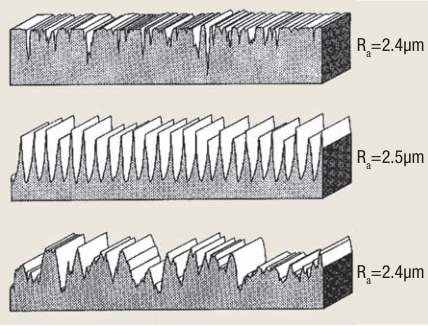
Courtesy of Saint-Gobain Abrasives
The three surfaces have approximately the same Ra, but the peaks and valleys are very different.
Tips for measuring surface quality
To get a detailed assessment of a part’s surface quality, you need a measurement method more exacting than Ra (arithmetic average roughness), said Ed Reitz, global market manager for Saint-Gobain Corp, Worcester, Mass.
While Ra can provide a general indication of a finish, Reitz continued, it’s based on an average value of a surface’s peaks and valleys. And a variety of different surfaces can generate identical numerical values.
“You could have one surface with a fairly high bearing area and a few very deep scratches, but an otherwise shiny appearance, and another surface with a very uniform finish with a matte appearance—and they each could generate the same Ra,” Reitz said.
Reitz’ preferred measurement method is finding a part’s Rmax (maximum roughness) readings. Rmax, he explained, measures the maximum peak-to-valley distances within a sample length. “It gives you an indication of the worst you can expect out of that particular surface,” Reitz said. “What’s important about that type of measurement is that it helps isolate any random scratches or anomalies, whereas Ra tends to blend those out.”
As a rule of thumb, if a part’s Rmax value is below a factor of 10 of the Ra measurement, it generally indicates a good and consistent surface finish, according to Reitz. “Let’s say the customer’s surface requirement is for a relatively smooth 15μin. Ra value,” he continued. “If the Rmax value is less than 150μin., then we can say that the finish is relatively consistent. But if you get an Rmax of 300 or 400, the finish is not consistent and you’ll be able to see or feel and measure some of the deep random scratches that typically are not acceptable.”
Other surface measuring tips include:
• Make sure the part is securely held; any movement could cause significant errors in the reading.
• Take measurements against the grinding pattern. “You want to line up the probe so that it travels perpendicular or as close to perpendicular as possible to the direction of the scratch or grind so that it will pick up all peaks and valleys,” Reitz said.
• Take multiple measurements at different locations on a part. “If one reading is at the edge or middle of a surface, the quality could be better or worse, based on the process, in certain areas,” Reitz said. “And if you don’t have representative samples of that surface that can throw off results. Also, any time there’s a process change—after dressing a wheel, for instance—it’s prudent to check the first, middle and last parts to get a representative sample.”
• Use benchtop or lab measurement instruments for mirror-like surfaces. “Once you get down to a 2μin. Ra surface finish and below, it very much looks like a mirror,” Reitz said. “Hand-held profilometers may lack the resolution to accurately measure those surfaces.” In those cases, lab-based equipment, such as white light interferometers, are the appropriate technology to ensure accurate measurements, he added.
—D. McCa
Glossary terms in this article
Related



Subscribers can use MFGAxis notes, saves and discussion tools with their innoNET account.