

Preset it and forget it
Minimize tool runout, extend tool life, reduce scrap and prevent fixture damage. An offline cutting tool presetter.
END USER: OKAY Industries Inc., (860) 225-8707, www.okayind.com.
CHALLENGE: Minimize tool runout, extend tool life, reduce scrap and prevent fixture damage.
SOLUTION: An offline cutting tool presetter.
SOLUTION PROVIDER: Koma Precision Inc., (800) 249-5662, www.komaprecision.com.
Every parts manufacturer faces a test of its ability to innovate at some point. OKAY Industries Inc.’s challenge was to design a better process for measuring and inspecting its cutting tools. The Berlin, Conn., company frequently machines 303, 304 and 17-4 stainless steel, as well as H-900 17-4, which is hardened to about 45 HRC, for medical, defense, arms and automotive applications.
The company handles production runs that total up to tens of thousands of parts per week. The cutting tools, however, are not large, mainly consisting of endmills from 3mm (0.118″) to 0.0763mm (0.0030″) in diameter and smaller, noted Joshua Palotti, lead CNC specialist at OKAY Industries.
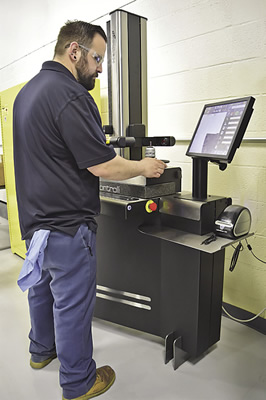
Joshua Palotti, lead CNC specialist at OKAY Industries, checks a tool on the Hathor Six offline tool presetter from Koma Precision. Image courtesy Koma Precision.
When applying microscale tools, runout of as little as 0.0002″ (5.1µm) —which is imperceptible to the human eye as they rotate—can cause problems, Palotti explained. “The first part would be way over size, the tool would instantly snap or tool life would be very inconsistent,” he said. “If we were expecting to run 300 cycles with a 1mm endmill, we might run from 100 to 300 cycles, depending on the runout.”
In addition, when finish milling one stamped part, there was only 0.0005″ (0.0127mm) of clearance between the workpiece and clamp, so excessive runout caused the tool to hit the clamp, Palotti noted. The clamp gripped a 0.020″ (0.508mm) land and the clamping force would be reduced if the tool hit the clamp, causing the part to move. This, in turn, required OKAY to rebuild the clamp, a 2- to 3-hour process that involved disassembling the entire fixture and creating a new one.
He added that some inexperienced operators applied worn tools, exacerbating the problem.
Review the print ads from this magazine to continue
This quick advertiser review unlocks the rest of the article and keeps the full-screen reader focused on the ads instead of the page chrome.
Advertisers included in this article experience
Print placements connected to this article
Fthaxis
Superior
Indexable Dovetail Cutters Inserts by Ingersoll Cutting Tools 45°and 60° The best indexable cutters on the market. HAIMER : Highest productivity and security in the hardest of materials – Out of this world milling. Tooling Technology Shrinking Technology Balancing Technology Measuring Instruments.
Superior Indexable Dovetail Cutters Inserts by Ingersoll Cutting Tools 45°and 60° The best indexable cutters on the market. www.fifthaxis.com HAIMER
Visit Fthaxis View this placement in the issue recordPrint ads from this magazine
Indexable Dovetail Cutters Inserts by Ingersoll Cutting Tools 45°and 60° The best indexable cutters on the market. HAIMER : Highest productivity and security in the hardest of materials – Out of this world milling. Tooling Technology Shrinking Technology Balancing Technology Measuring Instruments.
Superior Indexable Dovetail Cutters Inserts by Ingersoll Cutting Tools 45°and 60° The best indexable cutters on the market. www.fifthaxis.com HAIMER
Continue reading
September 2015
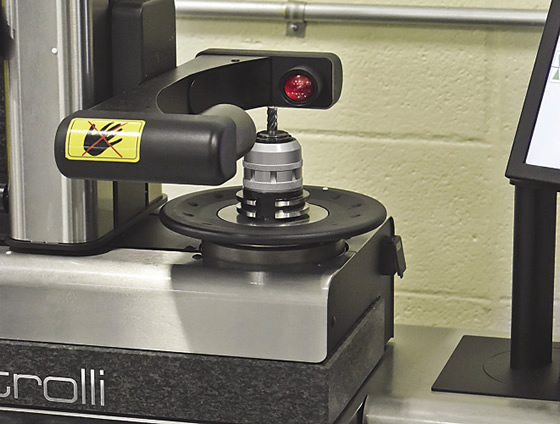
Koma Precision offers the Elbo Controlli Hathor Six for setting tools offline. Image courtesy Koma Precision.
OKAY took test cuts to ensure the cutter geometry was correct, but that was a time-consuming and cumbersome process for setting and adjusting tools. “Any time you changed a tool, it would take about 15 minutes if everything went smoothly, and up to an hour if things went poorly,” Palotti said. “We needed an offline presetter to easily check a wide range of tool types.”
In addition to researching four different models, Palotti said the acquisition process involved physically examining two presetters. The first was at another part manufacturer’s facility, where OKAY’s group of operators, setup personnel, management and manufacturing engineers watched tools being set up before the data was sent to the machine tools. The company also visited Koma Precision Inc., Windsor, Conn., where OKAY personnel used an Elbo Controlli Hathor Six offline tool presetter to set tools.
In addition to having an existing business relationship with Koma, Palotti said OKAY personnel appreciated that the presetter’s software platform is easy to use, enabling the company to tailor the unit to an application and a user’s ability.
“On a specific job, you can set up a library of tools and then when you select a tool, the presetter will automatically select the measurement technique,” he added. “It takes out a lot of the opportunity for error.”
Initially, OKAY dedicated the Hathor Six presetter to a small work cell of two to three machines and quickly saw a tremendous reduction in setup times by eliminating test cuts. “Now that we’re doing it off-line, it brought the billable time to zero because we are setting all the tools while a machine is running,” Palotti said.
After 6 months, OKAY decided to train all of its operators and use the presetter on all 23 milling machines in its main facility. Training a new operator takes about an hour, whereas new setup workers require a half a day because setting tools for new jobs is more involved. “It takes about a week before people are really comfortable using it,” Palotti said.
Tool life increased 43 percent after switching to the presetter, according to Palotti. Other benefits include less scrap from incorrect tool settings and improper runout, as well as the time savings from measuring offline. “The presetter was a significant process improvement,” he said.
Related




Subscribers can use MFGAxis notes, saves and discussion tools with their innoNET account.


