

Professional profiles: General Industry Coverage
When grinding complex cutting tool profiles, attention should be paid to the software, the wheel and the tool blank for best results.
Grinding a complex cutting tool can be, well, complex. And defining what makes a cutting tool complex can be challenging too.
“A complex cutting tool is generally defined by the tool profile and its tolerances,” said Paul Ehrlich, senior applications engineer for grinding machine builder United Grinding North America Inc., Miamisburg, Ohio. “You really need to take both of those parameters into consideration, because you might have a wide open geometry with a tolerance of two or three thousandths, and that’s not a big deal, but an odd shape, even with a looser tolerance, would be complex.”
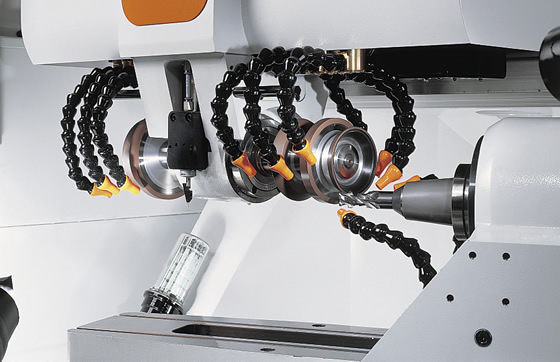
The Walter Helitronic Vision grinding machine produces rotationally symmetrical tools and parts with complex geometries. Image courtesy United Grinding North America.
Bill Freese, president of grinding machine builder Rush Machinery Inc., Rushville, N.Y., concurred, adding that multifunction tools, which may feature geometries intended to serve multiple purposes, are also complex.
Toolmaker and machine tool builder Star Cutter Co., Farmington Hills, Mich., expands the definition of complex to encompass anything outside of its normal range, noted Paul Schulte, manager of advanced technology.
“We view ‘complex’ as a tool with more than one diameter or a tolerance that is tighter than our off-the-shelf products,” he explained. “Our customers serve the automotive industry, which covers a range of tooling, so anything outside of that would definitely be complex.”
Software Solutions
While some disagree about what is the most important factor when grinding tools with complex forms, software always plays a big part in the discussion.
“You must ensure that whatever you see in the software is what comes out of the machine,” said Frank Holubeck, president of Reinecker Grinders, Pompano Beach, Fla., which sells grinding machines from German builder Ulmer Werkzeugschleiftechnik GmbH & Co. KG. “We urge our customers to spend time designing tools and running 3D simulations in NUMROTO software so blanks aren’t wasted. Carbide is expensive, so we want to make sure we are right on the screen, our machine is set up properly and the wheels are dressed properly. It’s not a time for trial and error.”
“The machine tool is not going to be the problem,” added United Grinding’s Ehrlich. “All toolmakers have 5- or 6-axis machines that can interpolate the most complex geometry you can think of. The real questions are, does the software possess the ability to process that kind of geometry, and can you produce the tools consistently?”
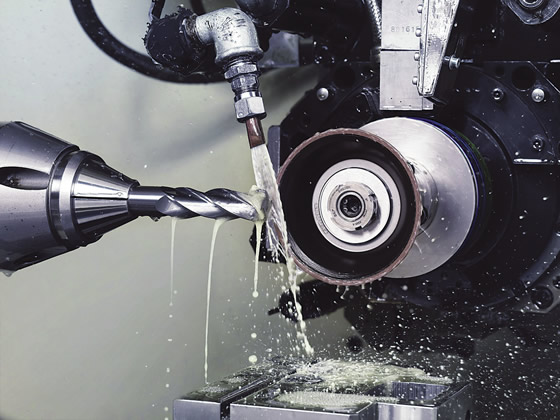
Radiac says its STARTEC XP-P abrasive reduces cycle times when grinding the flutes of round tools through effective profile retention, minimized tool deflection and reduced machine load. Image courtesy Radiac Abrasives.
United Grinding’s tool grinding machines utilize proprietary grinding software, which imports CAD drawings and feeds toolpaths to the machine. According to the company, what sets its software apart is specially developed correction software called FTC (Form Tool Compensation), which feeds data from the company’s Helicheck CNC measuring machines into the grinding machine’s CNC.
“If there are any deviances in the tool profile beyond a certain, predetermined tolerance, the Helicheck will correct the shape of the profile, and FTC will send that corrected shape to the grinder,” he explained. “A CNC grinder can usually be accurate to ±10µm; if we are checking regularly, we not only can account for variables like wheel wear, we can reduce that tolerance to ±3µm.”
In addition, whereas tool design and production were previously treated as separate processes, customer demands for high repeatability has led to the grinding process becoming more integrated with the design process, said Jason Walter, plant manager for the machine tool operations at Star Cutter. “We want to create an accurate simulation, and then we want to take that simulation and bring it to the shop floor as quickly as we can. The goal is keeping control over the process from beginning to end, without having to hand off the job from one point in the process to another.”
Wheel Be Back
Grinding wheels, of course, are a key part of making complex tools. “Obviously, you want a grinding wheel that is going to have good form-holding qualities, good mrr and be well balanced with excellent axial and radial runout.” said John Guenther, business unit manager–cutting tools for Radiac Abrasives, Oswego, Ill. “That means the tool you’re making plays a part. A small-diameter tool will be more vulnerable to pressure from the grinding wheel, so you won’t be able to really push the wheel the way you might on a large tool. Larger tools are a bit more forgiving, so you can shoot for a higher mrr.”
Wheel selection, added Rush’s Freese, also involves the tool geometry and determining the proper grit size, core material and bond.
“When you’re working with complex profiles, the grinding wheel itself becomes critical,” he said. “You are trying to hold a lot of tolerances in a lot of areas, and the more complicated the geometry, the more those come into play. We supply the machines for dressing and truing the wheels to do the job, because more complex geometries can require a more complex shape on the wheel itself.
Review the print ads from this magazine to continue
This quick advertiser review unlocks the rest of the article and keeps the full-screen reader focused on the ads instead of the page chrome.
Advertisers included in this article experience
Print placements connected to this article
Rushmachinery
CAM It Up
CAM-based simulation is that ded- icated simulation products actually read the G code rather than relying on the output of the CAM system’s post-processor to get it right. This generates a more accurate simula- tion, he said, something that’s es- pecially important with mill/turn and other complex machines. Simulation packages do more.
CAM It Up CAM-based simulation is that ded- icated simulation products actually read the G code rather than relying on the output of the CAM system’s post-processor to get it right. This generates a more accurate simula- tion, he said, something that’s es- pecially important with mill/turn and other complex machines.
Visit Rushmachinery View this placement in the issue recordPrint ads from this magazine
CAM-based simulation is that ded- icated simulation products actually read the G code rather than relying on the output of the CAM system’s post-processor to get it right. This generates a more accurate simula- tion, he said, something that’s es- pecially important with mill/turn and other complex machines. Simulation packages do more.
CAM It Up CAM-based simulation is that ded- icated simulation products actually read the G code rather than relying on the output of the CAM system’s post-processor to get it right. This generates a more accurate simula- tion, he said, something that’s es- pecially important with mill/turn and other complex machines.
Continue reading
April 2015
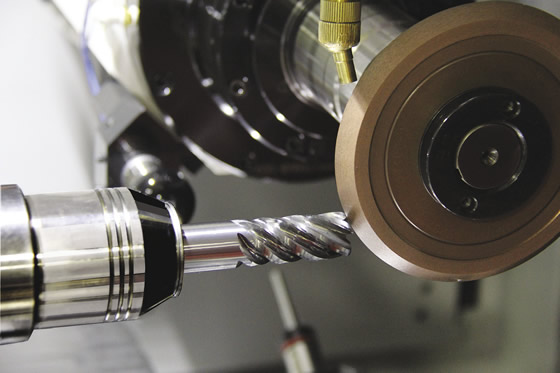
The Star PTG-6L linear motor tool gashes a specialized geometry on the tip of an endmill. Image courtesy Star Cutter.
“When you have multiple shapes and profiles within the same tool, being able to get in with the grinding wheel and get the work done can be tricky,” Freese continued. “That’s why we like to leave wheel selection up to the customer. The software on our machines can provide some information to help with wheel selection, but when the tool is being engineered, the necessary wheels will typically be spec’d out along with the material of the tool and the finish required.”
United Grinding’s Ehrlich said the main consideration boils down to what wheels the customer can use.
“A lot of customers don’t have a wheel dresser, nor do they want to invest in one,” he said. “In that case, we typically recommend a resin-type wheel for roughing the profile, then source an electroplated wheel from another manufacturer, because it is less likely to lose shape. On the other hand, if a customer has dressing capabilities, we will tool them up on different types of abrasives because they can redress that wheel as it wears.”
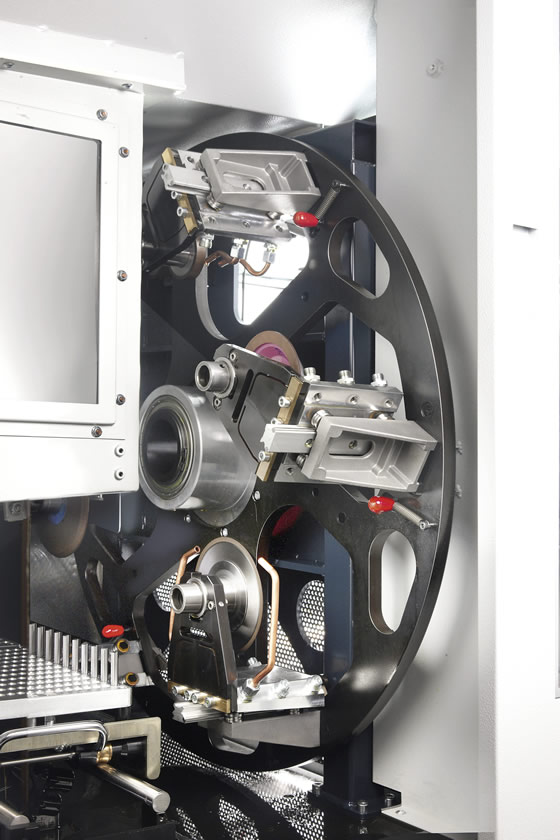
Reinecker’s WZS-700 tool grinder comes with an automatic wheel changer, allowing peel and profile grinding in a single setup. Reinecker Tool Grinders.
Ehrlich added that for holding tight profiles, a metal-bond or copper-bond wheel is best.
“In some cases, you are faced with trying to make a critical tool on an older machine,” Radiac’s Guenther noted, “so you need to be cognizant of the limitations when selecting a grinding wheel spec versus someone with a brand new machine who can take advantage of the latest technologies from grinding wheel companies.”
Blank Generation
A crucial—and sometimes overlooked—consideration for all cutting tools, including complex cutters, is the actual tool blank. According to Radiac’s Guenther, this is especially the case for complex form tools.
“You must have minimal runout on the blank,” he said. “The machine tool, the rigidity of the spindle, the method of holding and supporting the blank and the quality of the grinding wheel are important, but if the blank isn’t good, there’s only so much those other factors can do to account for it.”
Guenther said Radiac has seen more cutting tool manufacturers using peel grinding—a process that reduces the part OD prior to grinding the tool—because it allows them to make custom blanks in small batches for tools, which reduces machining time.
Reinecker’s Holubeck pointed out that, in addition to manufacturing dedicated peel grinders, the company’s WZS 700 tool grinder comes with a wheel changer, allowing customers to perform peel and profile grinding in a single setup.
“The biggest bottleneck on a standard tool and cutter machine is getting the blank prepared,” he said. “There are already many steps required to make the tool, and it takes a lot of additional work to blank out the diameter. Good blank preparation can greatly reduce the amount of time spent on the tool and cutter grinder.”
The Human Touch
However, for all the advances made in machine tools, grinding wheels and manufacturing software, they can’t replace experience. Reinecker’s Holubeck noted that while design and simulation software is arguably critical to the process, ensuring a tool is ground at the proper speeds and feeds frequently comes down to the operator’s experience and ability to find the “sweet spot.” This ability pushes the wheel as hard as it can go without having it break apart or produce an out-of-spec tool.
“The interface with the wheel is arguably the most important aspect of the entire process,” Radiac’s Guenther added. “It really comes down to having a skilled operator. You can have the best machine tool and the best raw material in the world, but the human element can make or break anything.
“What I love about the American worker is that so many of them have a wonderful imagination, an imagination that helps them produce things that might not exist in software,” he continued. “Talented machinists know ways around limitations in the software, because they understand how the tool interacts with the wheel.” CTE
About the Author: Evan Jones Thorne is assistant editor for CTE. Contact him at (847) 714-0177 or ejonesthorne@jwr.com.
Glossary terms in this article
Related




Subscribers can use MFGAxis notes, saves and discussion tools with their innoNET account.


