Prototyping company sees rapid rise
From humble beginnings, a speed-focused manufacturing company has grown into a global leader.
Proto Labs Inc., which does business as Protolabs, prides itself on its prowess in rapid prototyping and quick-turn, low-volume machining of metal parts. But that’s only part of the company’s story, which dates back more than 20 years and is marked by expansion and the addition of a variety of manufacturing capabilities.
The company now known as Protolabs was launched in a Minnesota garage in 1999 by Larry Lukis, an engineer and entrepreneur who wanted to slash the time that it took to produce injection-molded plastic prototype parts. He wrote over a million lines of computer code to automate the early stages of the injection molding process at his fledgling firm, which he called The Protomold Co.
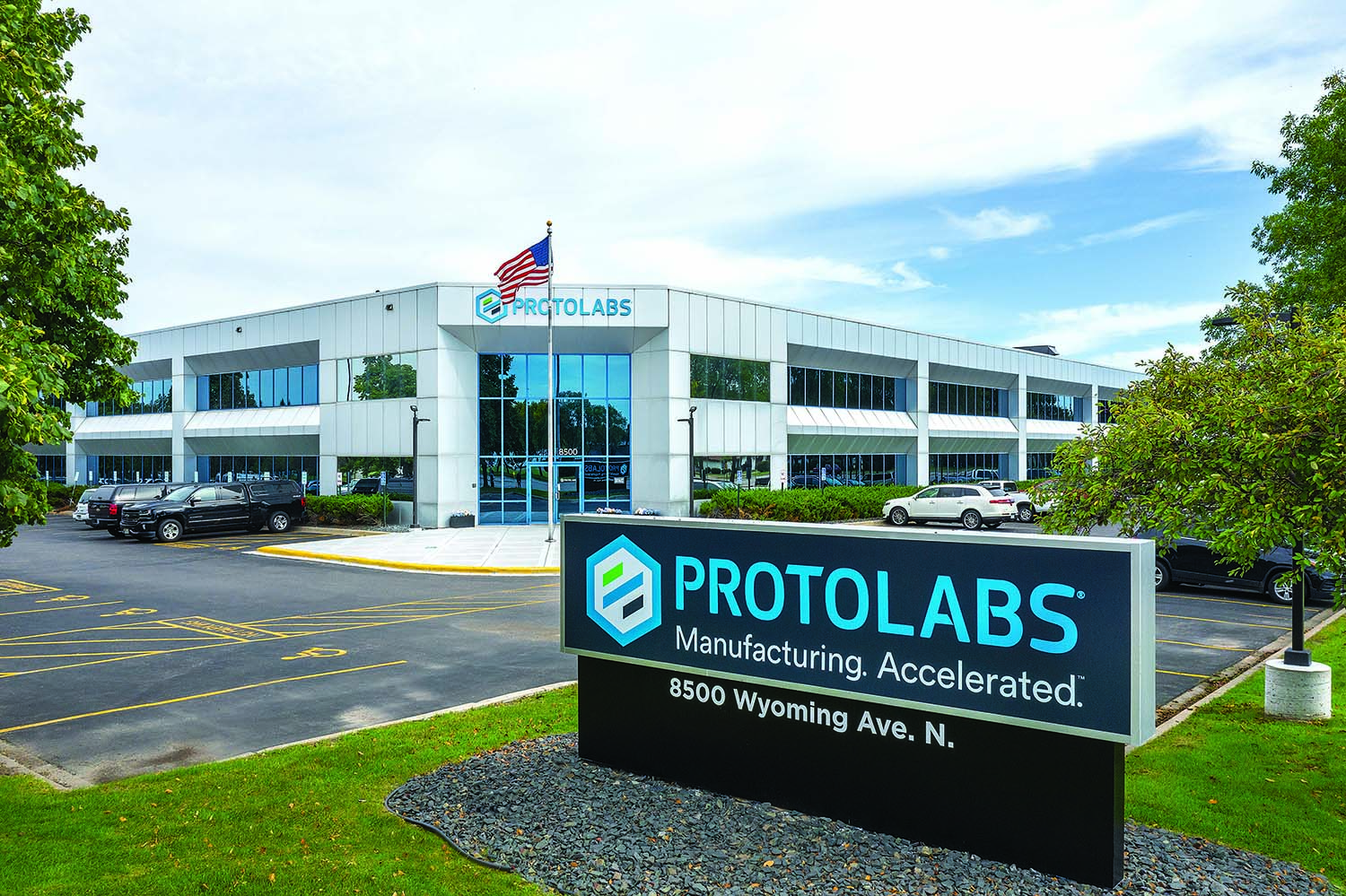
Protolabs’ 215,000-sq.-ft. facility in Brooklyn Park, Minnesota, contains more than 300 CNC mills and lathes. Image courtesy of Protolabs
In 2007, the company added a second quick-turn manufacturing service, a CNC machining business called First Cut. It was essentially an outgrowth of Protomold, said Greg Thompson, Protolabs’ global product director of CNC machining.
“To get our injection-molded parts out as fast as we did, we were doing a lot of rapid machining to cut the tools,” he said. “It was just a natural extension to take that technology we had and apply it to cutting the parts themselves.”
In the beginning, Thompson said First Cut was manufacturing only relatively small plastic parts. Eventually, though, the company added metal cutting, which now makes up the bulk of its machining business.
In 2009, Protomold and First Cut became Protolabs. Milestones afterward included the launch of industrial-grade 3D printing services; the acquisition of Rapid Manufacturing Group LLC, a New Hampshire-based custom parts supplier specializing in sheet metal fabrication and CNC machining; and the purchase of Hubs, a global online CNC manufacturing network.
Fast and Comprehensive
Headquartered in Maple Plain, Minnesota, Protolabs bills itself as “the fastest and most comprehensive digital manufacturing service in the world.” Globally, the company operates nearly 500 CNC machines at three AS9100-certified facilities. Last year, these CNC facilities turned out more than 68,000 machined parts per month and brought in revenue of almost $190 million. Capable of producing parts in a single day and offering tolerances down to ±0.005″, the plants can machine over 40 plastics and metals, including aluminum, brass, copper, steel and titanium.
Protolabs’ in-house milling and turning capabilities are supplemented by those available from its Hubs network of hundreds of manufacturing partners. Companies in the Hubs network can handle 60 or more materials, offer tolerances down to ±0.0008″ and provide volume pricing options that lower per-part costs as quantities increase.
For customers seeking rapid prototyping and quick-turn, low-volume production, Protolabs’ automated in-house machining process “tends to work very well,” Thompson said. “But if you’re talking higher quantities, that’s where we need to tap in to the network. We did the acquisition of Hubs to get some partners that are way more efficient at scale. So if you’re willing to wait and want to get the most economical price point, (your job) is going to fall to the network.”
While the company’s own rapid machining equipment consists mostly of mills, companies in the Hubs network offer “whatever is needed for the part,” he said, including electrical discharge machining, grinding and Swiss machining.
The network also can handle much larger parts than the firm’s in-house machines, Thompson added.
Digital First
At Protolabs’ machining facilities, the company applies what it calls a “digital-first approach” to the entire manufacturing process. This starts with an e-commerce interface that customers use to upload 3D CAD part design files. Within a few hours of uploading a file, customers receive an automated manufacturability analysis, along with an interactive quote that lets them change materials and quantities and see the resulting price updates in real time.
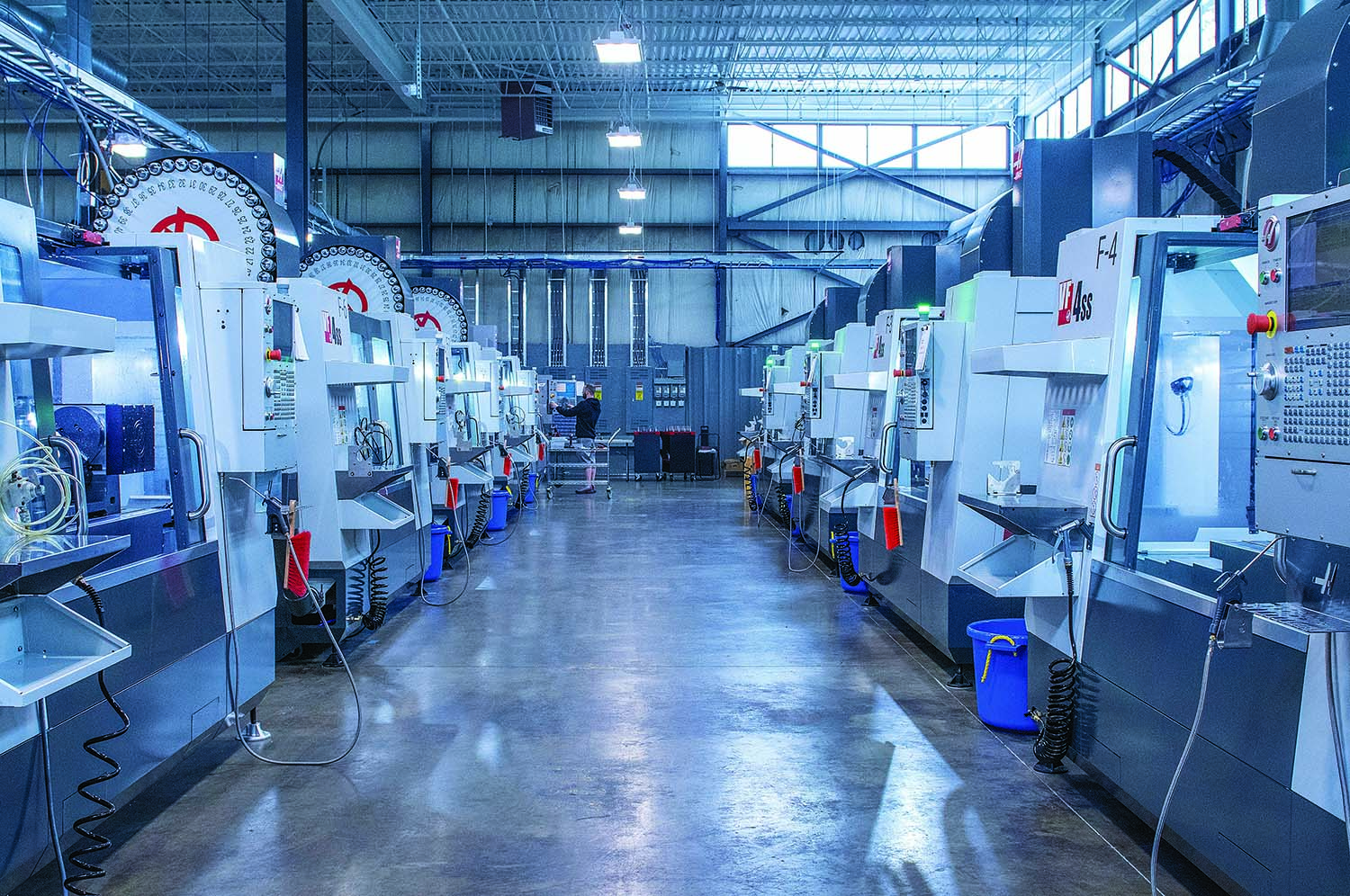
Operators at Protolabs’ largest CNC machining facility (below) can run multiple machines, thanks to physical and software error-proofing techniques aimed at ensuring repeatable processes and quality levels. Image courtesy of Protolabs
“Our homegrown software generates the G code to digitally manufacture the part before we even quote it,” Thompson said.
At a conventional machine shop, the initial stages of a job typically involve people who study the part design to produce a quote, manufacturability feedback and the computer code needed to cut the part, noted Dan Snetselaar, product sales leader for CNC machining. In addition, he said early steps in the process include obtaining material blocks close to the part size and making sure the shop has the right hardware to cut the part, as well as building custom fixtures in many cases.
Combined, these tasks can take “a lot of weeks” to complete, he said.
When Protolabs receives customers’ CAD files, by contrast, “we almost never look at drawings on the quick-turn side of things,” Snetselaar said.
In addition to automation, the company’s approach depends on tight control of manufacturing variables for the sake of speed. This means that quick-turn customers must limit themselves to the material block sizes and cutter sets available at a Protolabs factory.
Review the print ads from this magazine to continue
This quick advertiser review unlocks the rest of the article and keeps the full-screen reader focused on the ads instead of the page chrome.
Advertisers included in this article experience
Print placements connected to this article
Hainbuchamerica
The only workholding system with adaptations for O.D., I.D., and jaw clamping
TOPlus collet chuck with hexagonal configuration offers 25% increased clamping force over round versions. MANDO Adapt Mandrel-in-clamping-device for powerful I.D. clamping. Change-over to any adaptation in less than 2 minutes Chucks and adaptations are available in round or hexagonal configurations Keep the basic clamping device mounted on the machine.
The only workholding system with adaptations for O.D., I.D., and jaw clamping TOPlus collet chuck with hexagonal configuration offers 25% increased clamping force over round versions. MANDO Adapt Mandrel-in-clamping-device for powerful I.D. clamping. Change-over to any adaptation in less than 2 minutes Chucks and adaptations are available in round or hexagonal configurations
Visit Hainbuchamerica View this placement in the issue recordPrint ads from this magazine
TOPlus collet chuck with hexagonal configuration offers 25% increased clamping force over round versions. MANDO Adapt Mandrel-in-clamping-device for powerful I.D. clamping. Change-over to any adaptation in less than 2 minutes Chucks and adaptations are available in round or hexagonal configurations Keep the basic clamping device mounted on the machine.
The only workholding system with adaptations for O.D., I.D., and jaw clamping TOPlus collet chuck with hexagonal configuration offers 25% increased clamping force over round versions. MANDO Adapt Mandrel-in-clamping-device for powerful I.D. clamping. Change-over to any adaptation in less than 2 minutes Chucks and adaptations are available in round or hexagonal configurations
Continue reading
August 2023
“We ask you to fit your project into our box,” Snetselaar said.
With certain inputs fixed, the company’s CAM software can make a precise assessment of each job.
“We know exactly how long it will take to make a part, which feeds into your lead time and pricing,” Snetselaar said. “And you know that when a quote goes back to you, it is 100% accurate.”
On the downside, a machining process optimized for speed can leave leftover material for customers to deal with. But the idea is to deliver parts fast enough to make that an acceptable trade-off.
“We want the customer to be able to say, ‘You guys got me 95% of the way there. If I get (the part) today, I can clean up this one little feature,'” Snetselaar said.
Featured Facility
Protolabs’ largest CNC machining facility, a 215,000-sq.-ft. factory in Brooklyn Park, Minnesota, houses more than 300 CNC mills and lathes. Visitors to this plant see rows of machines but not many employees in the aisles. This is because each worker can run multiple machines, due in part to physical and software error-proofing techniques implemented to ensure repeatable processes and quality levels.
Although skilled machinists are on the plant floor, Snetselaar said they aren’t needed to operate the machines.
“Because we have so much automation built in to our quick-turn plant, we can use operators instead, which are much easier to come by in the market these days,” he said, adding that a single operator can run as many as 20 machines at once, depending on the workload.
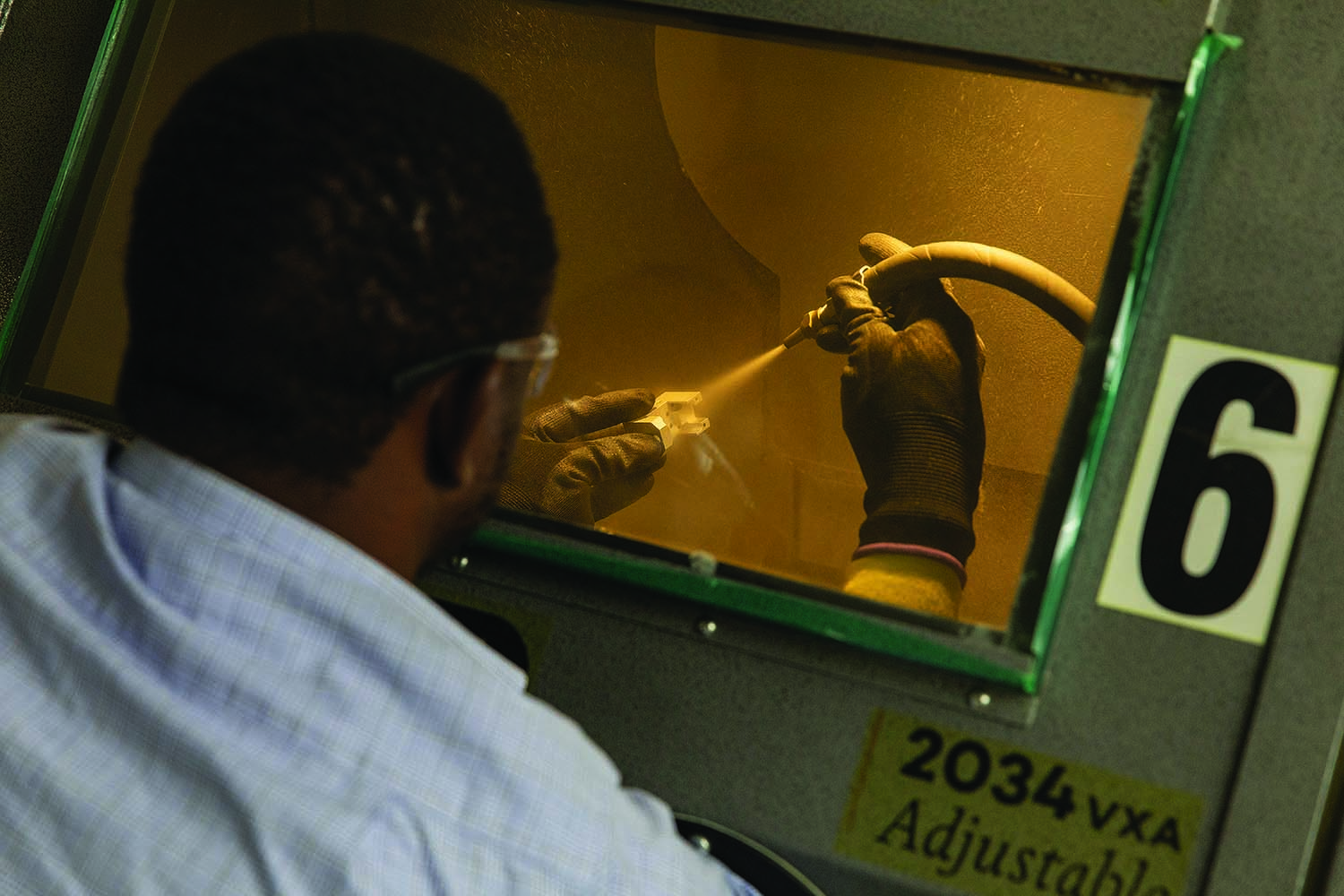
Some metal parts manufactured at Protolabs’ main CNC machining facility receive a light bead blast in the finishing area. Image courtesy of Protolabs
Since many of the more routine tasks at the plant are automated, “when we do use people, we deploy them where human insight really adds a lot of value for customers,” Thompson said. For example, “even though we digitally manufacture parts and our software automatically generates the G code, before we actually kick the job off and run it, we still want a human to review that job and the choices the system made to make sure it’s going to deliver what we promise to the customer.”
According to Protolabs, the plant can ship machined parts in as little as five hours if they are ordered early enough in the day and their geometry allows quick-turn machining. When a same-day order is received, the job is moved to the head of the production queue and chips often are being cut within 30 minutes.
Robot Rescue
Earlier this year, Protolabs’ speedy machining service saved the day for Bloodsport, a robot competing in Fight Night of BattleBots World Championship VII in Las Vegas. In its first fight, the 250-lb. robot flipped over and landed on a 3D-printed plastic housing, causing the housing to shatter. Bloodsport’s team had just 48 hours to obtain a replacement part before the next battle.
Working overnight, the team came up with a design for an aluminum part that it hoped would outperform the plastic housing. The following morning, the team sent the design to Protolabs, which had provided rapid prototyping services when Bloodsport was tested before the event.
The team “uploaded (the design) and asked, ‘Is there any way you can get this to us by tomorrow?'” Thompson said.
Protolabs made the deadline, delivering the aluminum part within 36 hours of receiving the design, he said, adding that the part held up throughout Bloodsport’s remaining bouts.
Although customers tap Protolabs’ quick-turn machining service for its speed, there have been instances when they got more speed than they bargained for.
“We’ve had times where customers placed an order and an hour later they called and said, ‘I forgot to add this feature. Can we cancel that order?’ And we said no because we were already cutting material,” Snetselaar said. “So sometimes we almost move too fast for our own good.”
For more information about Protolabs, call 877-479-3680 or visit www.protolabs.com.