



Push-button precision: General Industry Coverage
Effectively and efficiently grinding workpieces to meet tolerance requirements is no easy task. Machine operators generally don't perform the calculations for determining optimal grinding parameters because they are too complicated and instead go with the values that worked well in the past or rely on their gut feelings, according to Erhard Kämpf, head of the forms and threads department at grinding machine builder Fritz Studer AG.
Effectively and efficiently grinding workpieces to meet tolerance requirements is no easy task. Machine operators generally don’t perform the calculations for determining optimal grinding parameters because they are too complicated and instead go with the values that worked well in the past or rely on their gut feelings, according to Erhard Kämpf, head of the forms and threads department at grinding machine builder Fritz Studer AG.
“For them, it is often not possible to obtain good results in the desired time and without much optimization effort,” Kämpf said. He explained that the optimization effort involves determining what changes to make if the surface finish or roundness tolerances are not achieved. Those changes cover the dressing speed, infeed speed, spark-out time and rotation ratio of the workpiece and grinding wheel.
Courtesy of Fritz Studer
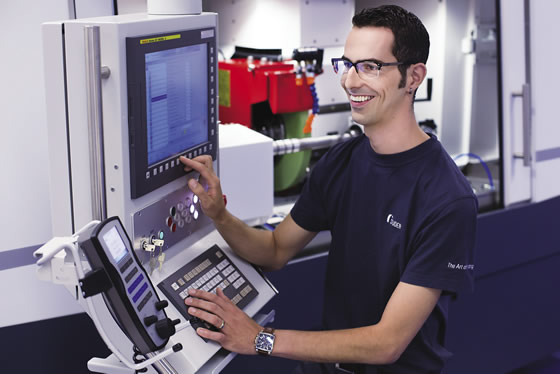
Having Studer-Technology Integrated software determine the correct grinding parameters relieves grinding machine operators from performing complex calculations.
The operator usually starts with one of these influencing factors, regrinds the workpiece and measures the part again, possibly repeating the time-consuming procedure several times until the tolerances are met. He added that most users underestimate the machining output of a wheel and, therefore, rarely dare to approach the limits of what is possible.
The task is particularly daunting when cylindrical grinding because more than 300 grinding parameters determine the process. Kämpf pointed out that in addition to the material-removal rate, feed rate for roughing, finishing and fine finishing, switching points, spark-out time and traverse speed—the most important parameters—grinding values include ones that are not often considered, such as critical speed, or integer, ratios (incorrect ratios for the number of workpiece and wheel revolutions can cause nonround diameters, such as polygons with varying numbers of lobes), part deflection and tangential force.
A new software package, StuderTechnology Integrated, overcomes this obstacle to higher productivity by performing the calculations to determine the optimal cylindrical grinding parameters based on operator entry of just a few critical process variables, such as the type of grinding wheel, workpiece material (including its hardness), and coolant, according to the company. Studer and its software partner, mcs software ag, developed the software, which is included at no additional charge in Studer grinders with StuderWIN controls.
Courtesy of Fritz Studer
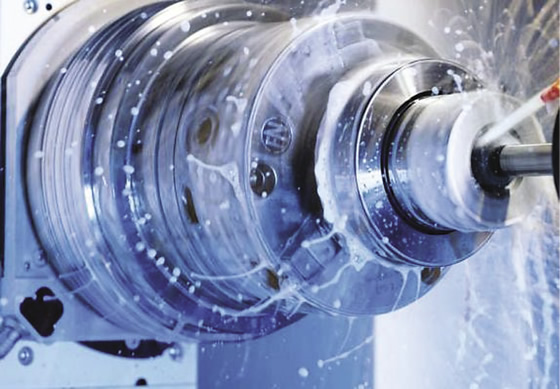
In most cases, StuderTechnology Integrated cuts cylindrical grinding time in half, according to the company.
“StuderTechnology Integrated allows shops, in most cases, to grind workpieces in half the time,” Kämpf said, adding that the return on investment for a grinder with the software is 25 percent quicker than the same grinder without it. “But because almost no optimization time is required, savings per workpiece is probably more than half.”
The company reports that the program contains the “best of cylindrical grinding” data from Studer’s nearly century of experience and that database is improved as Studer and its customers gain more process knowledge. “StuderTechnology is an open system,” Kämpf said. “The operator can accept the proposals and adapt his values at any time and save them as his own company know-how.”
According to Kämpf, because the software ensures an ideal result in a few seconds at the push of a button, operators with only a basic understanding of CNC machining can effectively run grinding machines. “They should at least know the types of workpiece materials, what heat treatment is and, roughly, the existing types of abrasives,” he said.
For more information about Fritz Studer AG, Thun/Steffisburg, Switzerland, contact United Grinding Technologies Inc., Miamisburg, Ohio, at (937) 859-1975 or www.grinding.com. For more information about mcs software ag, Bern, Switzerland, visit www.mcs.ch/en. CTE
Glossary terms in this article
Related



Subscribers can use MFGAxis notes, saves and discussion tools with their innoNET account.


