

Putting a damper on vibration
The Beach Boys may have celebrated "Good Vibrations," but people who work in the machining industry will agree that the best vibrations are no vibrations.
The Beach Boys may have celebrated “Good Vibrations,” but people who work in the machining industry will agree that the best vibrations are no vibrations.
Mass dampers traditionally have been used to reduce vibration when turning. These dampers must be tuned appropriately, however, to account for such factors as cutting speed, tool wear and the workpiece material. As a result, operators must frequently stop the machines to reset the dampers, leading to a variety of inefficiencies in the process.
These concerns have been addressed with the introduction of the Self-Tuning Mass Damper by Stockholm-based MAQ. The key to the STMD is its design. The impetus came when Qilin Fu, MAQ’s co-founder and CEO, was a doctoral student at KTH Royal Institute of Technology in Stockholm. He studied how vibration affected machining and realized there were opportunities for improvement.
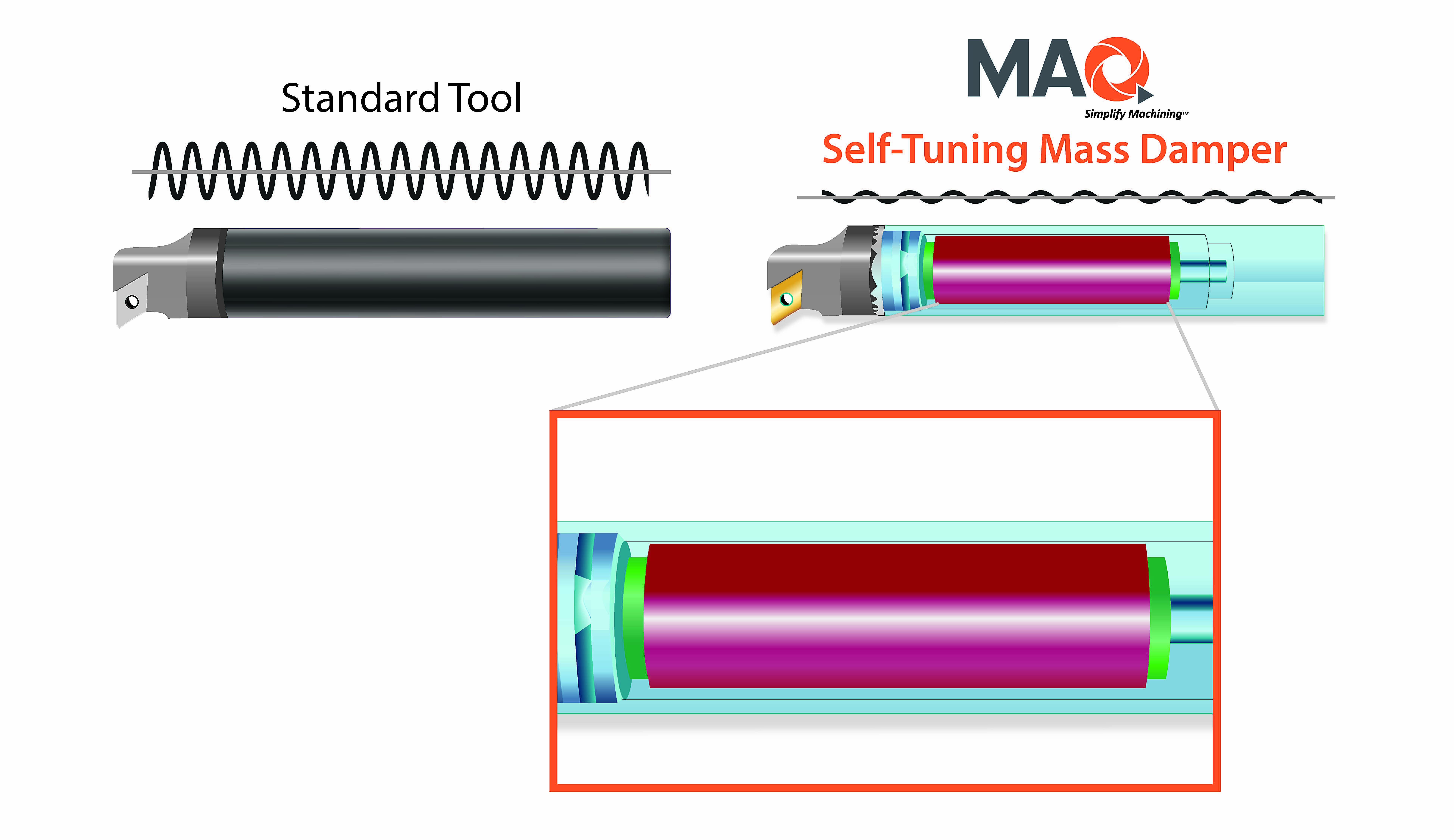
Polymer discs inside the STMD react and adjust to changes in vibration. Image courtesy of MAQ
“We had a breakthrough in 2015,” Fu said. “Using existing polymers, my colleagues and I developed methods for accurately measuring a polymer’s frequency-dependent stiffness. We found that some polymers have a substantially increased stiffness with increased frequency.”
Eventually, the team determined that a group of polymers, having a particular physical structure and chemistry, will exhibit the required frequency-dependent stiffness for mass damper applications.
Machine tools vary in size and age, and these variables influence vibration. A typical mass damper has to be tuned for each combination of those factors. The STMD is different because of the adaptability of its polymers. Inside the tool is a tungsten mass supported by polymer discs. The discs react to changes in vibration, changing their own stiffness in response and maximizing their damping effectiveness.
View print ads from this spread
Review the ads on this magazine spread to continue reading. Each ad takes two seconds; a two-page ad counts once.
Advertisers on this magazine spread
Print placements on this magazine spread
Kyoceraprecisiontools
MFH-RAPT R
DRV HIGH FEED MILLING AT ITS ABSOLUTE BEST INDEXABLE MAGIC DRILL Ø0.375"~Ø0.625" | Ø8mm~Ø16mm Ø0.625"~Ø2.000" | Ø16mm~Ø50mm Ø1.000"~Ø6.000" | Ø25mm~Ø160mm Experience the Power of the MFH High Feed Milling Cutter Family Boost productivity and reduce machining costs with the MFH-RAPTOR’s economical double-sided inserts. Covering such a.
MFH-RAPT R DRV HIGH FEED MILLING AT ITS ABSOLUTE BEST INDEXABLE MAGIC DRILL Ø0.375"~Ø0.625" | Ø8mm~Ø16mm Ø0.625"~Ø2.000" | Ø16mm~Ø50mm Ø1.000"~Ø6.000" | Ø25mm~Ø160mm Experience the Power of the MFH High Feed Milling Cutter Family Boost productivity and reduce machining costs with the MFH-RAPTOR’s economical double-sided inserts. Covering such a broad spectrum of machining operations, the MFH is an essential part to any machine shop’s cutting tool arsenal. Face Milling & Slotting Ramping Helical Milling Pocketing Contouring Shouldering
Visit Kyoceraprecisiontools View this placement in the issue recordPrint ads from this magazine
DRV HIGH FEED MILLING AT ITS ABSOLUTE BEST INDEXABLE MAGIC DRILL Ø0.375"~Ø0.625" | Ø8mm~Ø16mm Ø0.625"~Ø2.000" | Ø16mm~Ø50mm Ø1.000"~Ø6.000" | Ø25mm~Ø160mm Experience the Power of the MFH High Feed Milling Cutter Family Boost productivity and reduce machining costs with the MFH-RAPTOR’s economical double-sided inserts. Covering such a.
MFH-RAPT R DRV HIGH FEED MILLING AT ITS ABSOLUTE BEST INDEXABLE MAGIC DRILL Ø0.375"~Ø0.625" | Ø8mm~Ø16mm Ø0.625"~Ø2.000" | Ø16mm~Ø50mm Ø1.000"~Ø6.000" | Ø25mm~Ø160mm Experience the Power of the MFH High Feed Milling Cutter Family Boost productivity and reduce machining costs with the MFH-RAPTOR’s economical double-sided inserts. Covering such a broad spectrum of machining operations, the MFH is an essential part to any machine shop’s cutting tool arsenal. Face Milling & Slotting Ramping Helical Milling Pocketing Contouring Shouldering
Continue reading
January 2019
The STMD’s combination of polymers plays an important role with a key metric that affects vibration: the length-to-diameter ratio. Turning tools are set at different lengths based on the materials being machined. MAQ’s tests have shown that as the length-to-diameter ratio increases, the STMD is increasingly effective versus competitors in controlling the vibration amplitude.
The STMD is essentially plug and play, according to the company. MAQ offers the STMD in a variety of length and diameter combinations, in both metric and inch dimensions and with different-size cutter heads.
The company is growing its product line, Fu said, and is also developing tools for milling and holemaking applications. He added that MAQ wants to work with customers who need different dimensions. “We want these customers to challenge us with their custom dimensions.”
Francois Gau, MAQ’s chief marketing officer, elaborated on the quality and economic benefits. Minimizing vibration enhances the surface finish while reducing scrap and energy costs. Tool life increases because of more efficient use and less wear. These efficiencies, along with time saved from frequent tool changing, significantly lower cycle time.
“All in all,” Gau said, “the STMD can help our customers reduce their total cost of ownership by as much as 30 percent.”
For more information about MAQ, call 724-875-5358 or visit www.maqab.com.