PVD Coatings for Turning
PVD Coatings for Turning
Researchers report on their study of coating performance. Their tests of TiN, TiCN and TiAlN coatings involved turning Inconel 718, medium-carbon steel and ductile cast iron. The wear rates and failure mechanisms of the coated tools are compared.
Hard coatings have come a long way since the mid-1980s, when coated tools." title="Added to titanium-carbide tooling to permit machining of hard metals at high speeds. Also used as a tool coating. See coated tools." aria-label="Glossary: titanium nitride (TiN)">titanium nitride (TiN) was first applied by the physical vapor deposition (PVD) process on cemented-carbide cutting tools. These first-generation TiN-coated carbide tools were initially used in interrupted-cutting applications such as the milling of steels. The superior milling performance of these PVD-coated tools prompted their use in other machining applications, such as threading, grooving, parting, boring, and turning.
The continued success of PVD-coated tools led to the commercial development of second- and third-generation PVD coatings. Tools coated with titanium carbonitride (TiCN) and titanium aluminum nitride (TiAlN) offer higher hardness, toughness, and wear resistance for better machining productivity. While the superior performance of these later-generation coatings has been seen in the field, research is needed to determine exactly how these coatings enhance performance and to identify those applications and cutting conditions that benefit most from the coatings' properties. Researchers at Kennametal Inc., Latrobe, PA, have critically assessed the relative merits of PVD TiN, TiCN, and TiAlN coatings on a cemented-carbide substrate in the turning of a variety of workpiece materials. The metalcutting results are considered in relation to the physical, chemical, mechanical, and microstructural properties of the coated tools.
Putting PVD Coatings to the Test
The hard-metal composition employed for the insert substrate in this study was a WC-6% Co alloy. This material has a room-temperature hardness of 1770 HV30. The CNGP 12 04 08 inserts were manufactured by conventional powder-metallurgy techniques. The positive rake in this geometry, coupled with a sharp edge, reduces cutting forces. With PVD coating, this geometry is employed in finish-machining applications.
TiN and TiCN coatings were applied to the inserts by the ion-plating technique. A high-ionization magnetron-sputtering process was employed to deposit the TiAlN coating. All coatings had a nominal thickness of 3.0µm to 3.5µm.
| UTS (MPa) | YS (MPa) | El. (%) | H (Bhn) | |
| Inconel 718 | 1450 | 1210 | 20 | 330 |
| Medium-Carbon Steel | 730 | 450 | 24 | 210 |
| Ductile Cast Iron | 550 | 380 | 6 | 240 |
Table 1: Properties of workpiece materials tested.
The researchers evaluated the PVD-coated inserts in the turning of Inconel 718, medium-carbon steel (SAE 1045), and ductile cast iron. These materials varied widely in such properties as tensile strength, hardness, and ductility (Table 1).
The researchers machined these materials at metalcutting parameters typically used in the field. They conducted tests on Inconel 718 at speeds of 46m/min. and 76m/min., setting a feed rate of 0.15mm/rev. and a depth of cut (DOC) of 1.50mm. For medium-carbon steel, cutting speeds were 305m/ min. and 396m/min., the feed rate was 0.15mm/rev., and the DOC was 0.75mm. Ductile cast iron was tested at a speed of 244m/min., a feed rate of 0.20mm/rev., and a DOC of 1.50mm. The researchers used flood coolant in all tests.
End-of-life criteria for the tools included either crater depth exceeding 0.10mm; uniform flank wear of 0.40mm; or maximum flank wear, nose wear, or DOC notching (wear at the edge farthest from the insert nose) exceeding 0.75mm.
Taking a Closer Look
The researchers studied the PVD coatings using optical, scanning, and transmission electron microscopy (TEM) in cross section. They observed a high density of slip lines indicating plastic deformation in the WC grains adjacent to the TiCN coating. These slip lines are believed to be caused by the high residual growth stress generated in the TiCN coating during the PVD process. In contrast, the WC grains did not reveal slip-line activity in the regions adjacent to the TiAlN coating, suggesting low residual growth stress. The adhesion of the coatings to the hard-metal substrate was good, with no flaking observed in scratch adhesion tests involving loads up to 60 N.
The researchers then determined the composition of the TiCN and TiAlN coatings in the study. This is important because higher levels of carbon and aluminum can make a coating harder and more wear resistant. The TiCN coating is actually a multilayer coating with thin inner and outer layers of TiN. The approximate composition of the TiCN layer, as determined by Auger analysis, is TiC0.30.7. The approximate composition of TiAlN as determined by EDS is Ti0.55Al0.45N. These findings indicate that, in the case of TiCN, some of the nitrogen is replaced by carbon, and in TiAlN, some of the titanium is replaced by aluminum.
As expected, all three coatings showed a face-centered cubic crystal structure. The researchers examined the compressive stress generated during each coating process. It is desirable for a coating to have slightly compressive stress. They observed the highest compressive stress in the TiCN coating (3775 MPa) followed by TiN (3580 MPa). These stress values were calculated from the elastic moduli of 570 and 640 GPa for TiCN and TiN, respectively. It was not possible to obtain reliable stress measurements in the TiAlN coating because of low intensity of the high-angle X-ray peaks and lack of reliable elastic-modulus data on TiAlN. However, during TEM thin-foil preparation, TiAlN-coated foils showed much less bending than the TiN- or the TiCN-coated foils, indicating much lower compressive stress in the TiAlN coating than in the TiN or TiCN coatings.
Coatings 3.0µm to 3.5µm thick were deposited on hard-metal bars for three-point-bend transverse rupture strength (TRS) tests. The researchers observed that the TRS of the coated hard-metal test bars did not vary widely from the TRS of the uncoated WC-6% Co bar, which was 3523 ±200 MPa. In comparison, the TRS of the TiN-coated bar was 3475 ±248 MPa, the TRS of the TiCN-coated bar was 3330 ±200 MPa, and the TRS of the TiAlN-coated bar was 3379 ±276 MPa. These measurements show that the PVD coatings have no deleterious effect on the TRS of the bars. This indicates absence of gross columnar defects, porosity, or tensile stress in the coatings.
Coatings 8µm thick were deposited on test bars for Vickers microhardness measurements. The researchers made hardness measurements using a 50gf indentation load. Figure 1 shows the plot of Vickers microhardness as a function of temperature from 25° to 1000° C for the coatings. The TiCN coating has the highest hardness at room temperature, but above 750° C the TiAlN coating is harder than TiCN or TiN. At 1000° C, TiAlN is considerably harder than TiCN and TiN. The higher hardness of TiCN and TiAlN compared to TiN may be partly attributed to the effect of the solid solution of carbon or aluminum in the TiN lattice. In the TiCN coating, some nitrogen is replaced with carbon; in the TiAlN coating, some titanium is replaced with aluminum. The result is a harder coating that offers more wear resistance. In addition to the solid-solution effect, the high compressive residual stress contributes to the hardness in the TiCN coating.
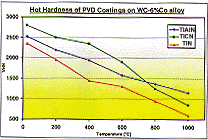 |
| Figure 1: Hot-hardness data for the three PVD coatings in the study. |
Putting the Coatings to Work
After comparing the properties of the three PVD coatings, the researchers conducted metalcutting tests on the three workpiece materials. Figure 2a shows tool life for identical carbide substrates coated with TiN, TiCN, and TiAlN in the turning of Inconel 718. At cutting speeds of 46m/min. and 76m/min., TiCN- and TiAlN-coated tools performed significantly better than TiN-coated tools. The end of tool life for all three coated tools was dictated by maximum flank wear and nose wear. Figure 2b plots maximum flank wear as a function of time at a cutting speed of 46m/min. The researchers noted the excellent resistance to maximum flank wear of the TiAlN-coated tools.
Not only did the TiAlN-coated tools show the lowest maximum flank wear, but they exhibited lower nose wear and crater wear than tools coated with TiN and TiCN. The researchers examined the used edges of the TiN-, TiCN-, and TiAlN-coated inserts after 5 minutes of cutting at 46m/min. Although the TiAlN-coated tools showed a tendency for DOC notching, the end of tool life was reached by maximum flank wear.
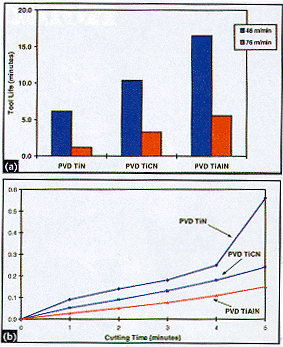 |
| Figure 2: Metalcutting test results (a) for the wet turning of Inconel 718 at speeds of 46m/min. and 76m/min., a feed rate of 0.15mm/rev., and a DOC of 1.50mm; wear curves (b) at the slower speed. |
Figure 3a shows tool life for the three PVD-coated tools in the turning of SAE 1045 at speeds of 305m/min. and 396m/ min. Again, the TiCN- and TiAlN-coated tools lasted longer. At 305m/ min., the tool life of TiAlN-coated tools exceeded 60 minutes and the test was terminated. Figure 3b plots maximum flank wear as a function of cutting time at 305m/min. As in the case of Inconel 718, the superior wear resistance of TiAlN relative to TiN and TiCN was apparent.
The researchers then examined the used edges of the tools after 15 minutes of cutting medium-carbon steel at 305m/min. They noted the excellent crater-wear resistance of the TiAlN-coated tools relative to the TiN- or TiCN-coated tools.
| Figure 3: Metalcutting test results (a) for the wet turning of medium-carbon steel at speeds of 305m/min. and 396m/ min., a feed rate of 0.15mm/rev., and a DOC of 0.76mm; wear curves (b) at the slower speed. | 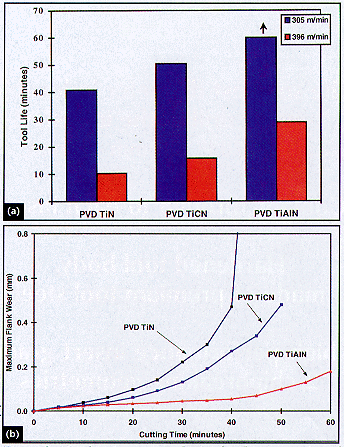 |
Figure 4a shows tool life for TiN-, TiCN-, and TiAlN-coated tools in the turning of ductile cast iron at 244m/min. Again, the TiAlN-coated tools had the longest tool life, followed by the TiN- and TiCN-coated tools. Figure 4b presents maximum flank wear as a function of cutting time. The researchers noted the improved flank-wear resistance of TiCN and TiAlN compared to TiN.
An examination of the used tool edges after 2 minutes of cutting ductile cast iron revealed results similar to those for medium-carbon steel. The TiN- and TiCN-coated tools showed more crater wear than the TiAlN-coated tools.
| Figure 4: Metalcutting test results (a) and wear curves (b) for the wet turning of ductile cast iron at a speed of 244m/min., a feed rate of 0.15mm/rev., and a DOC of 1.50mm. | 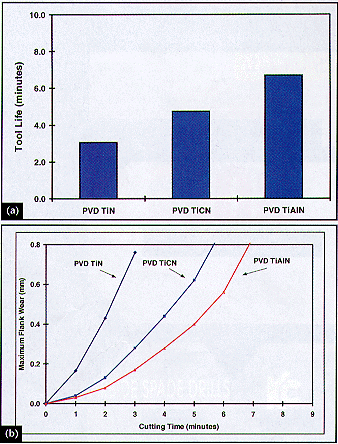 |
The researchers then sought to determine why the TiCN- and TiAlN-coated tools performed significantly better than the TiN-coated tools in the turning of all three workpiece materials in this study. They also attempted to explain why the metalcutting performance of TiAlN- and TiCN-coated tools relative to TiN was even greater at higher speeds than at lower speeds.
Wear's the Problem
The three most important material characteristics that affect machining performance of tools are fracture strength, resistance to plastic deformation, and resistance to wear (crater wear, nose wear, flank wear, and DOC notching). For a given macrogeometry and microgeometry of the tool (insert style and edge preparation), the composition and mechanical properties of the substrate typically determine the fracture strength and deformation resistance of the tool material. Since the substrate material was the same for all the coated tools, the observed differences in tool life and wear behavior cannot be ascribed to the substrate.
Coatings primarily increase wear resistance, but they may also reduce cutting forces and temperatures at the tool edge and thereby indirectly affect the deformation and fracture behavior of the tool. Unlike the PVD process, chemical vapor deposition (CVD) reduces the fracture strength of the tool material due to interfacial eta-phase formation or the presence of grown-in cracks due to tensile residual stresses in the coating. The results of the TRS tests with uncoated and PVD-coated carbide bars revealed that PVD coatings produced no degradation in fracture strength. This leads to the conclusion that tool-life differences between the PVD TiN-, TiCN-, and TiAlN-coated tools should be related to the effect of these coatings on their wear behavior and, consequently, on the deformation of the substrate.
The results of the wear-mechanisms study provide a clue to the sequence of events leading to tool-edge failure. On all three workpiece materials, cratering is observed first. Once the hard coating wears off and exposes the substrate, the tool-tip temperatures, and possibly the cutting forces, rise rapidly, leading to nose deformation and maximum flank wear.
There are several components to crater wear, including abrasive wear, dissolution wear, and diffusion wear. Abrasive wear occurs as the chip rubs on the insert. Dissolution wear is the chemical tendency of the tool material to dissolve in the workpiece. Dissolution wear must precede diffusion wear, which is the actual rate of atomic transfer between the tool and the workpiece. The degree to which the three coatings resist these components of crater wear can be related to the differences in their mechanical, chemical, and thermal properties as a function of temperature.
The TiAlN-coated tools showed the least tendency for cratering, which can be ascribed to several factors. TiAlN has significantly higher hardness than TiN or TiCN above 750° C, which will translate into improved resistance to the abrasive-wear component of crater wear for the TiAlN-coated tools.
The dissolution component of crater wear is related to the chemical stability of the coating material. Although TiAlN is thermodynamically unstable (the stable phases are mixtures of cubic and hexagonal crystals of TiN and AlN), it exhibits good high-temperature stability at the tool-tip temperatures encountered in metalcutting. (In continuous-cutting operations, the tool-tip temperatures typically exceed 900° C.)
This high-temperature stability is a result of the tendency of the TiAlN coating to form a protective outermost layer of Al2O3 and an intermediate layer comprised of titanium, aluminum, oxygen, and nitrogen during the machining operation, leading to higher oxidation resistance.
Chemical dissolution of the tool material into the workpiece becomes a significant wear mechanism, especially at high temperatures. Other researchers have predicted the relative dissolution-wear rates of the various coating materials in ferrous workpieces and shown that the dissolution rates of Al2O3 and TiN are six and two orders of magnitude lower, respectively, than TiC at 900° C. The higher crater-wear resistance of Al2O3 over TiN can thus be expected from the above differences in dissolution rates. The higher crater resistance of the TiCN coating compared to TiN can be attributed to the significantly higher resistance to the abrasive-wear component of the TiCN coating.
Finally, TiAlN has been shown to have the lowest thermal conductivity among the three coatings. This should result in lower tool-tip temperatures, as much of the heat generated during machining would be carried away by the chip. As a result, the TiAlN coating imparts excellent crater-wear resistance and consequently longer life.
This study has demonstrated that the high compressive residual stresses in ion-plated PVD TiN- and TiCN-coated tools retard premature tool-edge chipping, thereby providing consistent tool life. While the effect of compressive residual stresses may be less important in continuous turning operations than in milling applications, they play a beneficial role in retarding abrasive wear and DOC notching. This study also has shown the decreased tendency for DOC notching for TiN- and TiCN-coated tools in the machining of Inconel 718.
The researchers concluded that the tool-life improvement in TiAlN-coated tools results from retardation of dissolution wear as well as abrasive wear. In TiCN-coated tools, the abrasive-wear resistance predominates. The superior tool life of TiCN- and TiAlN-coated tools over TiN-coated tools can be partly attributed to the solid-solution strengthening effect of either carbon or aluminum in the TiN lattice. In the case of TiAlN coating, not only is the hot hardness increased due to solid-solution strengthening, but the substituting aluminum atom imparts higher chemical stability through the formation of a stable Al2O3 layer. These characteristics can, in turn, endow the coated tool with higher resistance to abrasive wear and dissolution wear, thereby providing longer tool life and higher speed capability on a broad range of workpiece materials.
About the Authors
P.C. Jindal is staff engineer, A.T. Santhanam is manager of carbide insert product development, A.F. Shuster is staff engineer, and B.K. Marsh is cutting edge scientist, field sales, at Kennametal Inc., Latrobe, PA. U. Schleinkofer was senior engineer at Kennametal at the time the paper was written. This article is based on a paper accepted for publication in "Proceedings of the Sixth International Conference on the Science of Hard Materials" and will be published in the International Journal of Refractory Metals and Hard Materials.
The authors gratefully acknowledge the contributions of Loretta Bell in the SEM study and Mary Carroll in the hot-hardness and optical microstructural evaluation. The critical review of the manuscript by Bill Bryant and Bernard North is greatly appreciated.