

Researchers focus on 3D repair
Conventional metal 3D-printed repair of damaged mechanical parts in machines requires bulky equipment and wastes metal powder. Although laser-directed energy deposition, or LDED, overcomes this challenge, the optimum forming conditions had to be determined hitherto by trial and error.
Conventional metal 3D-printed repair of damaged mechanical parts in machines requires bulky equipment and wastes metal powder. Although laser-directed energy deposition, or LDED, overcomes this challenge, the optimum forming conditions had to be determined hitherto by trial and error.
To this end, a team of researchers from Tokyo University of Science has developed a numerical method that automatically generates metal powder deposition elements and predicts forming process conditions, temperature distribution, the deformation state and residual stress distribution.
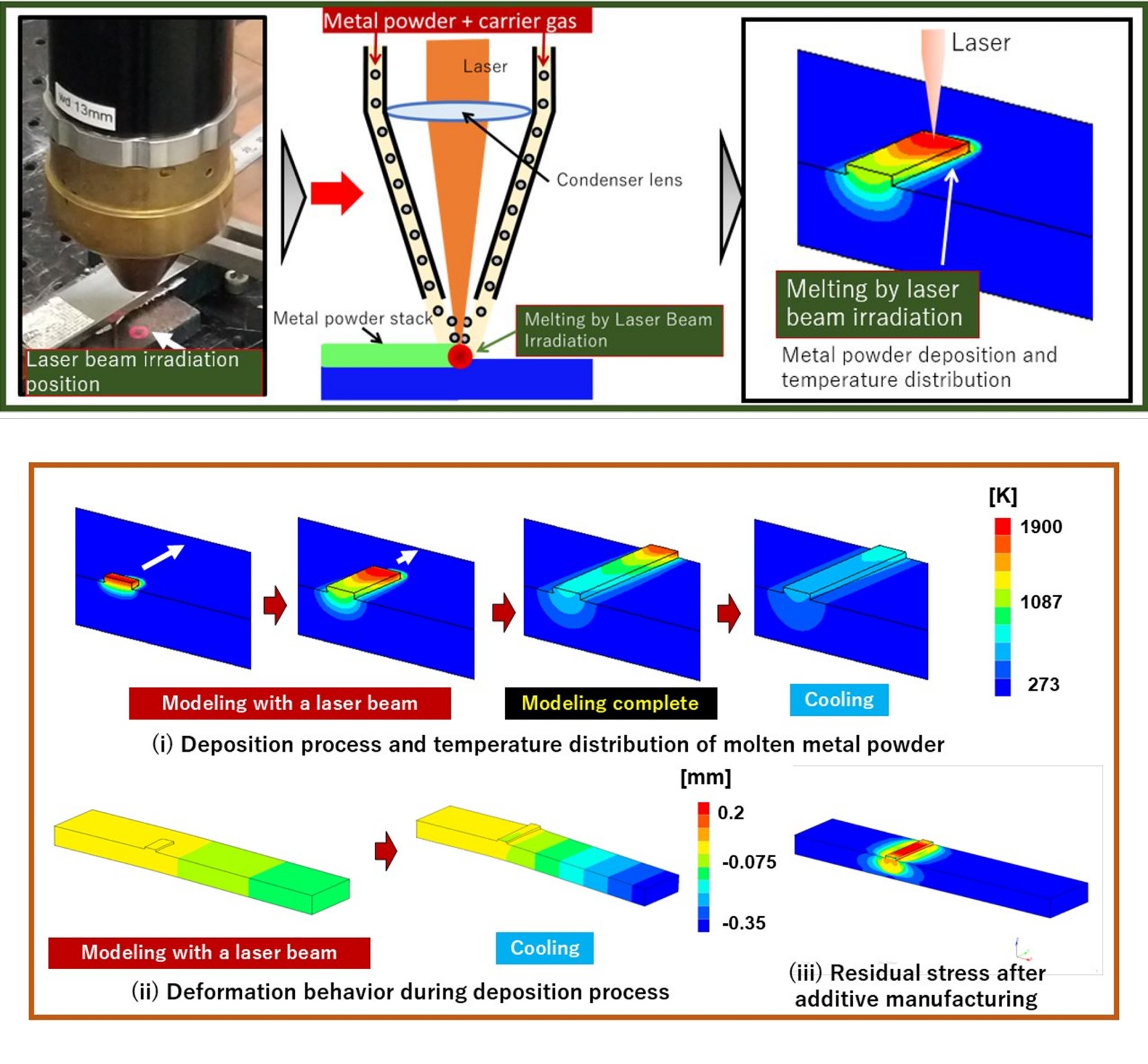
The research team demonstrated that LDED is superior to other repair methods in terms of interfacial strength and mechanical properties. Image courtesy of Masayuki Arai/Tokyo University of Science
Mechanical parts in industrial machinery and structures that develop thinning or cracks need to be replaced with new parts. In recent years, attempts at repair have been considered in relation to improving industrial sustainability. So repair technology for machines has been a hot topic of research and development.
Review the print ads from this magazine to continue
This quick advertiser review unlocks the rest of the article and keeps the full-screen reader focused on the ads instead of the page chrome.
Advertisers included in this article experience
Print placements connected to this article
Komaprecision.Com / 1-800-249-5662
Fanuc America
A CRX cobot is connected to a machine with Fanuc controls, and software simplifies robot integration and startup. ROTARY TABLES UNLOCK YOUR POTENTIAL TODAY! 20 MAY 2023.
Fanuc America A CRX cobot is connected to a machine with Fanuc controls, and software simplifies robot integration and startup. KOMAPRECISION.COM / 1-800-249-5662 ROTARY TABLES UNLOCK YOUR POTENTIAL TODAY! 20 MAY 2023
Visit Komaprecision.Com / 1-800-249-5662 View this placement in the issue recordPrint ads from this magazine
A CRX cobot is connected to a machine with Fanuc controls, and software simplifies robot integration and startup. ROTARY TABLES UNLOCK YOUR POTENTIAL TODAY! 20 MAY 2023.
Fanuc America A CRX cobot is connected to a machine with Fanuc controls, and software simplifies robot integration and startup. KOMAPRECISION.COM / 1-800-249-5662 ROTARY TABLES UNLOCK YOUR POTENTIAL TODAY! 20 MAY 2023
Continue reading
May 2023
Conventional metal 3D-printed fabrication uses the surface of a mechanically laid powder bed that is irradiated with a laser or electron beam to melt the metal particles and fuse them. However, this method requires bulky fabrication equipment. Also, a large amount of metal powder is disposed after the fabrication process.
LDED is a promising technology that overcomes the challenges. With this technique, metal powders are deposited at the focus of a laser beam, then melted and stacked.
The advantages of LDED are related not only to the compactness of the equipment but to the significant reduction of metal powder waste. Furthermore, this technology enables in-situ metal powder fabrication in a 3D shape on the surface of a substrate. This means that the process can be used to repair machines made of metal as well.
— Tokyo University of Science
Glossary terms in this article
Related



Subscribers can use MFGAxis notes, saves and discussion tools with their innoNET account.


