



Reverse-engineered parts hit the highway
Ensure custom motorcycle parts still seamlessly interface with OEM models after converting them from composites to metal. Scanning and CAD modeling services.
END USER: Misfit Industries, (877) 647-3489, www.misfitindustries.net.
CHALLENGE: Ensure custom motorcycle parts still seamlessly interface with OEM models after converting them from composites to metal.
SOLUTION: Scanning and CAD modeling services.
SOLUTION PROVIDER: NVision Inc., (972) 393-8000, www.nvision3d.com.
To reduce labor costs and production lead time, Misfit Industries converted many of its custom motorcycle parts from composites to die cast aluminum and steel. The Plano, Texas, company provides parts for custom Harley-Davidson touring models known as “baggers.” According to the company, it engineers its products for an ideal fit that are used to create “radical” machines that turn heads.
In the past, Misfit built most of its parts by manually laying composite fibers on a mold and spreading resin over the fibers. This was a labor-intensive process that consumed 6 to 8 weeks, and many customers did not want to wait that long for parts.
Images courtesy Misfit Industries
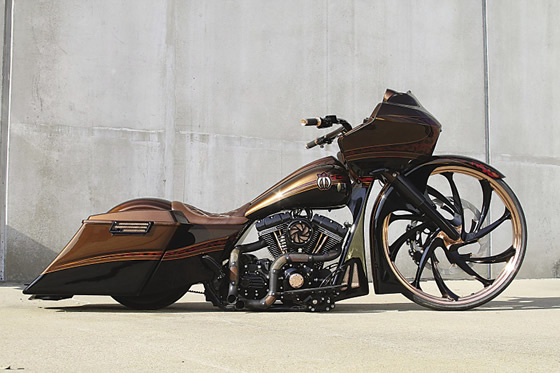
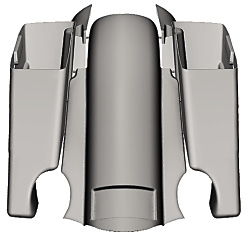
Brennivin bags from Misfit Industries are installed on a Sick CVO motorcycle. Below: A 3D rendering shows Misfit Industries’ Brennivin Real Steel saddlebag kit.
However, switching to aluminum and steel required the company to redesign its entire product line, noted Chris Eder, president of Misfit Industries. “We needed precise CAD models of each of our parts to provide to the company that builds the dies,” he said. “The CAD models were often not available. Using conventional engineering methods to create them would have been very expensive and time-consuming. We also ran the risk that the final parts might not fit perfectly, an unwelcome scenario that would have required expensive repairs to the dies.”
What Misfit needed was an efficient way to reverse engineer the parts at a reasonable cost. As a result, Misfit contacted NVision Inc., Coppell, Texas, to provide laser scanning and CAD modeling services and help Misfit reverse engineer the previous-generation parts, factory parts and sections of the motorcycles that interface with the parts. For example, to redesign the fenders, NVision engineers scanned a factory fender to identify the exact position of its mounting holes. They also scanned the motorcycle’s wheel to derive its true horizontal and vertical radius. Next, they scanned the previous-generation Misfit fender to obtain its specific styling and geometry. Then the engineers converted the data produced by scanning into surface models. Finally, the three surface models were combined in an assembly to create a new fender design that precisely mated to the frame and matched the existing Misfit design.
The resulting CAD models went to the die maker, substantially compressing the design cycle. “Our engineering team reviewed and polished the final designs and provided them to a supplier who built the dies to produce the parts,” Eder said. “The new parts provide a perfect fit and are considerably less expensive and time-consuming to manufacture than the previous generation. The key to success in this application was the use of NVision’s engineering services to quickly and accurately reverse engineer the motorcycle, factory parts and our own previous-generation parts.”
Related



Subscribers can use MFGAxis notes, saves and discussion tools with their innoNET account.


