Sawing In-House vs. Outsourcing: What Shops Should Consider
Sawing In-House vs. Outsourcing: What Shops Should Consider
An increasing number of shops are purchasing saws and bringing their cutoff operations in-house. This article discusses the benefits of such a move and explains the factors that must be considered before selecting a saw. Blade selection is also discussed.
Some machine shops that need to saw materials are faced with a dilemma: Should they send their sawing jobs to an outside service center or buy a saw and do the work in-house? It's a tough choice, since each option has its advantages and disadvantages.
Some shops find it easier to send their jobs to a sawing service center. The costs are presented up-front, and there's no long-term investment in machinery or personnel. However, this option does eat up valuable time, and working with outside contractors can be a hassle.
In-house sawing, on the other hand, offers faster turnaround times and convenience. But the initial expense of setting up an in-house operation can be intimidating, especially after factoring in costs such as personnel and material-handling equipment.
Despite the costs, though, more and more companies are finding that in-house sawing saves them money in the long run.
Weighing the Benefits
Companies that have moved their sawing operations in-house report that the advantages of doing so include convenience, flexibility, overall cost savings, and shorter turnaround times for their customers.
Hommer Tool and Mfg. Inc., an Arlington Heights, IL-based job shop, used to send out its sawing jobs. In 1997, the company purchased an NC saw and started doing the work in-house in order to save time.
"Not only is our delivery time shorter," says Hommer machinist Robert Skaja, "but now we have better control of the length of parts for secondary machining." Skaja says that the 17-year-old company is already seeing a return on its investment in the saw, and that everyone is pleased with the results, including Hommer's customers.
Charlie Yates, a Lenox representative for American Saw & Mfg. Co., East Longmeadow, MA, says that this happens frequently. Many shops that he deals with are skeptical about the initial investment, which can range from $1500 to $150,000, depending upon the shop's needs and current capabilities. However, most shops find these costs worthwhile, because the payoff is definitely there in the long run—for the shop and for its customers.
One of the reasons that sawing in-house does end up saving shops money is that in-house operators can cut the material to size on an as-needed basis (Figure 1). If a shop relies on a sawing service center for short-run, quick-turnaround service, says Yates, its costs are tremendous.
The combination of all of these benefits is incentive enough for many shops to seriously consider purchasing one or more saws. However, it's important to be aware of the potential problem areas, also.
According to Yates, one of the most frequently overlooked issues when making the move to in-house sawing is the cost of material-handling equipment. Many people don't think about getting the material to and from the saw, since it's something that they've never had to worry about before. "Just because you buy a saw doesn't mean you're ready to start cutting," says Yates. "You have to remember to plan for the cranes, hoists, and forklifts that will move the material to and from the machinery."
Another area of concern is the additional staff needed to operate the saw and handle the material. This can be a major investment for a smaller shop, since it usually means the addition of at least one full-time employee. Shops that move their sawing operations in-house often experience a transition period as their employees learn about the machinery and the sawing process. They can expect to gain more productivity after this initial learning stage is over and their staff becomes more knowledgeable.
There's also the matter of meeting customers' demands for tight-tolerance parts. Shops that perform their sawing jobs in-house can't always cut materials as accurately as service centers that specialize in this work.
All of these issues are only problems if a shop does not plan for them before beginning to saw in-house. It's usually helpful to talk to sawing experts, such as manufacturers' representatives or customer-service personnel. Another option is to seek advice from a shop that has already brought its sawing in-house.
Buying a Saw
If you decide to move your sawing operation in-house, you'll be joining others who have made the same decision recently. Yates says that he has seen an increase in the purchase of saws over the last three years. He suspects that the current low prices of saws manufactured by domestic companies are enabling companies to update their machinery. In addition, domestic companies are also offering saws with more features, such as swivel heads that provide more cutting-angle options.
"Domestic manufacturers are providing what the metalworking industry needs: convenience and capacity," says Yates. "I believe that this has allowed more shops to purchase saws during the last several years, and that the trend will continue for quite some time."
Before purchasing a saw, carefully consider your needs. For example, think about the sizes and types of materials that you cut. Will you be cutting hard metals or soft metals? The differences in saw capacities can be extreme.
More importantly, cautions Yates, you must think about whether your needs will be changing several years from now. "Many people think that if they need to cut 9" now, they should buy a saw with a 9" capacity," says Yates. "Then two or three years down the road, they need to cut 12" or 13", but their saw can't handle it and they're stuck."
Yates also warns that you should do some research or talk to people who are knowledgeable about sawing before you purchase anything. Many shops who don't do this end up buying a saw that is incapable of doing what they want it to do.
For example, some people only look at the size of stock a saw can handle. However, careful analysis of the saw's blade speed, feed rate, and other specifications is crucial for maximum performance.
Choosing Blades
Whether sawing in-house or at a service center, the right blade can be crucial to ensuring the profitability of your operation. The blade should be specifically designed for the application. A better, more expensive blade is sometimes more cost-effective than a cheaper blade, especially when a shop does high-volume sawing.
Cutting mild to moderate steels is one of the most common applications. For these steels, bimetal blades with cobalt-HSS edges exhibit good wear life.
The tooth configuration is also essential to effective cutting. A blade with a positive-rake tooth effectively penetrates solid materials with mild to moderate machinability. A positive rake also promotes faster cutting rates, resulting in higher productivity and a lower cost per cut.
One saw-blade manufacturer has studied the most common reasons for blade failure. Its study shows that blades that cut solids well are less effective at cutting structurals, such as I-beams (Figure 2). The findings also show that the primary reasons shops change saw blades are broken blades, blades cutting out of square, blade pinching, chipped teeth, and stripped teeth.
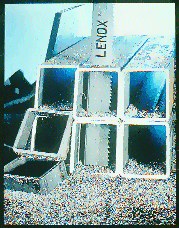
Figure 2: It's important to choose the right blade for each job. A bandsaw blade cutting a structural is shown here.
Most serious blade problems occur because of a single tooth—a fractured tooth edge, for example—or a crack in the gullet. A crack in the gullet might travel straight across the blade, causing it to break. A tooth-edge fracture might chip the tooth, prompting the blade to vibrate and cut out of square. One chipped tooth can also put more stress on the other teeth, prompting several teeth in a row to break or strip.
Some blades are designed specifically to resist fatigue and wear. They're recommended for shops that make a lot of interrupted cuts. Computer-aided design and finite element analysis (to determine where stress occurs in the blade) have facilitated the development of stronger tooth forms. These tooth forms do not fracture easily, meaning they are more resistant to chipping and stripping and are less likely to cut out of square.
Newer blades designed for sawing pipe and tubing feature an improved edge-material composition that maintains sharpness longer and minimizes the force needed for cutting. Maintaining a low cutting force results in less stress on the blade. This lessens the chance of blade failure by preventing an initial crack from forming.
Besides a strengthened tooth form and new edge composition, another feature that can vastly improve the sawing of some tubing and structurals is an extra-heavy set. "Set" refers to the bending of the teeth to the left or to the right to allow clearance of the back of the blade through the cut. An extra-heavy set primarily helps eliminate blade pinching.
For cutting solids, ground-tooth blades last longer and cut with greater accuracy than milled blades. Materials with moderate machinability, or tougher aerospace alloys, can be cut more easily with ground-tooth blades. Users will find they can cut more smoothly without having to repeatedly change blades.
Blades that are manufactured by a grinding process have greater tooth accuracy than those produced by the more common milling process. Creep-feed grinding produces a more accurate tooth height and makes a tooth less likely to chip. Saws with ground teeth have sharper cutting edges and more precise, repeatable gullet forms. When cutting tough steel alloys, a saw with a ground-tooth profile delivers up to 25% longer life than the best milled bimetal blade.
Besides the type of saw and blades you use, there's a lot to consider when setting up a successful in-house sawing operation. Careful planning is the key. Your success will depend on thorough research, an honest assessment of your needs, and realistic expectations.
CUTTING TOOL ENGINEERING would like to thank Ann Rooke, communications coordinator at American Saw & Mfg. Co., East Longmeadow, MA, for her contributions to this article.