


Self-aware roughing toolpaths
The Get With The Program column for the October 2011 issue of Cutting Tool Engineering magazine discusses Mastercam's Dynamic Mill, which offers self-aware roughing toolpaths.
As you’re probably aware, the following scenario is quite common. A tooling sales rep installs the so-called “latest and greatest” cutting tool in a shop’s best vertical mill. He clamps a perfectly straight-sided block of tool steel onto the table and drives the tool to a position 1 ” deep with a 0.050 ” step-over into the block. He revs the tool to 12,000 rpm and sends it down that straight path, ripping out a large swath of material at a blinding speed. “Look how fast that tool can go,” he boasts.
Perhaps the first time you saw this demo you purchased the tool and vowed to use it to enhance the material-removal rate on your most roughing-intensive work. If so, it’s a good bet you broke the tool, damaged the part or even overloaded the machine. This happens so frequently that most machinists err on the side of being overly conservative when roughing. After all, roughing is only a small part of the total machine cycle for most parts.
The problem with the demo was not the tool—it probably was as good as the vendor claimed. However, it was demonstrated in ideal conditions where straight sides and no turns resulted in constant tool load. In a shop’s real and imperfect world, cutters are constantly changing direction and entering curves and corners where tool load can spike in the blink of an eye. In the past, CAM programmers spent a lot of time calculating and programming toolpaths to compensate for continually shifting tool loads. Shops could only afford to invest in this programming time to reduce cycle time for parts with long production runs, since shorter runs would not produce enough in savings to justify the programming expense.
Eventually, CAM vendors developed bandages that helped programmers overcome some of the most troublesome areas. For example, “trachoids,” or tiny circular loops, nibble away material on sharp curves and corners. These gizmo algorithms allowed programmers to make fine adjustments so tools ran at optimal speeds without getting buried.
A better approach, however, would be to use “self-aware” toolpaths in which an algorithm in the toolpath does everything to keep a continually sprinting and looping tool under constant load as if cutting a straight edge. A self-aware toolpath not only detects impediments to operating at optimal cutting speeds and tool loads, but also makes adjustments to correct for them. This would make it possible for every CAM program to deliver optimal cutting performance without the programmer having to make time-consuming micro-adjustments.
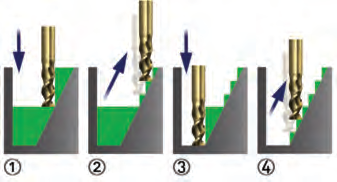
Courtesy of CNC Software
Mastercam X5’s OptiRough approach drives the tool to the full flute depth and uses the Dynamic Mill algorithm to machine the largest possible conical area. Once the tool roughs this area, it proceeds to step up in a series of small increments and machine the material remaining on the sides at each interval.
View print ads from this spread
Review the ads on this magazine spread to continue reading. Each ad takes two seconds; a two-page ad counts once.
Advertisers on this magazine spread
Print placements on this magazine spread
800.521.9520 | mscmetalworking.com
MILLING • HOLEMAKING
THREADING • INDEXABLE For over 60 years, Hertel has been providing the metalworking industry with unsurpassed value. Hertel cutting tools are ideal for general machining applications and come in a wide variety of styles and sizes. Available exclusively at MSC Industrial Supply Co.® South-Tec 2011 • October 11-13 • Charlotte, NC • See us in Booth #936.
MILLING • HOLEMAKING THREADING • INDEXABLE For over 60 years, Hertel has been providing the metalworking industry with unsurpassed value. Hertel cutting tools are ideal for general machining applications and come in a wide variety of styles and sizes. Available exclusively at MSC Industrial Supply Co.® 800.521.9520 | mscmetalworking.com
Visit 800.521.9520 | mscmetalworking.com View this placement in the issue recordPrint ads from this magazine
THREADING • INDEXABLE For over 60 years, Hertel has been providing the metalworking industry with unsurpassed value. Hertel cutting tools are ideal for general machining applications and come in a wide variety of styles and sizes. Available exclusively at MSC Industrial Supply Co.® South-Tec 2011 • October 11-13 • Charlotte, NC • See us in Booth #936.
MILLING • HOLEMAKING THREADING • INDEXABLE For over 60 years, Hertel has been providing the metalworking industry with unsurpassed value. Hertel cutting tools are ideal for general machining applications and come in a wide variety of styles and sizes. Available exclusively at MSC Industrial Supply Co.® 800.521.9520 | mscmetalworking.com
Continue reading
October 2011
In 2009, Mastercam X developer CNC Software Inc. introduced the Dynamic Mill algorithm for 2-D pocketing within areas bounded by straight, 90° walls. Unlike conventional roughing that zigzags across the material while deeply engaging only the tip of the flute, Dynamic Mill can apply the entire flute length at a high spindle speed and feed but with tiny step-overs.
The toolpath protects the tool and machine by monitoring the condition of the material at every stage of the machining process and adjusting the toolpath according to what is ahead, as well as adjusting the feeds and speeds for air moves to continuously keep tool load constant and within safe limits. These toolpaths tend to be smoother and more continuous. Using this approach, alternate tool motion, such as trachoids, becomes less necessary to reduce tool loads.
With the release of Mastercam X5 in 2010, Dynamic Mill was expanded to allow 3-D, full-flute roughing of areas with slanted walls. This OptiRough approach drives the tool to the full flute depth and uses Dynamic Mill to machine the largest possible conical area. Once this area has been roughed, the tool proceeds to step up in a series of small increments and machine the material remaining on the sides at each interval. By stepping up instead of stepping down, the tool engages as much of the flute as possible at each Z-axis interval.
Lab trials and user reports confirmed that this full-flute approach reduces roughing cycle times 10 to 70 percent. With self-aware, full-flute roughing, the spindle travels shorter distances to perform the same amount of work. In one case, 45,000 linear inches of travel to rough a part with conventional approaches was reduced to 16,000 linear inches. In combination with reduced tool load, this approach reduces machine wear.
The next generation of CAM software will provide more self-aware toolpaths. For example, Mastercam’s next release will extend the Dynamic Mill Motion concept to 3D HST OptiArea roughing, OptiCore roughing and OptiRest roughing.
Regardless of your company’s approach to incorporating new machining technologies, it’s important to monitor emerging CAM developments. Once the developments are on your radar screen, it’s likely you will find they are worth implementing as quickly as possible. CTE
About the Author: David Conigliaro is product manager for CNC Software Inc., Tolland, Conn. For more information about the company’s Mastercam CAM software, call (800) 228-2877, visit www.mastercam.com or enter #350 on the I.S. Card.
Glossary terms in this article
Related


Subscribers can use MFGAxis notes, saves and discussion tools with their innoNET account.