

Shape-shifting ceramics: Medical Manufacturing
An international team of researchers from University of Minnesota, Twin Cities, and Kiel University in Germany has discovered a path that could lead to shape-shifting ceramic materials. This discovery could improve everything from medical devices to electronics.
An international team of researchers from University of Minnesota, Twin Cities, and Kiel University in Germany has discovered a path that could lead to shape-shifting ceramic materials. This discovery could improve everything from medical devices to electronics.
Anyone who ever has dropped a coffee cup and watched it break into several pieces knows that ceramics are brittle. Subject to the slightest deformation, they shatter. However, they are used for more than dishes and bathroom tiles. Ceramics are used in electronics because, depending on their composition, they may be semiconducting, superconducting, ferroelectric or insulating. Ceramics are also noncorrosive and used to make a wide variety of products, including spark plugs, fiber optics, medical devices, space shuttle tiles, chemical sensors and skis.
Shape memory alloys are on the other end of the materials spectrum. They are some of the most deformable or reshapable materials known. Shape memory alloys rely on this tremendous deformability when functioning as medical stents, which are the backbone of vibrant medical device industries in the Twin Cities and Germany.
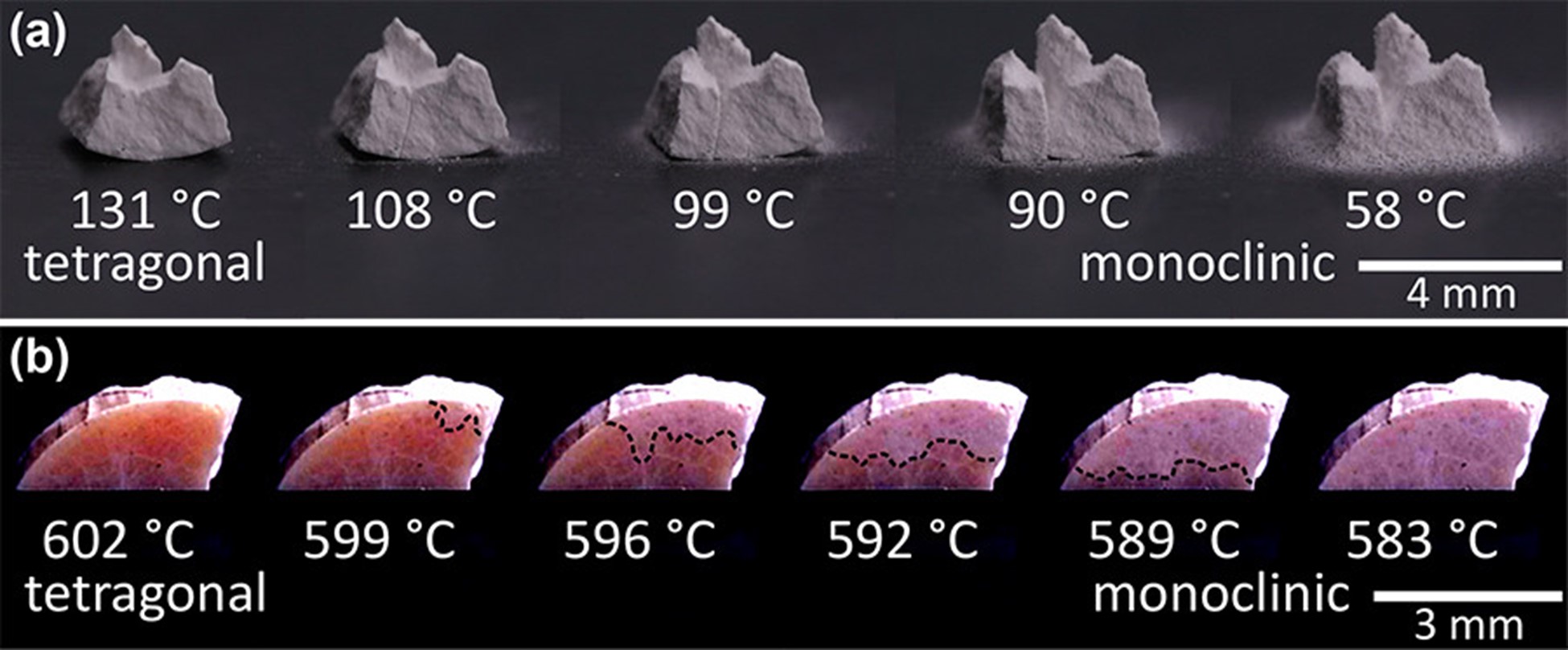
Creating shape-shifting materials is not an easy process. It involves a delicate tuning of the distances between atoms by compositional changes so the two phases fit together well. This diagram shows what happened when researchers implemented this recipe with one sample of ceramic material. Instead of improving deformability of the ceramic, they observed that some specimens gradually fell apart into a pile of powder, a phenomenon they termed “weeping.” Image courtesy of Hanlin Gu et al., University of Minnesota and Kiel University
The origin of this shape-shifting behavior is a solid-to-solid phase transformation. Different from the process of crystallization-melting-recrystallization, crystalline solid-solid transitions take place solely in the solid state. By changing temperature or pressure, a crystalline solid can be transformed into another crystalline solid without entering a liquid phase.
Review the print ads from this magazine to continue
This quick advertiser review unlocks the rest of the article and keeps the full-screen reader focused on the ads instead of the page chrome.
Advertisers included in this article experience
Print placements connected to this article
MazakUSA.com/Financing
BRING IT ON
Affordability with Uncompromised CAPITAL EQUIPMENT FINANCING Get approved today Quality and Performance with Mazak’s flexible Mazak’s new Ez Series gives you uncompromised machining performance financing plans. and reliability coupled with the programming flexibility and ease-of-use of the Learn more at MAZATROL SmoothEz control package. All backed by the industry’s best service.
BRING IT ON Affordability with Uncompromised CAPITAL EQUIPMENT FINANCING Get approved today Quality and Performance with Mazak’s flexible Mazak’s new Ez Series gives you uncompromised machining performance financing plans. and reliability coupled with the programming flexibility and ease-of-use of the Learn more at MAZATROL SmoothEz control package. All backed by the industry’s best service MazakUSA.com/Financing and support and available at a new affordable price point you can’t pass up.
Visit MazakUSA.com/Financing View this placement in the issue recordPrint ads from this magazine
Affordability with Uncompromised CAPITAL EQUIPMENT FINANCING Get approved today Quality and Performance with Mazak’s flexible Mazak’s new Ez Series gives you uncompromised machining performance financing plans. and reliability coupled with the programming flexibility and ease-of-use of the Learn more at MAZATROL SmoothEz control package. All backed by the industry’s best service.
BRING IT ON Affordability with Uncompromised CAPITAL EQUIPMENT FINANCING Get approved today Quality and Performance with Mazak’s flexible Mazak’s new Ez Series gives you uncompromised machining performance financing plans. and reliability coupled with the programming flexibility and ease-of-use of the Learn more at MAZATROL SmoothEz control package. All backed by the industry’s best service MazakUSA.com/Financing and support and available at a new affordable price point you can’t pass up.
Continue reading
May 2022
In this new research, the route to producing a reversible shape memory ceramic was anything but straightforward. Researchers first tried a recipe that has worked for the discovery of metallic shape memory materials. That involves a delicate tuning of the distances between atoms by compositional changes so the two phases fit together well. Scientists implemented this recipe, but instead of improving deformability of the ceramic, they observed that some specimens exploded when passing through the phase transformation. Others gradually fell apart into a pile of powder, a phenomenon that researchers termed “weeping.”
With yet another composition, researchers observed a reversible transformation, easily transforming back and forth between the phases, much like a shape memory material. The mathematical conditions under which reversible transformation occurs can be applied widely and provide a way forward toward the paradoxical shape memory ceramic.
“We were quite amazed by our results,” said Richard James, co-author of the study and distinguished McKnight university professor at University of Minnesota’s department of aerospace engineering and mechanics. “Shape memory ceramics would be a completely new kind of functional material. There is a great need for shape memory actuators that can function in high temperature or in corrosive environments. But what excites us most is the prospect of new ferroelectric ceramics. In these materials, the phase transformation can be used to generate electricity from small temperature differences.”
— University of Minnesota
Glossary terms in this article
Related




Subscribers can use MFGAxis notes, saves and discussion tools with their innoNET account.


