



Simulating tool functionality
Get With The Program column from January 2010 issue of Cutting Tool Engineering magazine.
Single-example products, such as tools, molds and dies, or production-run goods, such as high-volume machined components, are often developed via trial and error. That’s an expensive hit-and-miss journey that some call “R&D.”
In this pricey, scattershot approach, prototypes are manufactured for testing, the results of which are then used to alter materials or designs. New prototypes are subsequently further tested—again and again—until a satisfactory outcome is reached. This physically iterative approach to product development delays entry to market. Additionally and most importantly, any evaluation after prototyping adds costs to program budgets. In the end, using computer-aided engineering (CAE) or finite element analysis (FEA) after the fact (when troubleshooting) gives rise to margin-crushing inefficiencies, wasted materials, lost time and schedules, expensive energy inputs and missed market opportunities, while constraining design creativity. In contrast, when used properly CAE and FEA allow for early feasibility assessment and optimization of products and assemblies before any metal is cut.
Successful new product development integrates materials and simulation technologies. A product concept can be effectively evaluated on the screen prior to developing prototypes. In addition, materials, designs, assembly and field functionality can be altered at will until an optimal solution is achieved. This virtual approach allows the generation of rich, detailed and revealing behaviors of complex materials and products. Besides, validation ought to go beyond simple pass-or-fail gauging and into correlating numerical predictions to “real life” for future use of similar models.
In addition, tool, mold and die makers and part manufacturers must continuously enhance quality, reduce costs and accelerate their product delivery processes. Still, despite these imperatives, many tool, mold and die makers cannot meet these challenges with internal resources alone. More than ever, those companies are turning to testing laboratories and engineering consultants for help in developing new tooling materials, machining processes and tool, mold and die designs.
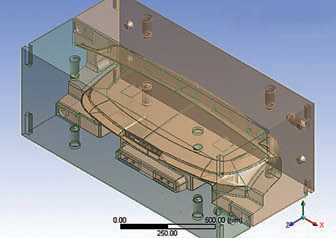
Courtesy of Ansys
A plastic injection molding tool in Ansys’ DesignModeler software.
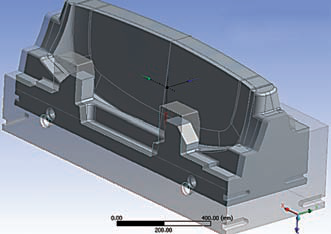
Courtesy of Ansys
Tool size per industry guidelines (outer) vs. an FEA-optimized tool.
Nonetheless, simulating the functionality of components prior to investment in prototyping helps negate trial and error on variations of physical prototypes. Such simulation includes materials testing and characterization, definition of design parameters and product and process validation—under accelerated conditions in the laboratory and field.
Materials testing and characterization. From an engineering standpoint, three numbers are prerequisites to analyzing a metalcutting tool using FEA: the elasticity or Young’s modulus, Poisson’s ratio and the yield stress. Unfortunately, such data on metals for producing tooling goes beyond a typical supplier’s specification sheets, which list grade, chemical ingredients and hardness. A simple “tension test,” with full extensometry, on the metal might be needed—up front. Additional characterization could occasionally look into elastomers for sealing, dampening and quieting machining operations.
Definition of design parameters. Design parameters are often neglected in product shaping or processing. For example, the most permissible deflection and stress are needed to assess FEA results for tooling. A maximum permissible deflection could also impact the surface finish of machined components. Maximum permissible stress and deflection are often post-processed from failure testing tool materials in the laboratory.
Interestingly, a tool may fail under excessive stresses or by fatigue with repeated production cycles. Complementary establishment of the fatigue limit of the tool material becomes necessary, then, through more testing on a servo-hydraulic load frame, such as those by Instron, Norwood, Mass., or MTS Systems Corp., Eden Prairie, Minn.
Minimum/maximum principal stresses resulting from FEA need subsequent plotting on Mohr’s circle. The mean stress must remain below the fatigue limit of the tool material tested. Fatigue resistance, endurance limit and cyclic strength are expressions used to describe the amplitude or range of a repeating stress that can be applied to a material without causing failure.
Overall, ferrous and titanium alloys typically have amplitudes below which there appears to be no number of cycles that will lead to cracking. However, other structural metals, such as aluminum and copper, will eventually fail even from small stress amplitudes; a number of cycles—usually 10 million—is practically chosen to represent their fatigue lives.
Product and process simulation and validation. The only alternative to costly and time-consuming trial and error is simulation of part performance and processing. Still, for simplicity, the FEA of a tool could start at the component level. It could also address assembled parts linearly by connecting interfacing surfaces. “Contact” between components raises nonlinearity in simulating sliding and separation of adjacent surfaces. Overall, tool, mold and die FEA combines geometry, a material model, boundary conditions and loads (and as many variations of each, as necessary, meaning the geometry of each component, a material load for each material, restraints and contact boundary conditions and all loads of the point force, line load, pressure or thermal loads).
Modeling ought to start simply, with one component at a time. Further modeling may look at assembling parts and considering nonlinear effects, such as material nonlinearities, contacts and large deflections. Correlation between simulation and validation testing is established and is part of “model building.” Subsequent “what if?” scenarios allow various possible virtual assessments. That should lead to an optimal product design and material usage before trial machining. CTE
About the Author: Dr. Ben Chouchaoui runs the Windsor (Ontario) Industrial Development Laboratory Inc. For more information about the company’s capabilities in product development via computer simulation, training on materials characterization and materials testing for FEA, call (519) 966-4479, visit www.widl.ca or enter #305 on the IS Form.
Glossary terms in this article
Related



Subscribers can use MFGAxis notes, saves and discussion tools with their innoNET account.


