How Simulation Improves Machining Tool Design and Performance
How Simulation Improves Machining Tool Design and Performance
Computer simulations of the cutting process can help tool designers predict the effects of tool-geometry changes. This article describes how one manufacturer is using the most recent advances in computer modeling to reduce the need for producing and testing prototype inserts. An accompanying article describes a commercially available simulation program.
Using computers to simulate and analyze the metalcutting process helps tool manufacturers improve machining and predict how well a product will perform in the real world. Some of the factors considered during these simulations are horsepower consumption, chipbreaking efficiency, chip evacuation, and tool life.
Ingersoll Cutting Tool Co., Rockford, IL, is one of the companies working to simulate the metalcutting process on computers. The company's aim is to optimize tool design and machining methods in a closed-loop, iterative environment before a tool is actually manufactured. This has resulted in better performing products being brought to market faster.
Ingersoll has developed models for turning, milling, and drilling. Cutting parameters that can be predicted include stress, strain, strain rate, deformed-chip thickness, and chip-curl radius. They can be obtained for a given tool/workpiece combination at various speeds and feed rates.
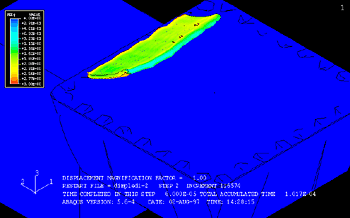
Machining models that incorporate FEA are generally based on 2-D orthogonal cutting. Ingersoll's model simulates the metalcutting process in three dimensions.
Developing 3-D Capability
Earlier research into the mechanics of machining focused on shear-zone models. These models ignored some of the significant features of metalcutting, such as frictional conditions on the tool-rake face, workhardening, and the effect of extreme temperatures on workpiece materials.
During the last two decades, researchers have successfully applied finite element analysis (FEA) to the metalcutting process. FEA is able to handle complex material-property definitions, tool/chip interactions, and non-linear geometric boundaries, such as the surface of the chip. FEA can also predict local variables, like stress and temperature distribution.
In order to simplify the computations involved, machining models that incorporate FEA are generally based on 2-D orthogonal cutting. Few models have been developed that simulate 3-D machining. And the ones that have are greatly simplified, which casts doubt on the reliability of their predictions. The accuracy of any FEA model is directly dependent on the number of assumptions made, as well as the effort involved in correlating the computer model and the real application.
To be a truly effective predictive tool, a machining simulator should be sensitive to changes in material properties, operating conditions, cutting parameters, and tool geometry. One of the hurdles in developing such a simulator is that the mechanics of the machining operation are largely unknown. Also, there is a lack of process data for the area of interest near the tool tip. Coupled with this is a need for an efficient software code—one that can handle large deformations and complex contact conditions simultaneously, so that computer run times are practical. The conditions that the program's calculations must take into account include sticking and sliding friction, as well as the loss or gain of contact that occurs at the tool/chip interface as the chip develops.
Ingersoll's Simulator
Ingersoll has developed a machining simulator by customizing ABAQUS, a general-purpose, FEA software package. The company's proprietary FEA code receives input about tool and workpiece geometries from Pro/ENGINEER software. Other inputs are material properties, contact conditions, boundary conditions, and thermal properties. Output data include cutting forces and the temperatures that develop in the tool and the workpiece.
Currently, the simulator takes into account material properties at high cutting speeds and feed rates. The simulator also incorporates a failure model that is designed to allow the stable removal of material (elements) from a finite element mesh if the workpiece tears or rips. Deletion of elements facilitates separating the chip from the workpiece.
For any predictive computer model to simulate real-world machining conditions, material properties must be accurately represented. Material properties, such as flow stress, are unique for each material and are dependent upon the temperatures and velocities encountered at the tool tip. The material properties of metals at high velocities and temperatures cannot be obtained easily with conventional methods of physical testing. As a result, predicted values of cutting forces and temperatures do not correspond to values obtained in actual cutting operations. A realistic and dependable simulation of the process must incorporate the material's behavior at the specified process conditions.
Ingersoll's machining simulator uses experimental data in combination with FEA simulations to provide data about the behavior of materials. Forces on the tool are directly correlated to the deformation energy during the cut. During the developmental stages of the project, comparisons of simulated and actual cutting forces were conducted. A Kistler dynamometer was used to test various workpiece materials at several cutting parameters.
Friction at the tool/chip interface plays an important role in determining chip formation and the forces and temperatures developed in this region. FEA can model the interaction between chip and tool to an extent. The Ingersoll simulator is able to differentiate the effects of various friction factors on chip formation, as well as other process parameters.
Simulator in Action
A drill insert that Ingersoll recently developed serves as an example of the simulator's effectiveness in optimizing tool design.
Shops that drill soft steels (<220 Bhn) have tremendous difficulty breaking chips that are of a manageable size. Chips tend to be stringy, even if the operator uses the correct machining parameters and the best inserts available on the market (Figure 1). Unbroken chips are difficult to evacuate through the gullets. They cause hole-size problems, clog chip-conveyor systems, and pose safety risks when ejected from the tool. Further compounding the problem is the fact that the hardnesses of the raw materials a shop receives tend to vary from lot to lot.

Figure 1: Ingersoll used its simulator to help develop an insert for drilling soft steels. Chips cut from these materials tend to be stringy and difficult to break.
Ingersoll established three criteria that the new insert had to meet:
- operate at an acceptable surface speed and feed rate;
- work across a range of material hardnesses and compositions; and
- produce small, curled, manageable chips.
The simulator's flexibility allowed a matrix of design features to be evaluated for effectiveness and optimal performance, both independently and in combination. Varying any one feature independently altered the behavior of chipflow considerably. The final design incorporated several chipbreaking schemes that had been tested.
Output from the evaluation produced a typical chip, as seen in Figure 2. Physical testing substantiated the computer models. The new insert produced the chips shown in Figure 3.
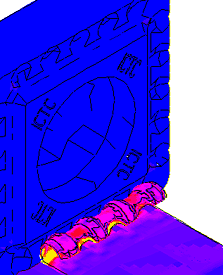
Figure 2: Simulated chip formation with insert designed for soft steels.
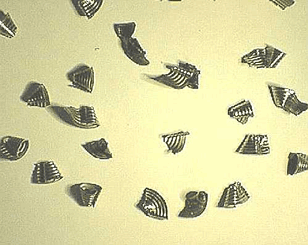
Figure 3: Ingersoll developed its new drill insert based on data collected during simulations. Shown are actual C-shaped chips cut by the insert.
Performance tests showed that the final design had the broadest range of chipbreaking abilities ever achieved by a single insert design when drilling soft materials. This case proved to be an "out of the box" success, meaning only one prototype mold had to be constructed.
Conclusions
The use of dynamic FEA adds a scientific component to the metalcutting process. Clearly, it forms the leading edge for the design and development of advanced cutting tools. Beyond tool optimization, it greatly reduces development costs and the time needed to bring a new product to market.
In Ingersoll's opinion, the use of FEA to simulate the metalcutting process is a great breakthrough for the industry. And although fairly new with respect to optimizing tool designs, use of it is expected to grow rapidly.
Off-the-Shelf Modeling Software for Metalcutting
Several universities and companies are developing proprietary software programs that model the machining process. A software package from Third Wave Systems Inc. is reportedly the first commercially available, experimentally validated modeling program dedicated to the metalcutting process.
"Unlike general-purpose simulation software," says Third Wave's sales and marketing manager, Paul Bayer, "AdvantEdge™ was built from the ground up to model the cutting process."
Third Wave introduced Version 3.0 of the software in mid-1997. The Minneapolis-based company released Version 3.1 in February 1999. In addition to the capabilities of the earlier program, Version 3.1 allows the user to model the cutting process with coated tools.
AdvantEdge software employs advanced material-modeling techniques and adaptive finite elements to capture the microsecond-by-microsecond changes that occur at the tool tip and to the chip and workpiece. It can be used to model turning, up and down milling, sawing, and broaching. Workpiece materials that can be modeled include assorted grades of aluminum and steel, copper, Inconel, and 316 stainless steel. Among the tool materials and coatings that can be simulated are carbides, ceramics, ultrahard materials, cobalt-base alloys, HSS, TiN, TiCN, and Al2O3.
Bayer says that AdvantEdge software lets companies accurately predict the effects of cutting on the tool's edge and geometry at user-defined process parameters. "It really saves time," he says. "Someone can evaluate different geometries, for example, without having to run out to the machine to test them."
– Don Nelson
1
2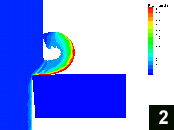
3
4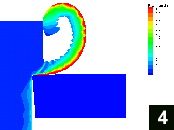
This sequence demonstrates AdvantEdge software simulating chip formation during a turning operation on 4340 steel. Process conditions include an insert with a near-0° rake angle, a 0.500mm/rev. feed rate, and a 900m/min. speed. 1: The chip begins to form. Two segments are visible, as is the strain induced in the segments (depicted by the colored contours). 2: The fully developed chip begins to curl back upon itself and contact the workpiece. The outer edge of the chip exhibits very high strain, typical of curl. 3 & 4: The curl of the chip is now influenced by its contact with the workpiece, and it begins to skid and slide along the workpiece, changing its effective radius. This also creates localized areas of high strain at the back of the chip.
About the Authors
Sumanth Kumar is a development engineer and Brian Hoefler is manager of materials technology at Ingersoll Cutting Tool Co., Rockford, IL.