


Small shop wins big award
The Micron Manufacturing teamEditor's Note: This is the first of a continuing bimonthly series of conversations with shops taking novel approaches to manufacturing parts and managing their operations.In October, Micron Manufacturing Co., Grand Rapids, Mich., was notified that it had won a 2009 Shingo Silver Medallion, one of several companies to be recognized for world-class lean manufacturing practices.
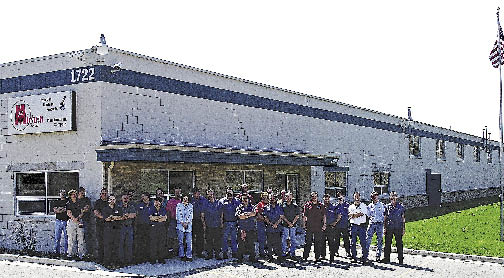
The Micron Manufacturing team
Editor’s Note: This is the first of a continuing bimonthly series of conversations with shops taking novel approaches to manufacturing parts and managing their operations.
In October, Micron Manufacturing Co., Grand Rapids, Mich., was notified that it had won a 2009 Shingo Silver Medallion, one of several companies to be recognized for world-class lean manufacturing practices. The Shingo Prize for Operational Excellence, created in 1988, honors Dr. Shigeo Shingo, a legendary Japanese industrial engineer. Most Shingo awards are given to large manufacturing companies, such as Raytheon and Lockheed Martin. With 30 employees, Micron is one of the smallest—if not the smallest company ever—to win a Shingo award. Alan Rooks, editorial director of Cutting Tool Engineering, spoke with Dan Vermeesch, plant manager for Micron, to find out how the company was able, with just 30 people, to win a Shingo award.
Micron specializes in making complex parts up to 2 ” in diameter using Acme Gridley 6-spindle and Brown & Sharpe screw machines, Swiss-style Escomatics, Swiss-style CNCs, vertical milling centers and conventional CNCs. The company serves the hydraulic pump, oil and gas exploration, heavy truck and furniture industries. It is moving into assembly work and hydraulic testing as well.
Rooks: How did Micron get started with the lean manufacturing process?
Vermeesch: We started on the lean journey in 2000. We had been a good company since our founding in 1952 and in 2000 we began the steps to become a great company. We’re really glad we did because 2000 was our best year ever and then we ran into 3 tough years, like most manufacturers in Michigan. We became more efficient at the very time we needed to become more efficient. I worked for a company from 1994 to 1996 that had started down the lean path. I joined Micron in 1996 and from 1996 to 2000 we did lean unofficially and pretty crudely. In 2000, the general manager, Mike Preston, and I decided to bring in a consulting group to help us with lean. They interviewed every person in the shop and their first recommendation was for the management team to learn how to work together and then pick a project to work on. We decided that our goal was to reduce setup in the Acme department by 25 percent in 6 months.

Dan Vermeesch
Rooks: What was the shop’s reaction to the initial project?
Vermeesch: We started with an off-site meeting where we explained the process and laid out the setup reduction goal. And everybody in the Acme department said it was impossible. Some of the guys were even offended by the idea. One guy had spent 40 years working on Acme machines and he felt we were telling him that he wasn’t doing his job right and wasn’t working hard. I told him that wasn’t the case at all, but that there had to be waste in the process. After the meeting, I walked around the company until I found seven people who said they had no idea if the goal was impossible or not and I said “great, you’re on the team.” Of those seven people, only one had ever touched an Acme Gridley machine in his life. We gave them the training, support and tools they needed and in 6 months they pulled out 37 percent of the setup time. I went back to the 40-year veteran and told him that if he wanted, we would roll back the clock on everything we’d been doing. He said, “don’t you dare because I don’t ever want to do it that way again. The new way is so much easier and better.” I wish I’d had a tape recorder. After that, people elsewhere in the company said “I want to be on a team,” and that led to a real change. It used to be we had two or three people in an office that were in charge of everything, but everyone became involved in deciding how to improve things.
Rooks: Did you apply lean to management as well?
Vermeesch: Unfortunately, it took us 2 years to apply the lean concepts to the management structure, and that was a mistake. People who try to implement lean often don’t think it applies to the guys in the corner offices, but it does. When we did that, it made a huge cultural difference. For example, when the managers go home now, there isn’t supposed to be a thing on our desks other than our staplers and our phones. Every day, you come in to a clean desk. When we started the process, I went out on the floor and told the folks that we were going to have a different person from the floor come in every week and audit the managers. If we didn’t pass the audit, we had to correct whatever the error was. People loved that idea! It made it clear that everybody participates.
Rooks: Did anyone resist the lean process?
Vermeesch: At the very beginning, there were some people who continued to resist all of the efforts, and unfortunately we had to let three people go. Since then we’ve had excellent participation from everyone. You can’t allow poison to exist in this process because it begins to fester, and we made a promise to the people who made the needed efforts that we would not allow other people to disrupt the process.
Rooks: What were the steps that led to Micron winning a 2009 Shingo Silver Medallion?
Vermeesch: From 2000 to 2003, we made some significant but random improvements. In 2003 we really started to get our act together. We began using a monthly process where 3 weeks of improvement activities take place, and in the fourth week we review those improvements and plan for the next 4-week cycle. Our long-term goals are broken out into 1-year goals, which are further broken down into quarterly goals and finally 1-month goals. And every day, we have a 5-minute huddle to deal with what happens on a daily basis.
In 2006, we started doing one-page strategic plans. We started with a SWOT (Strengths, Weaknesses, Opportunities and Threats) analysis for the shop. All of our company goals are spelled out on this document. Also, every person in the shop has their own one-page planning goal posted that says “I will accomplish specific goals in specific time frames.” It’s really a powerful tool.
Rooks: What were the new lean goals in 2006?
Vermeesch: One was to take all of the lean efforts from the past 5-plus years and formalize them. We also wanted to use the Shingo application process to determine what is world class for shops like us on a national level. We had to write an achievement report to apply for the Shingo award and that process took 13 months and came out to 123 pages. Even if we hadn’t won any level of the awards, the process was worth every dime because it showed us where we stood.
Another goal was to reduce setup in the Acme department even further. Our average setup on an Acme in 2000 was 32 hours. By 2006, through continuous improvement of the concepts developed by that first team, we had reduced setup to 8 to 10 hours, but were stuck there. So, in 2007 we got another team together with the goal of reducing setup time to 5 hours. By the end of 2007, we were at 3.6 hours per setup. I’ll put that setup time up against anybody in the industry. The 2007 effort focused on areas outside the machine, and we focused on pulling out as much internal setup to make it external so that we could perform it while the previous job is running.
As part of that process, we developed a standardized work process that everybody has to follow—no exceptions. Every step is spelled out with the amount of time it should take. There are tools on the left side of the machine that stay on that side, and the same is true on the right. Some operators may want to do things their own way, but we don’t allow it. The five guys on the team took videos of how different people perform setups. They studied it and all agreed to do it the same way. It was a huge improvement.
Rooks: Describe the process of applying for the Shingo award.
Vermeesch: We began in March 2007. We joined a user group in Grand Rapids run by The Right Place Inc., part of the Michigan Economic Development Corp. The user group helps you through the achievement report process. Utah State University had 10 auditors from various companies review our report, and based on their recommendations, we got to the next level, where four assessors from different companies examined us for 2 days. We found out we had won the Silver Medallion in late October. Most of the award winners are from large companies with a lot of resources, and our shop could fit in one small corner of their plants. One of the assessors said “never again will I go into a company with 4,000 or 5,000 people and believe them when they say they don’t have the resources to do the lean process. What you guys do with 30 people is mind-boggling,” and to me that was a great compliment. CTE
About the Shingo Prize: Each year, the Utah State University Jon M. Huntsman School of Business names winners at three levels: the Shingo Prize, Shingo Silver Medallion and the Shingo Bronze Medallion. The 2009 award winners will be recognized at the 21st Annual Shingo Prize Conference at the Opryland Hotel in Nashville, Tenn., May 5-9, 2009.
Glossary terms in this article
Related




Subscribers can use MFGAxis notes, saves and discussion tools with their innoNET account.