


So long bactericide: General Industry Coverage
Nobody in their right mind enjoys working in a place that smells like Dante's Inferno. Yet metalworking professionals face that prospect when the bactericide level in a coolant emulsion dips to a level that causes bacteria to rapidly multiply and the shop air to turn rancid and sour.
Nobody in their right mind enjoys working in a place that smells like Dante’s Inferno. Yet metalworking professionals face that prospect when the bactericide level in a coolant emulsion dips to a level that causes bacteria to rapidly multiply and the shop air to turn rancid and sour. And the more bacteria, the more destabilized the emulsion becomes and the more bactericide is needed to kill the bacteria and correct the pH value so new bacteria don’t bloom.
“The problem is the bacteria receive more and more ‘knowledge’ from the bactericide [and adapt to it], so you need [to use] more and more bactericide—a vicious circle,” said Martin Desinger, manager of business development for Bonderite L-MR at Henkel Adhesive Technologies. He added that although bactericides don’t produce health problems when the emulsion is fresh and in good condition, they are toxic agents and can cause issues if the emulsion goes south.
Therefore, the company formulates its Bonderite L-MR metalworking lubricants to be bactericide-free, Desinger noted. This eliminates the need to regularly top off with bactericides and makes the fluid concentrate, as well as the emulsion, nearly odorless. “Henkel developed a formulation based on a new combination of proven raw materials,” he said.
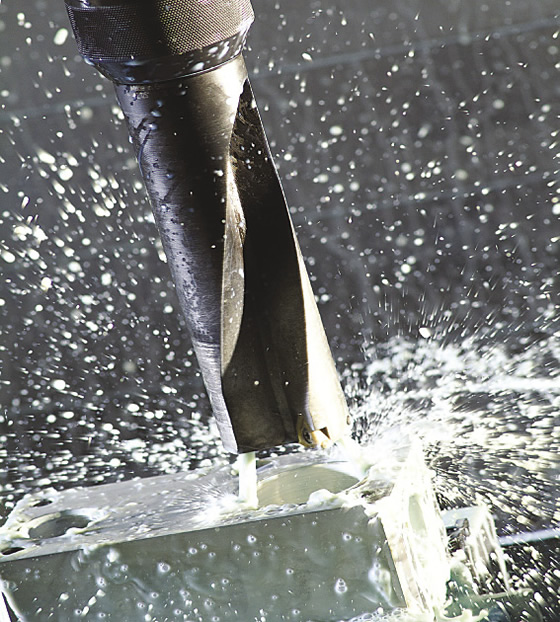
Courtesy of Henkel
The concentrate and emulsion of Henkel’s Bonderite L-MR metalworking fluids are nearly odorless because bactericides are not part of the formulation.
He explained that the fluids exhibit enhanced hard-water stability, increasing the bath lifetime two to eight times. Because machining creates a lot of heat, the emulsion evaporates while salt and other minerals remain. An analogy is evaporated water from an ocean, which contains no salt when it rains because the salt stays with the main body of water.
However, Desinger added, an emulsion will “split” if the water is too hard, meaning it has a high dissolved-mineral content. If the bath lifetime is short because of bacteria problems, a lubricant with high hard-water stability isn’t needed. But if the bath lifetime is long, two possible options are available: Refill with demineralized water or use a product with a high hard-water stability.
In one example, Desinger said a Nordic manufacturer of construction equipment was consuming a lot of bactericide to keep bacteria at bay while dealing with unpleasant odors. The company predominantly machines gray cast iron, which is difficult to filter from the emulsion and a dirty emulsion favors bacteria growth. As a result, bath lifetime averaged only about 3 months. After switching to a Bonderite L-MR product formulated for gray cast iron, the emulsion has remained clean, odorless and at a stable pH level for 2 years to date. “And that is not a special exception,” he added.
Desinger emphasized that, similar to other coolants, it’s important to keep the concentration above 5 percent. However, when maintaining that concentration level of more than 5 percent, the topping-off concentration for Bonderite L-MR only needs to be 1 percent versus 2 percent for other products. “Overall, our customers save—provided the worst-case calculation—a minimum of 30 percent concentrate per year,” he said.
For more information about Henkel AG & Co. KGaA, Düsseldorf, Germany, call +49-211-797-0 or visit www.bonderite-lubricants.com. CTE
About the Author: Alan Richter is editor of CTE. Contact him at (847) 714-0175 or alanr@jwr.com
Glossary terms in this article
Related


Subscribers can use MFGAxis notes, saves and discussion tools with their innoNET account.