



Sort, Select, Start Up: Drilling Performance
Choosing a multitask machine from a bewildering array of options can be challenging, but the right one can be a shop game changer.
Choosing a multitask machine from a bewildering array of options can be challenging, but the right one can be a shop game changer.
The simplest definition of multitasking is “the performance of multiple tasks at one time.” In the world of machine tools, however, multitasking takes on a far more dynamic meaning. Simultaneous turning operations, machining multiple part surfaces and combining several manufacturing operations into a single setup are just a few of multitasking’s many flavors.
If it sounds like yesterday’s news, that’s because lathes with live tooling have been around for decades, and multispindle mills are older than the surviving members of The Beatles. Well, these are not your father’s multitask machines.
Builders are delivering all-in-one machines in mind-blowing configurations: twin-spindle, three-turret lathes with automatic toolchangers; machining centers with more degrees of freedom than a pogoball; and hybrid units that are neither a lathe nor a mill.
These multitaskers can do things only hinted at 30 years ago, with capabilities such as pinch milling, gear cutting and cylindrical grinding. As a result, many shops are reexamining the status quo. Multitasking presents a new paradigm in manufacturing, one that drastically reduces cost per part while raising the bar on productivity and quality.
Proof Positive
Need proof? Case studies abound. One example from machine builder Mazak Corp., Florence, Ky., showcased an Illinois manufacturer faced with a huge increase in orders for diesel engine shafts. By investing in multitaskers, the company went from multiple operations done across single-spindle lathes and mills to a single operation on a Multiplex 6300 dual-spindle, dual-turret multitask machine, increasing throughput 30 percent.
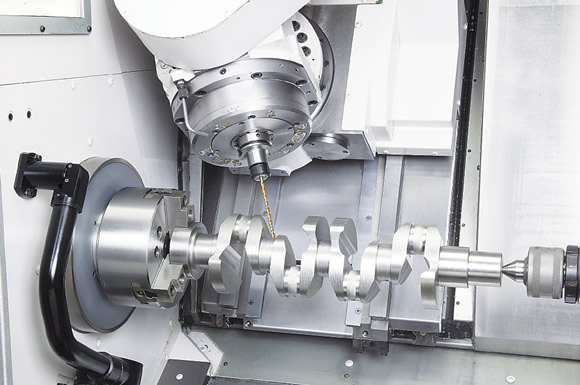
Courtesy of Okuma America
An Okuma Multus B300 machining a crankshaft. The multiaxis machine can mill, drill, tap and turn, and has an automatic toolchanger.
Machine tool supplier Methods Machine Tools Inc., Sudbury, Mass., cited a control valve manufacturer in Kansas City, Mo., that saw “major improvements” in cycle time and part quality by installing a Nakamura-Tome NTX twin-spindle, 124-tool turning cell to do lights-out machining. And Okuma America Corp., Charlotte, N.C., reported that an Indianapolis job shop took a 3-minute cycle time on an electrical connector pin down to just 67 seconds thanks to its LB3000EX-MY live-tooled lathe.
This is exciting stuff, but for a shop looking to take this road, it’s not as simple as saying, “Hey, we’ve gotta get us some of that.” Multitask machines are application-specific, and the builders participating in this market offer a dizzying array of equipment choices. Where do you start?
It’s a Mill! It’s a Lathe!
No, it’s … Supermachine!
David Fischer, product specialist at Okuma America, outlined some of the available options. “The holy grail of multitasking is a machine that excels at both turning and milling without any compromise. That goal may have been reached. There are machines that perform turning equal to a large lathe and milling equal to a large horizontal machining center.
“For example, our Multus series is popular because of its combination of power and user-friendliness,” he continued. “The Macturn has a secondary turret for faster processing, and the MU series brings turning capability to machining centers. The decision on which one is best in any given application is complex and can only be determined by thoroughly reviewing current and anticipated needs.” According to Okuma, its Partners in THINC program, which brings together suppliers of related machining tooling and equipment, helps make the selection process easier.
According to Fischer, shops must consider value and the impact a multitask machine will have on their business and compare that with the cost of operating conventional machines, which typically require more fixtures, tooling, electricity and floor space for multiple machines, compared to just one multitask machine. And because you need multiple operations to complete a workpiece, cost of work in process is also higher with conventional machines.
But for a job shop looking to venture into multitasking, he pointed out that simpler might be better, such as one with a single turret. “This makes it much easier to program and debug the process,” Fischer said.
Does that imply you need to be a rocket scientist to run one of these things? Not at all. “Our OSP control does a lot to simplify the programming process, Fischer said. “Everything is programmed as if it is upper turret, left spindle. The control flips the geometry to suit the actual spindle or turret being used so the programmer doesn’t have to continually change his frame of reference. In many ways, multitask machines are simpler to operate [than standard CNC machines] once you get used to them.”
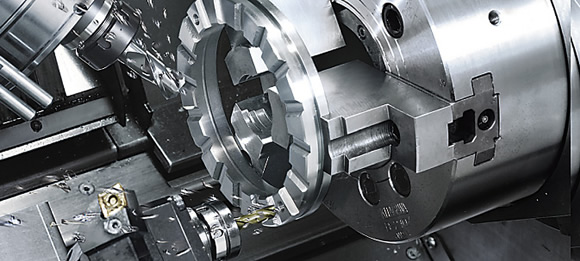
Courtesy of Mazak
Mazak has divided its multitask machine offerings into five levels, with one being simple machines and five being highly complex machines and systems. In level five, shown here, “Ultra-Tasking” is performed with specialized machining functions and multitasking automation.
How can a machine with more crash potential than a stock car race be simple to run? “On many of the models, only one tool is in the turret at a time, so you never have to worry about adjacent tool interferences,” Fischer said. “Second, there are plenty of tools so you never have to ‘make do’ with the limited number of tools available in a conventional machine.”
It is also much easier to make a part accurately in a single machine than trying to maintain accuracies across four or five setups in a conventional one, according to Fischer. By machining a part on a single machine, the operator always knows the location of each part feature. “A multitask machine is different, not necessarily more complex, to operate,” he said.
Done in One
Some builders use an iterative approach to machine tool selection. For example, Mazak’s “Five Levels of Multi-Tasking” Web site asks potential machine tool buyers about production volumes, workpiece size, complexity of milled features and part geometry.
As Marketing Manager George Yamane explained: “Level 1 begins with small, simple parts, which can be accomplished on a single-spindle lathe with rotating tool capability. Level 5 might require a specialized machine with a high level of automation. Each customer’s parts are unique, and the benefits you achieve depend on many factors. It’s very complicated. That’s why we developed the five levels.”
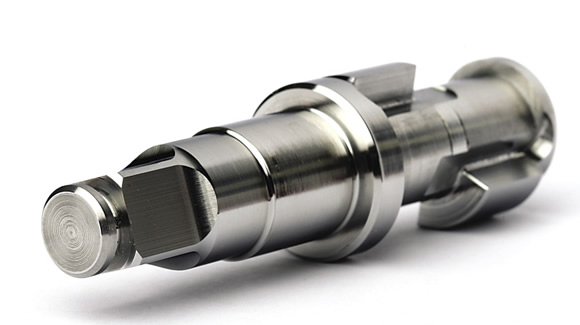
Courtesy of Methods Machine Tools
A Nakamura-Tome NTY-3 multitask turning center replaced three traditional machine tools in the manufacture of this spindle shaft. Cycle time was cut in half, to 2¼ minutes, among other benefits.
Once you have that machine, you should go back to school. “Training is very important,” Yamane said. “We have eight North American technology centers where we teach programming, operation and maintenance, and offer seminars on specific topics like touch probes in multitasking and machining titanium turbine blades.”
Mazak has partnered with companies such as Sandvik Coromant and FANUC to collaborate on customer problem solving. “How we interface with the customer today is completely different than in the past,” Yamane said. “You can’t choose a machine based on a canned demonstration and price. You have to show the customers the different types of parts you can make and tell the story behind each one.”
One of the stories Yamane pointed to involves Englewood, Colo., manufacturer Reata Engineering Inc. In 2011, Reata purchased a 5-axis Integrex i-200S with twin turning spindles, a 12,000-rpm milling spindle and a 72-tool magazine. Since then, average cycle time for a family of pump parts has dropped by nearly half, five machining operations are now done in one multitask operation and lead times for finished components have gone from weeks to a few hours. “These machines make more money,” Yamane said. “Profitability and cash flow is improved, and WIP is reduced. But you have to be ready to completely change your mindset as to how parts are processed.”
Up a Notch
One good way to look at multitasking is to imagine operations not possible with standard machine tools, according to Gregg Hyatt, chief technical officer for DMG / Mori Seiki USA Inc., Hoffman Estates, Ill. “People tend to look at multitask machines in terms of combining existing, conventional processes into a single machine. But more exciting are the operations they can perform that are simply not enabled by any simpler machine,” he said.
Those operations include pinch milling, where both sides of a thin- walled workpiece are milled simultaneously between the upper and lower spindles on a turn/mill machine, and pinch fixturing, where the lower turret is used as a programmable fixture to support the part. Other operations supported by multitasking include gear cutting, cylindrical grinding and grind hardening, where the workpiece is heat treated in the machine, relying on friction between the workpiece and wheel instead of flame or a furnace. This allows annealed-state machining and then selective surface hardening, followed by finish grinding or hard turning.
“We intentionally do everything wrong in grinding,” Hyatt laughed. “This allows us to generate a precise heat flux. It gives far more control than you can achieve with traditional heat treating. Better yet, it reduces energy consumption by 70 percent compared to traditional surface hardening techniques.”
Aside from the obvious process benefits of combining nontraditional operations into a single processing step, these techniques allow shops to avoid purchasing specialty machine tools. “For example, if you buy a shaping machine or a hobbing machine, that’s all you’re going to do with it,” Hyatt said. “You can’t repurpose it for another application. But by bringing those operations to a mill/turn machine, when the customer’s needs change repurposing the machine is simply another setup.”
What determines whether you go with a milling machine with turning capabilities or a turning machine with milling capabilities? “It’s not just a matter of the part being cylindrical or prismatic,” said Hyatt. “It’s more complex. A lot of cylindrical parts go onto mill/turns, but they are typically larger-diameter parts. But these parts tend to be short, so you don’t need to support them with steady rests or a subspindle. Obviously bar-fed or longer cylindrical parts belong on a turn/mill. But we also have prismatic parts on the turn/mills where the customer wants to pass the part from one chuck to the other.”
Job shops are one of the primary markets for these kinds of machines, as well as companies that want to differentiate themselves by offering quick delivery. “Rather than fighting it out in the trenches over pennies per part, shops can present a value proposition to their customer, offering quick delivery of difficult parts at a premium price,” Hyatt said.
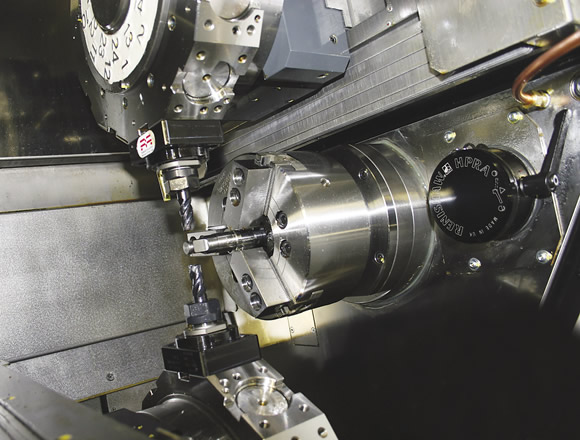
Courtesy of Methods Machine Tools
This Nakamura-Tome NTY-3 multitask turning center features opposed twin spindles and three turrets, each with Y-axis and 9.5-hp milling capability.
One multitasking success story came from a company machining an aerospace component, a huge Inconel forging. “They went through 64 machining operations, from forging to assembly,” he said. “With 64 setups on 64 different pieces of equipment, it took them the better part of a year to get the part through the manufacturing cycle. By consolidating 40 of those operations into a turn/mill machine, not only was there a huge reduction in machining cost, but lead time dropped by months. Considering the cost of the forgings—around $10,000 apiece—the customer reduced WIP by more than the initial cost of the machine.”
Yes, MAM
Multitasking sounds swell, but choosing the right machine remains a challenge and requires answering difficult questions. Rich Parenteau, director of applications development at Methods Machine Tools Inc., said education is key. “That’s one of the first things I tell my sales people. For example, Nakamura has over 30 different models, and everyone else has a huge selection as well. So you have to ask: How many turrets do I buy? Do I need a double Y-axis or a triple? What about milling, and how many tools do I need? How much can I afford?”
Say you have to deliver a prototype part for a new customer, and he wants it next week. Looking at the part, you determine it requires seven different operations. This might be a good fit for a multitask machine, but do you really want to tie up a $500,000 machine for a one-piece order? “Absolutely,” Parenteau said. “Using a conventional process, you’ll be handling that part seven different times, once for each operation. This means program, set up, inspect, machine, deburr and move, times seven. In the multitask machine, you get that part done in one operation.”
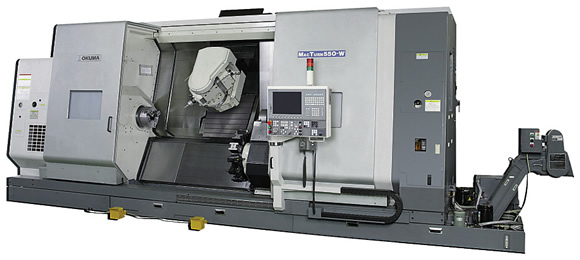
Courtesy of Okuma America
Okuma’s MacTurn 550-W is a multifunction horizontal lathe that improves throughput and virtually eliminates fixturing, according to the builder. The machine has an automatic tool changer, large tool storage, a lower live turret and 9-axis machining/turning capabilities.
Multitask machines reduce fixturing costs and offer faster turnaround times and more accurate parts. “Nobody wants to carry any inventory these days—they’d rather order one part today and one part 3 weeks from now,” Parenteau said. “If you have seven machines to set up, and three of them are tied up on other jobs, what do you do? Half the time you end up tearing into setups to satisfy one customer. You don’t get paid for that.”
And what about making 1,000 of those parts? On a multitasker, that’s where the rubber hits the road. “In that case, you have the opportunity to optimize the setup,” Parenteau said. “Now you can engage that second or third turret or be milling one end of the part while drilling the other. Whether you’re talking about prototypes or high volume, the bottom line for anybody is cost per part. Mill/turn or turn/mill, either platform is going to get you a lower cost per price than traditional machining centers, because you’re handling that part just one time.”
Does this spell the end for Plain Jane machine tools? Probably not. High throughput operations, such as automotive parts, are not a good application because of the cost of buying enough multitask machines to produce sufficient part volume, according to Parenteau.
“But even here, some big manufacturers are looking at multitasking simply because they achieve better geometric accuracy than with conventional processes,” he said. “In the U.S. market, multitasking is where everyone is going. You have reduced setup and process time, tools resident in the machine, twin spindles and milling capability, even 5-axis contouring if you want. It’s a one-stop shop, where you put the material in and a finished part comes out. Wash it, ship it and invoice it.”
 Describing multitasking, Parenteau used the old adage that shops need to work smarter, not harder. And when it comes to machining, multitasking is about as smart as it comes. CTE
About the Author: Kip Hanson is a contributing editor for CTE. Contact him at (520) 548-7328 or khanson@jwr.com.
Contributors
DMG / Mori Seiki USA Inc.
(847) 593-5400
www.dmgmoriseikiusa.com
Mazak Corp.
(859) 342-1700
www.mazakusa.com
Methods Machine Tools Inc.
(877) MMT-4CNC
www.methodsmachine.com
Okuma America Corp.
(704) 588-7000
www.okuma.com
Glossary terms in this article
Related



Subscribers can use MFGAxis notes, saves and discussion tools with their innoNET account.


