


Speed Needs Precision: Feature Article
Advanced toolholding allows Ed Carpenter Racing to push spindle speeds while holding race-critical tolerances.
IndyCar regulations list several parts race teams can make themselves to help reduce the cost of putting cars on the track. Most of those parts are suspension components, such as dampers and various chassis elements like front and rear rocker components. Teams can also produce other items, such as throttles and brake pedals. When an IndyCar team like Indianapolis-based Ed Carpenter Racing produces parts in-house, the team not only saves money, it also can change and tweak those components to improve the overall racecar performance.
Ultimately, the expectations for the team’s racecars and machine shop are the same: go fast. There is always a need for the parts produced in-house because cars get damaged on the track or parts simply wear out.
The Ed Carpenter Racing team machines most of their parts from 7075 and 7075 T6 aluminum. Many of these parts are for modifications to a car’s dampers, which provide stability and help increase fuel mileage.
Currently, the team fields two cars for the full season in the NTT IndyCar Series and three cars for the Indianapolis 500. Ed Carpenter Racing employs roughly 75 people, three of whom run the team’s machine shop, and there are typically four mechanics and one crew chief per car. In addition to building cars, the team also disassembles them throughout the season to conduct part crack tests and check suspension components between races.
The shop typically produces parts for one race season at a time and will make extras beyond that amount for stock. These aren’t high-volume jobs, but they require many smaller associated parts that the team needs on a regular basis, such as various types of fasteners and brackets.
To accomplish both part cost reduction and increased production speed, Ed Carpenter Racing acquired a 5-axis CNC milling machine with a maximum spindle speed of 24,000 rpm. Unfortunately, the team quickly realized that cutters spinning that fast required the right toolholders.
“The holders we initially used resulted in some serious runout at 24,000 rpm, which hindered our ability to hold part tolerances,” explained Brent “Woody” Harvey, Ed Carpenter Racing engineering manager. “We need to hold tolerances typically to within ±0.003″, but for critical damper parts, tolerances must be within ±0.0002″.”
With the driver top of mind, Harvey added, “we have to maintain smooth surface finishes because there are several mating components that fit together and slide up and down, and the less friction the better to help the car maintain its stability and handling.”
According to Harvey, if the team kept using its original holders, the shop would have to machine at slower spindle speeds. This would not only defeat the purpose of having a high-speed machine but would also slow part production significantly.
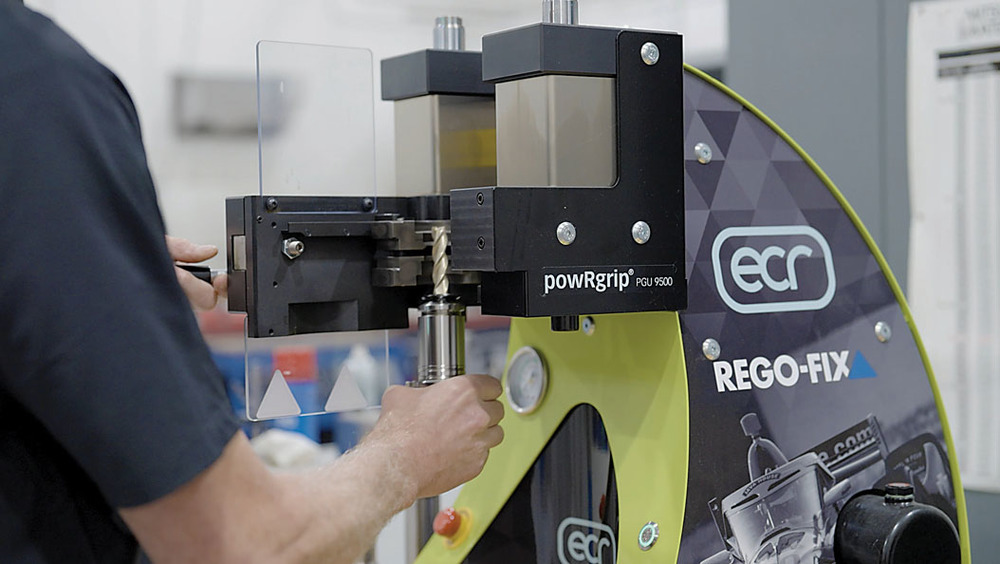
During a visit with its machine tool supplier, the team asked for a tooling solution and was advised to contact Rego-Fix USA in Whitestown, Indiana. After meeting with Rego-Fix, the team incorporated the company’s powRgrip toolholders.

The toolholders are balanced by design to minimize tool runout. And in terms of speed, holder assemblies are balanceable for use at speeds up to 42,000 rpm. Additionally, the vibration-damping taper-to-taper, press-fit, collet-holding design of the powRgrip system creates a juncture point, or gap, that essentially interrupts the waves of vibration — caused by runout — to reduce their strength and severity.
With the new holders, Ed Carpenter Racing reports that it maintains precision and critical surface finishes, extends tool life, minimizes tool runout to less than 0.0051 mm (0.0002″) and shortens cycle times.
Harvey said the team machines parts at the full 24,000-rpm spindle speed for the majority of the time, which would be impossible without the powRgrip system. As a result, jobs that once took two or three weeks are done in a couple hours. This capability allows the shop to mill more intricate car parts, including those it will eventually 3D print and finish on the milling machine.
According to Jason Clark, Ed Carpenter Racing’s director of team partnerships, the powRgrip solution resulted in Rego-Fix becoming a technical partner for the team. “Our Rego-Fix partnership is very important to us and has progressed and strengthened each year over the past three years,” Clark said. “They allow us to reap the benefits of high-speed machining with their tooling.
“In turn,” he continued, “we provide hospitality for Rego-Fix to utilize at our races throughout the season and promote the partnership through our social channels, and branding on our race cars, as well as on garage and team equipment.”
When Ed Carpenter Racing puts drivers in cars made to hit speeds over 321.9 km/h (200 mph), every component is critical, especially those machined in-house. Excessive tool runout during machining costs the team time and money. More importantly, it threatens the integrity of those parts and puts drivers at risk.
Related


Subscribers can use MFGAxis notes, saves and discussion tools with their innoNET account.