


Spindle bearing preload selection is key
The June Machine Technology column in Cutting Tool Engineering covers selecting and maintaining preload in spindle bearings.
A major challenge for designers of machine tool spindles with rolling element bearings is selecting and maintaining the preload in the spindle bearings. Preload means a radial load is applied to all the rolling elements, or balls, simultaneously.
Spindle bearing preload is required for static accuracy. It keeps the rolling elements in contact with the spindle and housing and prevents “play” in the spindle. A gap, or play, would allow the spindle to rattle in the housing, and the position of the spindle centerline could shift.
In addition to accuracy, preload is required for stiffness. The balls in a ball bearing assembly deform under the application of a spindle load. Their stiffness is generally less than that of the spindle body, so the balls play the role of springs. A spindle with balls contacting both sides is about twice as stiff as it is if some of the balls lose contact. The preload has to be great enough that the balls stay in contact regardless of the load on the spindle.
In addition, the balls are not linear springs. It is easy to slightly deform a ball, compressing it a little near the surface. If the ball begins to deform more, the contact patch is larger, and stiffness increases. Therefore, the balls are “stiffening” springs.
Courtesy of S. Smith
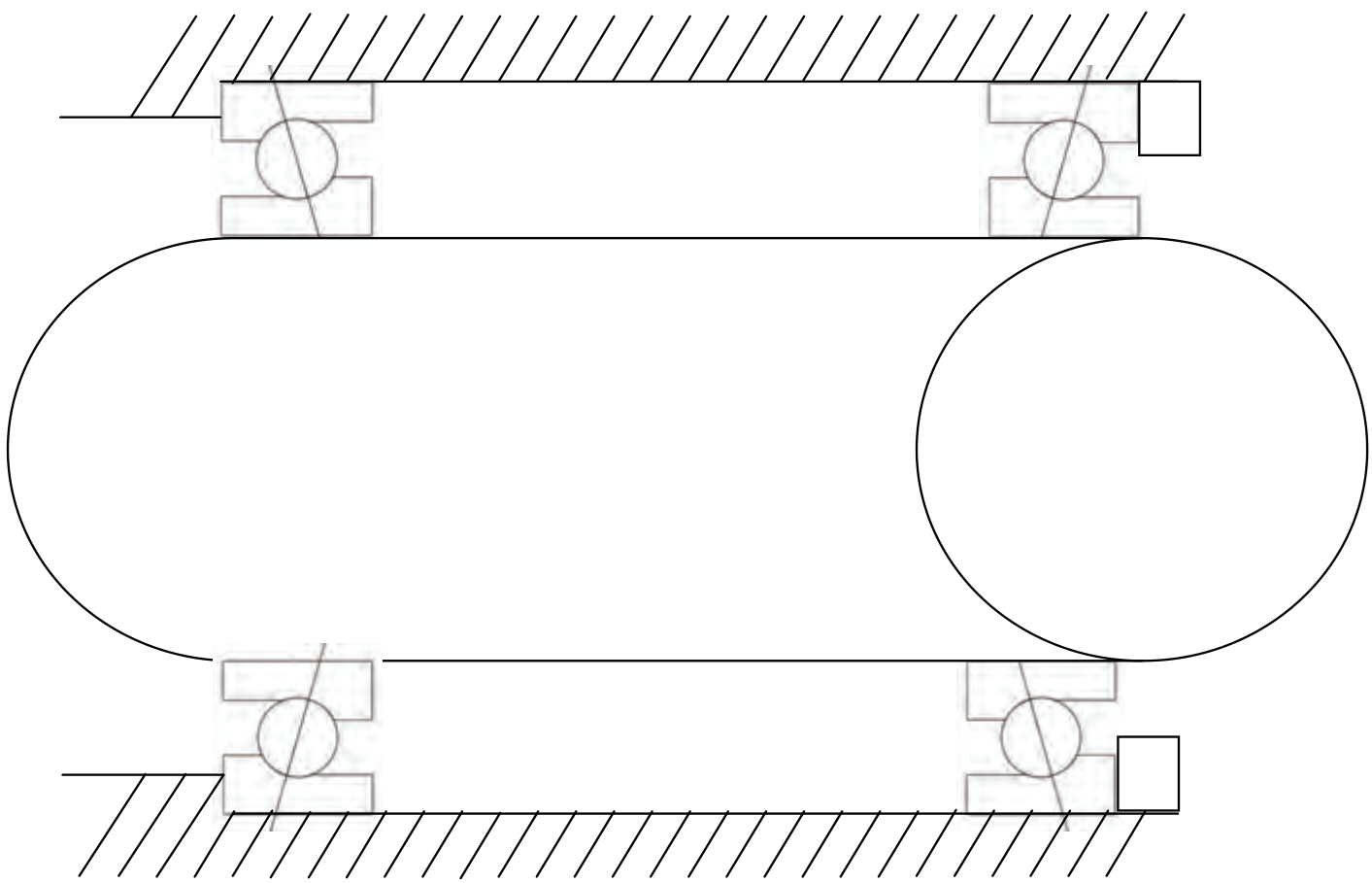
Figure 1. An angular contact ball bearing spindle in the “Big X” configuration.
How is the preload imposed? In high-speed spindles, the spindle acts as the rotor of the motor. The bearings are often angular contact ball bearings (Figure 1). In the figure’s simplified model, the spindle nose is toward the left, and the line between the contacts of the ball on the inner and outer races is inclined with respect to the spindle axis. This configuration is called “Big X” because the contact lines through the balls look like an X. If the contact angles were reversed, the configuration would be called “Big O.” There is a nut threaded into the housing at the right (tail) end of the spindle. Tightening the nut pushes the bearings toward each other and increases radial preload.
When the spindle begins to rotate, heat causes complications. Heat comes from the motor rotor, which is on the spindle shaft. The only path for that heat to escape is through the balls. When the spindle shaft gets hot, it grows. The spindle housing is not as hot, so it grows less. This difference increases the preload.
Friction also causes heat. The contact between each ball and the race is not a point, but a small, deformed contact patch. Because not all parts of the contact patch are the same distance from the center of the rotation, the ball cannot purely roll on the race. There must be sliding, and the sliding creates heat. The heat increases the preload, and the increased preload increases the friction, which generates more heat. If corrective action isn’t taken, the rising temperature will cause the spindle to seize.
One way to remove heat is to cool the spindle. Cooling the housing with a water jacket, for instance, is not enough, and may even make the problem worse. That’s because a cool housing with a hot spindle has a higher preload than a hot housing with a hot spindle. Effective cooling must access the spindle body. Some spindle manufacturers introduce chilled oil down the center of the shaft and collect it as it passes through the bearings. This is a robust, but expensive, solution.
Another solution is to allow the bearings to move. This keeps the preload more constant. In this strategy, the nose bearing is typically fixed (to keep the tool point stationary), and the spindle is allowed to grow toward the tail. For example, spring elements could be introduced between the outer race of the back bearing and the nut. This requires the outer race of the bearing to slide in the housing. The motion of the outer race is small, and the force between the race and housing is large, so the race is prone to fretting, corrosion and jamming. Mounting the outer race in another axial bearing is an option, but that reduces radial stiffness.
Machine tool spindles are complicated and precise instruments. Well-designed spindles have similar performance characteristics at room temperature and maximum operating temperature. The design choices for managing preload depend on the application. There is no single best choice, and there are many considerations beyond preload. CTE
 About the Author: Dr. Scott Smith is a professor and chair of the Department of Mechanical Engineering at the William States Lee College of Engineering, University of North Carolina at Charlotte, specializing in machine tool structural dynamics. Contact him via e-mail at kssmith@uncc.edu.
Related



Subscribers can use MFGAxis notes, saves and discussion tools with their innoNET account.