

Staffing Shortage Stymies Metalcutting Shops
An exclusive survey finds shops struggling to locate and hire skilled labor. This report of the survey's findings also reveals the most popular techniques to ease staffing woes.
An exclusive survey reveals how companies are scrambling to find skilled labor.
No matter what part of the U.S. you work in or what manufacturing segment you compete in, you know that it’s extremely difficult to attract skilled workers these days. Unfortunately, it looks like this trend will continue through 1999.
In fact, according to a recent survey conducted by CUTTING TOOL ENGINEERING Magazine, 33% of respondents believe conditions will get even worse during the next 12 months, while 56% expect things to stay the same. Only 11% think the staffing picture for machine operators, CNC programmers, and other key shop personnel will improve. Two-thirds (68%) of respondents claim that it’s been very difficult to find metalcutting workers during the last 12 months. An additional 29% say it has been somewhat difficult, while only 3% report they’ve had no difficulty finding new talent.
The following comments reflect how most shop owners and managers feel about today’s competitive job market. “I’ve seen nothing but horror stories,” notes the owner of a 15-person job shop in Pennsylvania. “Filling entry-level positions is impossible. People don’t recognize that it takes 10 years to become a good machinist. It’s a classic economic model of demand being bigger than supply.”
“Retaining talent in our shop is one of our largest concerns,” says the human resource manager at an agricultural equipment manufacturer in Illinois. “We are about 40 miles from two considerably larger cities with large manufacturing economies and are constantly losing skilled workers to these larger companies. We have increased the wages of both new and experienced employees, which improved our situation slightly, but we still have problems.”
“The labor pool, besides being woefully short, is like trading baseball cards with little Bobby next door when you were a kid,” adds a manufacturing engineer at a small job shop in Northern California, who says few rules apply in today’s competitive labor market. “While the major players in the industry talk about partnering, total quality, and cost commitment, the skilled labor in the area follows the dollar and not the vision.”
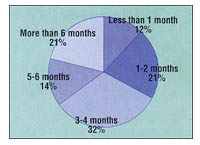
Figure 1: Time required to fill vacant jobs.
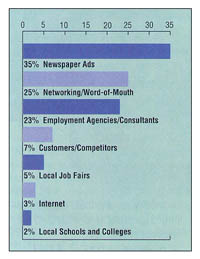
Figure 2: Recruitment tools.
Job openings typically take more than three months to fill in 67% of the shops and manufacturing plants surveyed (Figure 1). Specifically, one-fifth (21%) of respondents claim that some jobs go vacant more than six months before suitable candidates are found to fill them.
On the other end of the spectrum, only 12% report that it takes less than one month to fill positions. Three to four months is the norm at 32% of the companies, while 21% of respondents say it takes an average of four to eight weeks to find qualified individuals. Job openings tend to go unfilled the longest in states where there is a heavy concentration of machine shops and manufacturing plants, such as California, Connecticut, Michigan, New York, Pennsylvania, and Ohio.
Metalcutting executives are using a variety of sources to attract new talent for their shop floor. However, simply posting a help-wanted sign out in front of a building is a thing of the past.
Newspaper advertising is still the preferred method for finding employees in the metalcutting industry, according to one-third (35%) of respondents (Figure 2). Networking and word-of-mouth referrals (25%) are the second most popular staffing method, followed closely by employment agencies and consultants or recruiters (23%). Other sources of talent include customers and competitors (7%), local job fairs (5%), the Internet (3%), and local vocational schools and technical colleges (2%).
While only a few respondents currently use the Internet as a recruiting tool, this number is expected to increase during the next three years. “The Internet is revolutionizing the process of bringing people together with employers,” says Gordon Tucker, founder, CareerSite Corp., an Ann Arbor, MI-based employment search and recruiting service. “It is the ultimate medium for matching employees and employers.”
Some of the leading Web sites for finding new talent include America’s Job Bank (www.ajb.dni.us), CareerPath (www.careerpath.com), CareerSite (www.careersite.com), JobOptions (www.joboptions.com), The Monster Board (www.monster.com), and BrassRing (www.resume-link.com).
Alternative Solutions
A majority of respondents have not tried to attract qualified workers with special incentives, such as sign-on bonuses, extra benefits and perks, or rewards to current employees for finding new talent. In fact, only 27% have used this technique, but 21% claim they are thinking about trying such alternatives.
In some non-manufacturing industries, such as health care, sign-on bonuses are widely used to attract highly sought after workers. Typically, those bonuses are paid in several increments spread out between one to two years. For instance, if someone receives a $2000 sign-on bonus, he or she might receive $1000 a year for two years, paid out in $250 increments every three months. One half of all respondents claim they are working with local high schools, vocational schools, community colleges, and technical colleges to develop new sources of talent. However, only 31% claim they have formal apprentice programs, while 12% are considering this option.
More than two-thirds (71%) of respondents have used temporary help agencies to fill vacancies, but one-quarter (25%) have not used this short-term solution to staffing woes. An overwhelming number of respondents (90%) claim they would consider hiring former welfare workers. Despite that claim, many individuals said they would only pursue this option if the applicants were already trained to work in a shop environment.
Training Woes
When it comes to training employees, lack of time is the biggest challenge facing one-third (33%) of all metalcutting executives (Figure 3). Other factors that impede training efforts include employee turnover (23%), cost/financial burden (16%), lack of training resources (15%), and lack of qualified trainers (13%).
Many metalcutting executives are concerned about how turnover rates impact training efforts. “You can invest in an employee and train this person to the nth degree, but when a competitor calls and offers a 10% to 30% increase in base salary, where does the soundness of your investment stand?” laments a shop owner in Southern California. “You may be training and investing in your personnel, but if the competition elects to throw payroll dollars at your dedicated staff, then they are reaping the benefits of your vision, and you’re back at the bottom of the barrel staring upward.”
“We are experiencing difficulty in finding qualified workers and are forced to train about 80% of our work force,” adds the manager of a mid-sized shop in Ohio. “Our largest problem is retaining the people we train.” The majority (84%) of respondents would like to see the federal government offer shop owners tax breaks and other special incentives for on-site training programs. In addition, 67% believe there should be a separate “training wage” or a lower minimum salary for low-skilled and entry-level workers.
The Skilled Workforce Enhancement Act (H.R. 3110) is one piece of legislation that would offer such relief for metalcutting shops. Jim Talent (R-MO), chairman of the House Committee on Small Business, introduced the bill earlier this year. It is currently awaiting action when Congress reconvenes next month. If approved by the House and Senate, the bill would give companies with 500 employees or less a special tax credit for establishing formal training programs on site.
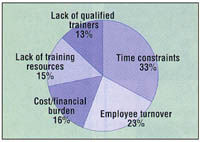
Figure 3: Training challenges.
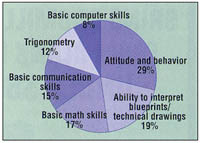
Figure 4:Job Applicant weaknesses..
Some other information gleaned from the CTE survey helps shed light on current employment practices in the metalcutting industry. For instance, more than half (59%) of the respondents are running two or more shifts per day in their machine shops. Specifically, 35% run two shifts per day and 27% operate with three shifts in their facilities, while 38% have only one shift.
Formal employee reviews tend to be conducted on an annual basis, according to 59% of respondents. Evaluations are performed semi-annually at 28% of the shops and plants, while only 13% conduct quarterly reviews.
According to 29% of the respondents, many of today’s job applicants tend to exhibit bad attitudes and poor behavior (Figure 4). Inability to interpret blueprints and technical drawings also is a cause of concern among 19% of shop owners and managers. Other key areas where metalcutting job applicants are weak include basic math skills (according to 17% of respondents), basic communication skills (15%), trigonometry (12%), and basic computer skills (8%).
Sidebar:
How to Find New Talent for Your Shop
- Work with local high schools and vocational schools (e.g., donate tools and equipment, talk to guidance counselors, participate in career days).
- Use the Internet to post job openings.
- Participate in local job fairs and create a memorable identity.
- Provide referral bonuses (e.g., $500) to current employees who identify new hires.
- Sponsor open houses to promote your company and showcase your work environment.
- Approach retirees and others who have worked in the industry before.
- Network with other small business owners in non-competing industries and share staffing ideas.
- Offer a sign-on bonus (i.e., up to 15% of base salary) to new employees.
- Explore non-traditional forms of recruitment advertising (e.g., consider radio spots, look into billboards, check out local cable TV channels, hire a plane to tow a help-wanted banner behind it). Be creative and dare to be different!
- Consider hiring people off state welfare rolls.
- Partner with your customers (ask them for employee referrals).
- Work with local technical colleges (e.g., get involved in tutoring and mentoring programs, donate tools and equipment, interact with guidance counselors, give talks on machining trends).
- Create a homepage on the Internet to promote your company and your work environment. One of the most effective ways to attract good people is by developing name recognition for your company.
- Think low-tech to find employees. Direct-mail items, such as coupons, postcards, and giveaways, targeted to demographic groups can be powerful recruitment tools.
- Ask your suppliers for referrals.
Related




Subscribers can use MFGAxis notes, saves and discussion tools with their innoNET account.


