


A stronger ‘sandwich’: Research & Innovation
Sabrina Nilufar's research involves sandwiches but not the kind that are eaten.
Sabrina Nilufar’s research involves sandwiches but not the kind that are eaten.
Instead, the Southern Illinois University, Carbondale researcher hopes to improve the ultrastrong sandwich materials hidden in the sleek, smooth and shiny car panels and airplane wings that people trust with their lives.
An assistant professor at SIU Carbondale’s School of Mechanical, Aerospace and Materials Engineering, Nilufar is working on ways to more easily construct these ubiquitous materials, improving efficiency while saving time and energy. She recently received a two-year, $200,000 grant from the National Science Foundation to study how to make specially designed structures using additive manufacturing, one of the fastest-emerging engineering research areas in the world.
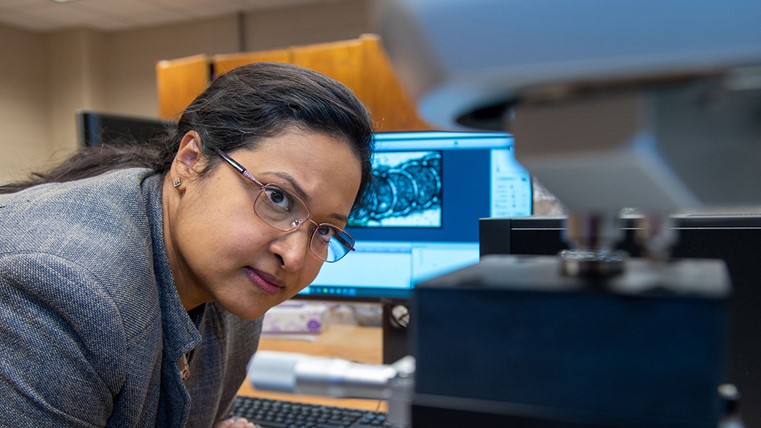
Sabrina Nilufar, assistant professor at SIU Carbondale’s School of Mechanical, Aerospace and Materials Engineering, is working on ways to more easily and efficiently construct so-called sandwich materials used in everything from automotive to marine and aerospace applications. Image courtesy of Russell Bailey
Sandwich structures generally consist of two outer face sheets separated by a lightweight, low-density core structure or foam. The engineering concept has found its way into myriad applications, including aerospace, sport, marine, military, thermal insulation, vibration and acoustic isolation, and automotive.
The traditional manufacturing process for sandwich materials, however, can be wasteful and limited. In contrast, additive manufacturing allows builders to fabricate objects or custom-tailor parts with complex geometries directly from the 3D models to meet specific applications.
The additive manufacturing process may hold the key to increased efficiency and better-quality parts, especially when combined with triply periodic minimal surface architecture. TPMS architecture uses complex geometries found in nature to improve strength and weight ratios.
“The aim of my research is to set a solid foundation of manufacturing sandwiches with TPMS-based core lattice for specific engineering applications,” Nilufar said.
Although sandwich structures are used in many manufacturing processes, the main limiting factor lies in what’s between the face sheets, which act as the “bread.” The topology of the middle, or core, of the sandwich majorly impacts the overall performance of the structure in terms of weight, strength, thermal properties and other factors.
Depending on the geometry of the core, such factors can be improved or diminished in function. Engineers theorize about new core structures but at this point know little because of limitations in the manufacturing process.
Working in her laboratory at SIU, Nilufar hopes to reveal the mechanisms and thermomechanical properties of various core structures that can be created with TPMS architecture. Her approach will integrate numerical and experimental methods to find out what manufacturers might achieve using additive processes.
“We want to fundamentally understand how structured core lattice architecture improves the mechanical and thermal properties of sandwich structures,” Nilufar said.
Additive manufacturing refers to creating an object one layer at a time, usually using a 3D printing process, which can deliver highly complex or even combination parts with added strength. Common applications include building ducts for environmental control systems, custom cosmetic aircraft interior components and rocket engine components.
Engineers say additive manufacturing can offer advantages, including a relatively low cost for acquiring equipment, less waste, improved energy efficiency and easier inventory management. The process also may make it easier to do short runs of rarely needed parts or to create hard-to-find parts for older machines.
— Tim Crosby
Related


Subscribers can use MFGAxis notes, saves and discussion tools with their innoNET account.