



Studying the impact of climate change on machines
The Fraunhofer Institute for Machine Tools and Forming Technology IWU, Chemnitz, Germany, wanted to study the impact of climate change on machines without having to ship them to far-flung locales. Therefore, the institute developed a climate chamber at its newly inaugurated test lab in which it could expose machines to various climates around the world.
Temperature variation, air humidity and drafts can significantly compromise a machine tool’s accuracy. For example, a machine with a long bed accumulates heat asymmetrically during operation and bends to one side.
Manufacturing facilities in various climate zones around the world often don’t have air conditioning. That can make it challenging to precisely determine how climate and ambient conditions—such as power units and other heat sources, like hot cutting tools—will affect the way a machine functions.
The Fraunhofer Institute for Machine Tools and Forming Technology IWU, Chemnitz, Germany, wanted to study the impact of climate change on machines without having to ship them to far-flung locales. Therefore, the institute developed a climate chamber at its newly inaugurated test lab in which it could expose machines to various climates around the world.
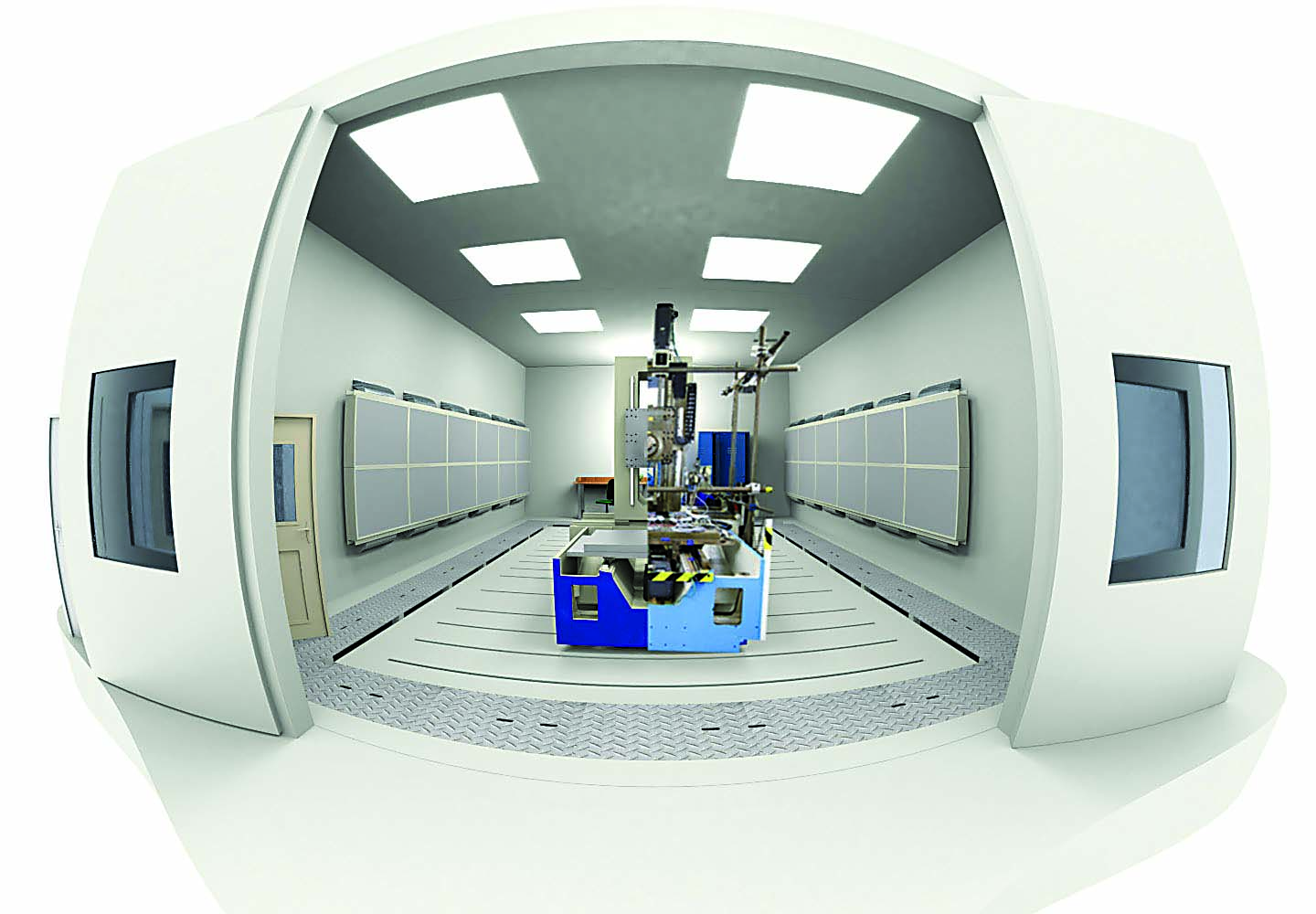
Thanks to the removable ceiling, researchers can lift entire machine tools into the climate chamber via a crane. Image courtesy of Fraunhofer IWU.
“Exposure to sunlight and drafts causes thermal interactions in the form of structural stretching, which we are able to reproduce in the environmental chamber,” said Dr. Janine Glänzel, research scientist at Fraunhofer IWU. “The aim is to stabilize and enhance machine precision directly via a machine control system by correcting thermally induced errors during operation.”
When thermal displacements occur, she added, researchers implement corrective algorithms they developed to positively influence production accuracy. “We calculate correction values directly via a reference point on the tool, the so-called ‘tool center point,’ so that thermoelastic displacements at the point of action during production can be corrected by the machine control.”
The researchers simulate various temperature and humidity scenarios in the climate chamber. According to the institute, temperatures from 10° to 40° C (50° to 104° F) can be configured with a tolerance of ±0.1° Kelvin. Air humidity of 10 to 90 percent, with a tolerance of 3 percent, can also be configured. Using special ventilation components, steam humidifiers and absorption dryers, researchers can study the influence of humidity on the swelling behavior of materials, such as wet-mix concrete.
The chamber has a surface area of 40 sq. m, a vertical clearance of 4.5m (14.8′) and a removable ceiling. The temperature-controlled flooring, in which the bottom plate is insulated and tempered for independent thermal stabilization at two levels, holds a maximum of 20 tons.
“With the help of a crane, machine tools are lifted into the climate chamber,” Glänzel said. “The laboratory environment is sealed from the hall environment, and the interactions of the machine tool and its components can be examined in a controlled manner.”
Before taking measurements, the researchers affix temperature sensors directly to the machine tool being examined. Meanwhile, displacement sensors are mounted on a measuring frame set up around the machine and linked via small rods to measuring blocks in locations where the researchers can measure the most influential thermal displacements. The temperature sensors enable researchers to measure the influence that internal and external loads have on the
machine structure.
“On the one hand, we determine the optimal placement of the temperature and displacement sensors for the experimental setup using a simulation-based sensitivity analysis,” Glänzel said. “On the other hand, the data measured in the experiment serves as input data for the calibration of the finite element simulation and for the correction of the thermal displacements at the tool center point.”
It’s also possible to gauge the behavior of machine tools under long-term exposure. The principle behind the institute’s technology for cooling and heating functions is like the climate control system in a car, according to Glänzel. That capability means machine builders and end users alike can configure their machine tools in advance and adapt them to future ambient conditions.
Related



Subscribers can use MFGAxis notes, saves and discussion tools with their innoNET account.


