

Suggestions for improving manual mills
Shop Operations columnist Tom Lipton offers some suggestions for improving the design of manual milling machines in the October 2012 issue of Cutting Tool Engineering magazine.
If the manual lathe is the king of machine tools, then the manual milling machine must be the queen. A machine shop is just not a machine shop without at least one manual mill.
When machinists think of a vertical milling machine, their first thought is a Bridgeport. This is the milling machine by which all others are judged. I have run a few Bridgeports in my time and have to say they are nice, well-made machines. The levers turn and lock smoothly with just the right click and feel. The height, width and depth lend themselves to machinists of average height and reach. But Bridgeports are far from perfect.
What happened to the Bridgeport mill is what often happens to an average design that achieves high demand and sales: The design stays static and all the design flaws are faithfully reproduced in the army of clones marching out of the factory. Worse yet for the original developer is competitors have a chance to correct the problems in their own knockoff brands.
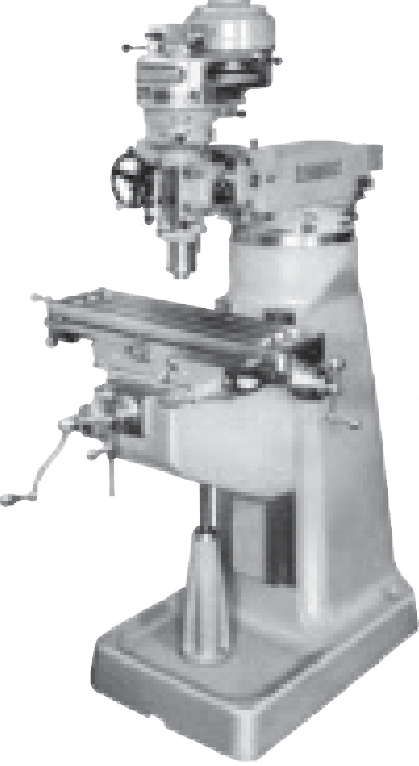
When machinists think of a vertical milling machine, their first thought is a Bridgeport.
If I had been the president of Bridgeport, I probably would have done the same thing. Why mess with success? Bridgeport had the manufacturing capacity and most-evolved design when there was a high demand for the machines.
However, the design should never have become static in the first place. Anybody who has spent time on a Bridgeport or clone can relate to the basic design flaws.
The Y-axis dovetail ways are much too narrow in relation to the table length. The entire X-axis can be rocked back and forth when the gibs are not snugly set. But set the gibs too tight for minimal play and your arm is dead at the end of the day.
The Y-axis ways should be extended to double their current length. This would have the added benefit of covering and protecting the exposed ways behind the table where all the chips land, damaging the ways. If you have ever looked at a clapped-out vertical mill, this is one area that shows the mill’s age.
The head tipping feature is grossly offset from the head’s center of gravity. Heavy cuts can easily knock the head out of tram. The pivots should at least be on the centerlines of the spindle. At the very least, the front-to-back tilt feature should be eliminated and replaced with a right-to-left tilt.
Review the print ads from this magazine to continue
This quick advertiser review unlocks the rest of the article and keeps the full-screen reader focused on the ads instead of the page chrome.
Advertisers included in this article experience
Print placements connected to this article
Dmgmoriseikiusa
DMU 125 P/FD duoBLOCK®
When it comes to complex machining, there’s a difference between surviving and thriving. Machines from DMG / Mori Seiki USA handle complex geometries, tough-to-machine materials and intricate details with speed and accuracy—offering productivity you may not have even believed possible. So you can have your part and profit, too
DMU 125 P/FD duoBLOCK® When it comes to complex machining, there’s a difference between surviving and thriving. Machines from DMG / Mori Seiki USA handle complex geometries, tough-to-machine materials and intricate details with speed and accuracy—offering productivity you may not have even believed possible. So you can have your part and profit, too. Machining is believing. www.dmgmoriseikiusa.com | 855-364-6674
Visit Dmgmoriseikiusa View this placement in the issue recordPrint ads from this magazine
When it comes to complex machining, there’s a difference between surviving and thriving. Machines from DMG / Mori Seiki USA handle complex geometries, tough-to-machine materials and intricate details with speed and accuracy—offering productivity you may not have even believed possible. So you can have your part and profit, too
DMU 125 P/FD duoBLOCK® When it comes to complex machining, there’s a difference between surviving and thriving. Machines from DMG / Mori Seiki USA handle complex geometries, tough-to-machine materials and intricate details with speed and accuracy—offering productivity you may not have even believed possible. So you can have your part and profit, too. Machining is believing. www.dmgmoriseikiusa.com | 855-364-6674
Continue reading
October 2012
The entire drawbar assembly could be drastically improved. Consider tool retention in CNC equipment. Thousands of lost man-hours could be mined with a few simple improvements.
First is the quill locking feature. I have seen quite a few novel methods to keep this limp locking device from dragging. They are all weak, temporary fixes for a bad design.
The axis locking screws could also be improved because they tend to push the axis off position when activated. How about some blade-type locks as per a jig bore’s design?
In addition, the Acme lead screws can be improved. Excellent ballscrews have been available for years. When are the manual machine tool builders going to take advantage of these low-friction components?
So, until some clever person decides to really take an objective look at the manual vertical milling machine and make some improvements, we’re stuck with what we have. Nonetheless, most machinists are pretty clever and find more than one way to make these machines produce parts and money.
They’re certainly clever enough to come up with shop tricks to use on apprentices and newbies, such as the old knee crank trick. Everybody hates manually cranking the knee up after having it near the bottom of the travel, so pretend to be listening to the machine as you slowly crank the knee up as a hapless victim walks nearby. Give a little harrumph of concern just as he gets close. If you’re lucky, he’ll ask what’s wrong. If not, call him over.
Ask him to crank the knee and see if he hears the noise. You will need to be nonspecific about the noise. As he’s cranking, listen and comment appropriately. “There it is! Did you hear that? Crank it again, but a little faster. Did you hear it that time?”
When you reach the desired height, shake your head in mock concern and say, “We certainly need to keep an eye on this machine.” CTE
About the Author: Tom Lipton is a career metalworker who has worked at various job shops that produce parts for the consumer product development, laboratory equipment, medical services and custom machinery design industries. He has received six U.S. patents and lives in Alamo, Calif. Lipton’s column is adapted from information in his book “Metalworking Sink or Swim: Tips and Tricks for Machinists, Welders, and Fabricators,” published by Industrial Press Inc., New York. The publisher can be reached by calling (888) 528-7852 or visiting www.industrialpress.com. By indicating the code CTE-2012 when ordering, CTE readers will receive a 20 percent discount off the book’s list price of $44.95.
Related



Subscribers can use MFGAxis notes, saves and discussion tools with their innoNET account.


