


Superhard vs. Superhard: Drilling Performance
Toolmakers combine technologies to meet growing demand for PCD tools.
Toolmakers combine technologies to meet growing demand for PCD tools.
The cutting edge geometries and final dimensions of cutting tools are typically produced on CNC tool and cutter grinders. Tools with PCD cutting edges, however, pose a challenge. Grinding PCD pits the hardest known substance (diamond) against an equally hard grinding wheel. The resulting virtual standoff consumes excessive time and wheels.
“When you think about it, what you are doing is taking two substances of equal hardness and trying to have one remove the other,” said Scott Ries, PCD division manager for Vollmer of America Corp., Carnegie, Pa. “You end up having an almost one-to-one wear, which becomes very expensive.”
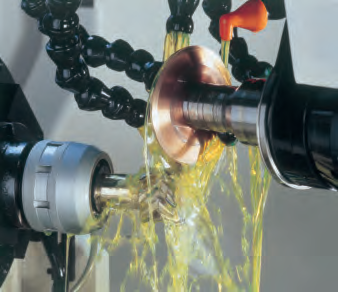
Courtesy of Walter
Electrical discharge grinding, shown here on a Walter Helitronic Diamond machine, is an efficient and accurate way to remove PCD when manufacturing or regrinding PCD tools.
One way to limit expense is removing PCD via electrical erosion, in the form of either electrical discharge grinding with a tungsten-copper disc or wire EDMing. The cobalt binder in PCD acts as a conductor for the electrical energy. The main benefit of using an EDG or a wire EDM to shape PCD tools is cost savings, Ries noted. “You are using a noncontact, electrical charge to remove material instead of wearing down a diamond wheel.”
Ries has been working with electrical erosion of PCD since the early 1980s, when, he said, thermal damage of the diamond material up to 0.2mm deep was a problem. “EDM at that time involved capacitors. The capacitors had natural charge and discharge times; with other electrical components we would try to influence that charge and discharge and either make it slower or faster.”
But the poorly controlled EDM pulses were “frying everything up,” according to Ries. “You had a recast layer or you were pulling the cobalt out,” he said. The thermally damaged PCD cutting edge would break down in use, and it was necessary to grind away the damaged PCD to produce a reliable cutting edge.
Today’s electrical erosion spark generators, however, employ solid-state circuitry that controls spark ontime duration and frequency within nanoseconds. “With optimized erosion, in a lot of applications we are actually duplicating a ground finish,” Ries said. A finish of 0.2µm Ra is possible with electrical erosion, he added.
The main benefit of post-erosion grinding is extended tool life. Ries said the decision to follow erosion with grinding to generate a finer finish is usually driven by economics. “It is based on the amount of time you want to take. If I am going to put grinding time into this tool, how much more tool life am I going to get in the application?”
In 2000, Ries compared the life of a PCD tool with a ground finish to that of one with an eroded finish when machining high-silicon aluminum. He said the eroded finish provided 85 percent of the ground tool’s operational life. Based on spark generator improvements since then, “I’m guessing now we’re in the 90 to 95 percent tool life range,” he said. “In an application, if all things are equal, what does that 5 percent tool life buy me? How much time do I put into it, how much grinding wheel cost, how much extra labor and machine time?”
Dual Capability
PCD tools with eroded finishes are effective in many applications. “We have eroded tools that are doing very well machining composites, titanium and high-silicon aluminum,” Ries said.
However, some tools with PCD cutting edges also require grinding on their carbide shanks. And some tools benefit from a finer finish than possible with electrical erosion. As a result, machine builders have developed units to remove PCD that combine traditional grinding with EDG.
Vollmer, for example, builds machines that combine conventional grinding with rotary EDG as well as multiaxis wire EDMs for shaping PCD tools. Walter Grinders, United Grinding Technologies Inc., Fredericksburg, Va., also offers machines with EDG and conventional grinding capabilities. Ed Sinkora, marketing manager, tool division for United Grinding, said Walter has two basic Helitronic Diamond platforms for these applications. In a 2-spindle machine, one spindle is dedicated to grinding, and the other can either be for grinding or erosion. “Those who are just getting into the PCD business will still have a 2-spindle grinder,” Sinkora said.
The other Helitronic Diamond configuration involves a single-spindle machine with a wheel changer that switches both the grinding or EDG wheel and its cooling manifold. A 12-position carousel can hold a mixture of grinding wheel and/or erosion wheel setups, which can be quickly exchanged to produce different tool features.
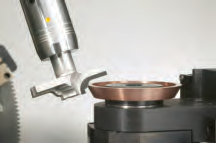
Courtesy of Vollmer
PCD cutting edges can be shaped via electrical erosion (EDG) with a tungsten-copper disc. The cobalt binder in the PCD tool conducts the electrical energy, and the electrical charge removes the diamond material. Here, the EDG disc in a Vollmer machine is in position at a tool before the flow of dielectric is started.
Vollmer’s Ries said wire EDM can offer an advantage compared to rotary erosion because it can create small inside radii and other complex tool features that a rotary disc can’t. On the other hand, he said, the rotary electrode is a thick, stiff piece of tungsten copper that, unlike a wire, does not offer any deflection. “It is much more rigid erosion, and all things being equal, you have a faster material-removal rate.” The advantage lessens, he said, when removing more than 0.3mm to 0.4 mm of excess PCD stock and wire EDMing becomes easier.
Ries said Vollmer’s wire EDMs present the wire to the part horizontally rather than in the common vertical alignment. That arrangement enables the wire to travel in a larger range of motion than a vertical wire when shaping a tool clamped in the machine’s C-axis.
Field Applications
Toolmakers are seeking ways to increase speed and quality when producing PCD tools in response to industry’s growing use of lightweight materials, such as aluminum and carbon-fiber composites, which can be productively machined with PCD tools.
Big Sky EDM Inc., Hayden Lake, Idaho, produces and refurbishes PCD and PCBN cutting tools for fabricators, tool producers and end users. “Probably 85 percent of our business is cutting PCD and CBN tips,” said Russ Scoffield, president. In addition to wire, sinker and high-speed CNC drilling with an EDM, the shop employs 6-axis robotic automation.
Automation minimizes labor costs during the lengthy process of cutting tips from PCD and CBN discs. “Cycle times are long, so instead of running three shifts a day to keep the machines running, we run one shift and the robot takes care of the rest,” Scoffield said. Big Sky recently began producing its own line of veined PCD tools for machining carbon-fiber and aluminum aerospace parts.
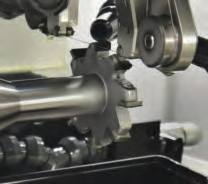
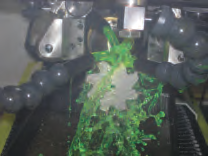
Courtesy of West Ohio Tool
West Ohio Tool recently added a Vollmer QWD 760 wire EDM to create PCD tool geometries unachievable with EDG. A back view of the machine (top) shows that the wire is presented to the part horizontally rather than in the common vertical alignment, an arrangement that enables the wire to travel in a larger range of motion than a vertical wire when shaping a tool clamped in the machine’s C-axis. A front view (bottom) shows the machine in action with a flood of dielectric fluid.
The shop EDGs and wire-EDMs custom cutting edge geometries on diamond-tipped inserts. Tool dimensions and geometry are programmed at the machine control by entering dimensions from 2-D drawings. “Our probing system maps the way the diamond tip is laying and then matches the program to the surface,” he said. “We’ve modified [the software for] our wire machine so that we can do those tools and assure that they are identical part to part.”
For some tools, Scoffield said, Big Sky applies both the disc eroding and grinding capabilities of a 6-axis Vollmer QXD 200 machine. One example is a special for an aerospace application. The tool consists of a 9⁄16 “-dia. carbide rod tipped with 0.150 ” of diamond. The diamond is attached to the tool shaft via a high-temperature/high-pressure process, so there is no brazed joint at the interface between the tip and shaft. Big Sky uses disc erosion to flute the diamond tip, then switches to conventional grinding for the carbide flutes. “Then we come back to erosion and finish the end of the tool,” Scoffield said, adding that the multistep process is fully automated and is carried out in one clamping of the tool.
The shop also employs electrical erosion to recondition PCD tools. “A lot of the time the tool edges will be chipped. We will push the tip back 0.005 ” on the OD or the front of the tool and burn enough to clean it back up and take the chips out.” He added that the shop also uses a 5-axis wire EDM to handle intricate tool details that can’t be reached with disc erosion.
Erode, Then Grind
Some PCD tools do require a ground surface finish.
West Ohio Tool Co., Russells Point, Ohio, designs and manufactures custom solid-carbide round tools, focusing on engineering, problem solving and technical support, as well as PCD and PCBN regrinding and manufacture of new round PCD tools. The company’s array of PCD tool processing equipment includes a Walter Helitronic Power Diamond unit as well as a Vollmer QWD 760 wire EDM. Depending on a tool’s intended application, the shop applies EDG alone or EDG plus grinding to produce a finer finish, and employs the wire machine for special tool geometries that can’t be produced via EDG, according to Kerry Buchenroth, president.
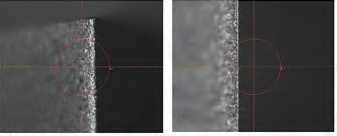
Courtesy of Walter
These 400× micrographs compare the 0.035µm Ra surface finish possible on a PCD cutting edge with conventional grinding (left) vs. the 0.10µm Ra finish produced by electrical discharge grinding on a Walter Power Diamond machine.
“There are some EDG or EDM units that can give you a very fine, crisp edge,” he said. But tools such as precision reamers used in aerospace and other applications may require tolerances within ±2.5µm. “You just can’t hold that kind of a tolerance in rotary erosion; there is a small degree of thermal damage and you just must have that smooth finish on the OD. For those tools, we rough the tool with EDG and leave a small amount of material, then OD grind to finish size to leave a real good finish.” For example, Walter offers a new fine-finishing EDG process that can produce a surface finish of 0.10µm Ra on a PCD tool, while the same tool can be ground to a finish as fine as 0.035µm Ra, according to the company.
Buchenroth said suitability of the EDG finish for a particular application depends on spark generator settings, which are specific to the machine and operator. The Walter machines, for example, allow adjustment of different generator parameters.
In general, he said, “The faster you burn, the more thermal damage and the rougher the tool finish. If the generator has been tweaked and tuned for a very fine finish, it takes a much longer time to run the tool. The finer the finish, the less damage there is to the diamond and the longer the tool life will be. But the price of the tool will be higher.”
PCD composition affects EDG performance, and PCD from different suppliers varies somewhat. “You have to tweak your settings according to that manufacturer’s PCD material,” Buchenroth said. West Ohio Tool is “ramping up on the PCD side pretty hard,” he added.
Tool performance and toolmaking technology advance hand-in-hand. As advanced tool materials like PCD gain favor in the marketplace, toolmakers will find quicker, better and more cost- efficient ways to produce those tools. Combining technologies like electrical erosion and conventional grinding is a good example of matching technologies to the challenge of making superhard tools. CTE
About the Author: Bill Kennedy, based in Latrobe, Pa., is a contributing editor for CTE. He has an extensive background as a technical writer. Contact him at (724) 537-6182 or at billk@jwr.com.
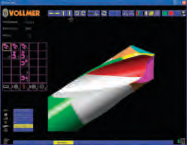
Courtesy of Vollmer
Flexible programming, verified through simulations, enables the order of operations in processing a PCD tool to be changed to meet requirements for cycle time, tolerance and surface finish.
Getting sound application advice
Vollmer’s Scott Ries said shops just getting into producing PCD cutting tools can usually benefit from application guidance offered by tool grinding machine builders. In some cases, he said, the advice concerns the “order of operations” required to process a helical tool. A drill, for example, has specific dimensions related to flute shape, gash, rake, relieved land and primary and secondary cutting angles. Typically, flute and land dimensions will be finished before end geometries, but flexible programming allows changes in the order of operations to meet requirements for cycle time, tolerance and surface finish.
Other recommendations relate to unlearning habits formed in turning and milling. “It’s not always a matter of going as fast as you can go in the erosion process,” Ries said. “Some will crank up the power on an erosion machine and think that faster is better, and a lot of the time that’s not the case. Sometimes, speed can sacrifice tool finish.”
However, Ries said, “The biggest thing I have to educate people on is handling the PCD itself so they don’t leach the cobalt out in their cleaning operations. The presence of cobalt as an electrical conductor in the erosion process is crucial.” Many shops use acidic-type cleaners with other tools, and they will also use them on diamond and not understand why the cobalt leaches out of the diamond and they can’t erode it, according to Ries. “Some of the more harsh detergents are the same way,” he said. “If you look at the diamond layer, you are probably 90 to 95 percent diamond, so you only have 5 to 10 percent cobalt. If people lose a little bit of that, it is significant.”
–B. Kennedy
Contributors
Big Sky EDM Inc.
(208) 762-8430
www.bigskyedm.com
United Grinding Technologies Inc.
(540) 898-3700
www.grinding.com
Vollmer of America Corp.
(412) 278-0655
www.vollmer-us.com
West Ohio Tool Co.
(937) 842-6688
www.westohiotool.com
Glossary terms in this article
Related


Subscribers can use MFGAxis notes, saves and discussion tools with their innoNET account.