Switch Drills?
Switch Drills?
For drilling standard holes in metal, there are three primary types of drills: twist, spade and indexable insert. This article discusses the pros and cons of each design and the applications for which each might be appropriate. Factors considered include hole depth, tool cost, drill speed, coolant delivery, tool inventory required, machine tool requirements and expected tool life.
If you're looking for peak performance and productivity, the right type of drill can make all the difference.
For superior holemaking, should you choose a twist drill, spade drill, or indexable-insert drill?
The question has no single, simple answer. The only general statement that is true in almost all instances is that both the spade drill and the insert drill will outperform a twist drill in hole diameters of 1/2" or larger, producing at least 300% more holes in a given amount of time. The spade and insert drills run at an sfm at least 5 times higher than the speed a twist drill can handle. And the holes cut by spade and indexable-insert drills are straighter and more consistent, and their surface finishes are better than the finishes a twist drill can produce.
Also, spade- and insert-drill cutting edges last up to 10 times longer than twist-drill edges. And when a spade blade or insert does become dull, it can be changed or indexed quickly and cheaply. Twist drills must be resharpened to be reused. This not only takes time and money, it also makes it difficult to maintain hole consistency, because resharpening changes the tool's diameter and gage length.
Twist drills do have an advantage when it comes to price. Their lower initial cost makes them the most economical choice for prototype or R&D applications that require only one or two holes. They also are the only type of drill available for holes 1/2" in diameter or smaller. Twist drills do not break as easily as indexable inserts or spade blades, so machinists may prefer them in situations that place severe stress on the tool. For example, a twist drill might be the best choice when drilling difficult holes in hard-to-machine materials, when coolant is unavailable, or when the machine produces low driving force. The twist drill's forgiving nature also can provide added security in applications where a broken tool can damage an expensive part.
In all other applications, the machinist will be better off using a spade or insert drill. But the question remains: Which is more likely to produce a good-quality hole economically? To answer this, we must look at the specific task the tool is being asked to perform.
The Long and Short of It
Each application produces its own pattern of forces and wear, depending on the workpiece material, the condition of the machine tool, the machining parameters, and the hole's dimensions. In some circumstances, these factors will have less effect on a spade drill than on an indexable-insert drill.
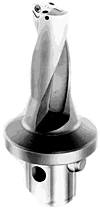
Figure 1: The cutting action of an indexable insert drill is similar to a front-cutting boring tool.
For example, spade drills are better for longer depths. To understand why, think of the insert drill as a front-cutting boring tool (Figure 1). The design of the insert drill makes it susceptible to both torque and bending forces in unfavorable conditions. In shorter lengths, these forces have little effect, but when the tool is 3 1/2 or 4 times longer than its diameter, the bending moment is created by the rotational, asymmetrical arrangement of the cutting edges. This results in oversize holes, chatter, and unstable cutting conditions.
Some insert-drill designs compensate for this action with adjustable carbide wear pads on the outside of the drill body to stabilize the drill. But these pads are expensive, and they can be difficult to maintain. Other designs incorporate a center drill that holds the drill in position as it enters the workpiece. This works, but it is an expensive solution to the problem. Users will have to pay a premium for these tools, because they are not widely manufactured or stocked.
Figure 2: The spade drill's center point allows it to drill holes up to 6 diameters deep unpiloted.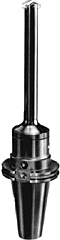
By contrast, a center point is an inherent feature of every spade drill's design. The form of the spade drill's center point does not create eccentric forces and automatically centers the drill. The geometry on the outer edges of the blade guides the tool as well, keeping it centered in the hole as it cuts deeper into the workpiece. The spade drill's stability makes it possible to drill a hole up to 6 diameters with an unpiloted tool (Figure 2).
In shallow-hole applications, an indexable-insert drill's performance characteristics may make it the best choice. For instance, the insert drill is better equipped to drill high-temperature alloys or 300-series stainless steel. Generally, carbide must be used to cut these highly abrasive materials, because they are difficult to machine, and their chips are hard to control. Carbide is the only material used for indexable-drill inserts. Carbide spade drills are available, but the spade drill cannot take full advantage of the tool material. Even though changing from HSS to carbide spade-drill blades will allow the machinist to increase speed, the recommended speeds for carbide spade drills are still much slower than speeds recommended for insert drills. And chip loads on carbide spade drills must be kept slightly below those for HSS spade drills, because the carbide's lower transverse rupture strength makes the blade more susceptible to damage at the cutting edge. Machinists should use carbide spade blades only to increase tool life in applications that have run successfully with HSS spade blades. Carbide cannot be used to extend spade drilling's range of applications.
Rather than using a carbide spade drill, a machinist will have better luck drilling high-temperature alloys and stainless steels with an indexable carbide insert drill. In other materials, machinability is less of a factor, and the choice of drill will depend on other conditions.
For hole depths beyond 3 1/2 to 4 diameters in high-temperature alloys and stainless steels, neither type of drill is ideal. A twist drill, with its toughness and its ability to penetrate nearly any material, would probably do the best job of drilling deep holes in these difficult-to-machine metals.
The speed difference between insert and spade drills at hole depths under 4 diameters in standard materials translates into overall productivity gains when an insert drill is used. Table 1 compares the performance of the two drills machining a 1"-dia. hole in 1018 steel. As the table shows, the indexable drill's penetration rate is 12.4 ipm. The penetration rate for a comparable spade drill is 11 ipm. The indexable drill's penetration rate for a hole 2" in diameter is 7.6 ipm, compared to 6.2 ipm for the spade drill. Because both insert and spade drills run at faster speeds than twist drills run, they produce a better surface finish.
Other Limitations
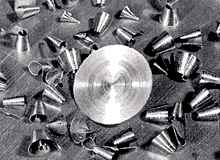
Figure 3: This disk of metal was left by an indexable-insert drill as it exited the hole.
Other factors may limit a shop's choice to only one type of drill. An insert drill will leave a thin disk of metal uncut when the tool exits a hole. In some applications, this disk can interfere with further operations (Figure 3). When drilling through a fabricated weldment, for instance, the disk can prevent the drill from penetrating the bottom plate after it has exited the top plate. A spade drill could be used in such an application, because it does not leave a disk.
The limitations of the machine being used to drill the hole also will influence the user's choice of tool. Indexable-insert drills require 25% to 50% more horsepower than spade drills. But spade drills require more thrust. To calculate the torque and horsepower requirements for an insert drill, a machinist must take into account the metal-removal rate and the workpiece material's machinability factor. As a general guideline, insert drilling requires 1 hp times a machinability factor for every cubic inch of material removed. This formula does not apply to spade drilling. The operation's complex combination of extrusion and cutting requires higher thrust and lower horsepower to penetrate the material.
Through-coolant is vital to the success of both insert and spade drilling.
If it is unavailable on the machine, coolant glands or inducers should be used to provide through-coolant capability. Flood coolant can be used only with very short hole depths, never in holes deeper than 1 diameter. Through-coolant must be used with spade drill depths greater than 1 diameter and with insert drill depths greater than 2 diameters.
Bit Parts
For some shops the choice between a spade or insert drill might depend on the type of components it will need to inventory for each type of tool. Insert drills normally use a WCMX-grade insert because of its strength. Recently, however, some manufacturers have produced drills that use other insert styles, such as LCMX milling inserts or square inserts. Most holders take a standard ISO/ANSI insert, though some take only the manufacturer's proprietary design. Machinists who can use standard inserts are likely to find the precise coating and grade they need among the standard inserts stocked by their tool suppliers. Machinists who must use proprietary inserts are limited to the inserts the drill manufacturer offers.
There is no standard for spade-drill blades. As a result, each spade-drill manufacturer uses its own blade design and method for holding the blade in the holder. As with proprietary inserts, the range of spade-drill blades available to a machinist is limited to those offered by the drill's manufacturer.
A shop may choose to ignore the limits of proprietary spade blades, however, if its operations require a tool that is more forgiving than a drill with standard carbide inserts. When a machinist can't devote his full attention to the drill and its condition, an HSS spade-blade can provide a wider margin of safety than a carbide-insert drill can provide. HSS's higher transverse rupture strength makes the material more impact resistant than carbide. As a result, HSS blades are tougher and more durable than carbide indexable inserts. An HSS spade drill will continue to drill with a dull blade past the point a dull insert must be changed. The extra turns of the spade drill may not produce an acceptable hole, but as long as the drill can keep cutting, it will not damage the workpiece beyond repair. The tougher and more-forgiving HSS blades might also be the best choice when the rigidity of the machine or the fixturing cannot be ensured.
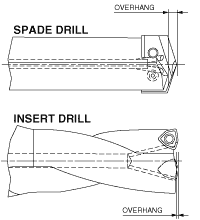
Figure 4: A worn or broken cutting edge is more likely to lead to holder or workpiece damage with an insert drill because the insert's short overhang leaves little room for error.
Because carbide indexable inserts are more susceptible to catastrophic failure when they lose their edge, the operator must carefully watch the load meter on the machine and listen for the sudden high-pitch whine that indicates a dull insert. If these indicators signal a need for a new insert, the operator must react quickly to avoid serious damage to the drill holder or workpiece. Even then, it may not be possible to save the drill, because the short distance the insert hangs over the holder leaves little margin for error (Figure 4). The risk of insert failure or damage to the holder or part is quite high, if the machinist is unable to change the insert on schedule after it has been in use for its allotted time or drilled its maximum number of parts.
Cost Factors
If the decision between insert and spade drills comes down to a question of cost, the user must determine how these costs will be incurred to find the most economical choice. When purchasing and operating expenses are added together, the two drills cost about the same to use. But when cost and inventory factors are considered individually, wide differences between insert and spade drills appear.
Only one spade-drill holder and a selection of blades is needed to drill a range of hole diameters. As a general rule, the largest blade that can be used with a spade-drill holder is 1.30 to 1.35 times the smallest size. With only a few spade-drill holder sizes, each covering a range of hole sizes, a shop might be able to satisfy all its drilling needs. By contrast, a shop will have to stock a separate insert-drill holder for each hole size it drills unless it also purchases an adjustable holder. With adjustable holders, available only for insert drills, the machinist can offset drilling diameters from +0.040" to -0.008". The adjustable holder broadens the range of hole diameters one holder-and-insert combination can produce, and it makes it possible to size the tool more precisely.
Depending on their size, indexable-drill holders cost from $200 to $500, which is 20% to 30% more than spade-drill holders cost. Because of the inserts' short overhang, which increases the risk of holder damage, most users will probably need more replacements for indexable-drill holders than spade-drill holders, so to stock enough holders to cover the range of hole sizes they are drilling and replace broken holders, shops will have to pay significantly more initially to perform insert drilling.
But over a long run of parts, insert drilling's price advantage per cutting edge can offset spade drilling's initial cost advantage. An HSS spade-drill blade, with one cutting edge, costs about $25. The two carbide inserts an indexable drill requires cost $9 each, which amounts to $3 per cutting edge, since each insert has three edges. Spade drilling can be even more expensive if a shop is drilling a wide range of hole diameters. It will have to buy different spade-drill blades for each diameter its machinists drill. By contrast, one size of indexable insert loaded into different holders can drill a variety of holes. Typically, a shop can cover its full range of holes with only seven or eight insert sizes.
However, one other factor must be considered: Carbide- insert cutting edges don't last as long as HSS spade-drill edges. In one test application, a single spade-drill cutting edge did the work of three insert edges (which were drilling holes at a higher penetration rate). If cost is a deciding factor, the additional expense and time that will be required for the operator to index or change carbide inserts must be weighed against the spade blade's higher cost per cutting edge.
When all cost and performance factors are taken into account, indexable-insert drilling will be the best choice for the majority of applications that require a lot of drilling over a long term. Short-term applications will be best served by spade drilling. But given the number of factors that must be considered, it's difficult to make any recommendation that will be universally applicable.
About the Author
Jack Burley is product manager, rotating tooling for KPT Kaiser Precision Tooling Inc., Elk Grove Village, Ill.