


Swivel or suffer the consequences
The Grinding Doc: Grinding flat on flat almost always produces pain and suffering.
View print ads from this spread
Review the ads on this magazine spread to continue reading. Each ad takes two seconds; a two-page ad counts once.
Advertisers on this magazine spread
Print placements on this magazine spread
Tel: 508-987-0121
High Precision Universal and Centerless Grinders Centerless Grinding Machines Universal OD / ID Grinders Internal Grinding Machines Comprehensive Technical Sales, Service and Support Full series of high precision surface grinders and rotary grinders Rotary table machines in both vertical and horizontal spindle configurations.
Tel: 508-987-0121 eMail: [email protected] High precision, long term reliability, worldwide support and affordable maintenance www. gmsigroup.com High Precision Universal and Centerless Grinders Centerless Grinding Machines Universal OD / ID Grinders Internal Grinding Machines Comprehensive Technical Sales, Service and Support Full series of high precision surface grinders and rotary grinders Rotary table machines in both vertical and horizontal spindle configurations
Visit Facebook View this placement in the issue recordPrint ads from this magazine
High Precision Universal and Centerless Grinders Centerless Grinding Machines Universal OD / ID Grinders Internal Grinding Machines Comprehensive Technical Sales, Service and Support Full series of high precision surface grinders and rotary grinders Rotary table machines in both vertical and horizontal spindle configurations.
Tel: 508-987-0121 eMail: [email protected] High precision, long term reliability, worldwide support and affordable maintenance www. gmsigroup.com High Precision Universal and Centerless Grinders Centerless Grinding Machines Universal OD / ID Grinders Internal Grinding Machines Comprehensive Technical Sales, Service and Support Full series of high precision surface grinders and rotary grinders Rotary table machines in both vertical and horizontal spindle configurations
Continue reading
January 2021
Dear Doc: We grind the ID and bottom face of hardened-steel open-top cylinders with a vertical-spindle grinder. The ID isn’t a problem, but the bottom face is killing us: corner breakdown, rubbing, weird patterns and burn. One operator said to swivel the wheel. Is this a good idea?
The Doc replies: It’s a great idea.
When cylindrical grinding, the general rule is: Curve on curve is good, curve on flat is good, flat on curve is good, and flat on flat is bad. You’re grinding two surfaces. The first is the inner-diameter surface, which is a curved wheel on a curved workpiece, so this isn’t a problem. But you’re also grinding the bottom surface, which is a flat wheel on a flat workpiece. And flat on flat almost always produces pain and suffering.
You might think that the material on the bottom of the cylinder is being removed by the bottom flat face of the wheel. But this isn’t the case. As the wheel slowly feeds down into the rotating bottom surface, all the material is being removed by a very thin section on the outer diameter of the wheel. How thin? You’re effectively doing cylindrical traverse grinding with a wheel width of 0.008 mm (0.0003″). This produces a huge grit penetration depth and huge corner breakdown.
What is that big bottom face of the wheel doing? Rubbing and only rubbing — and generating heat and weird spiral marks.
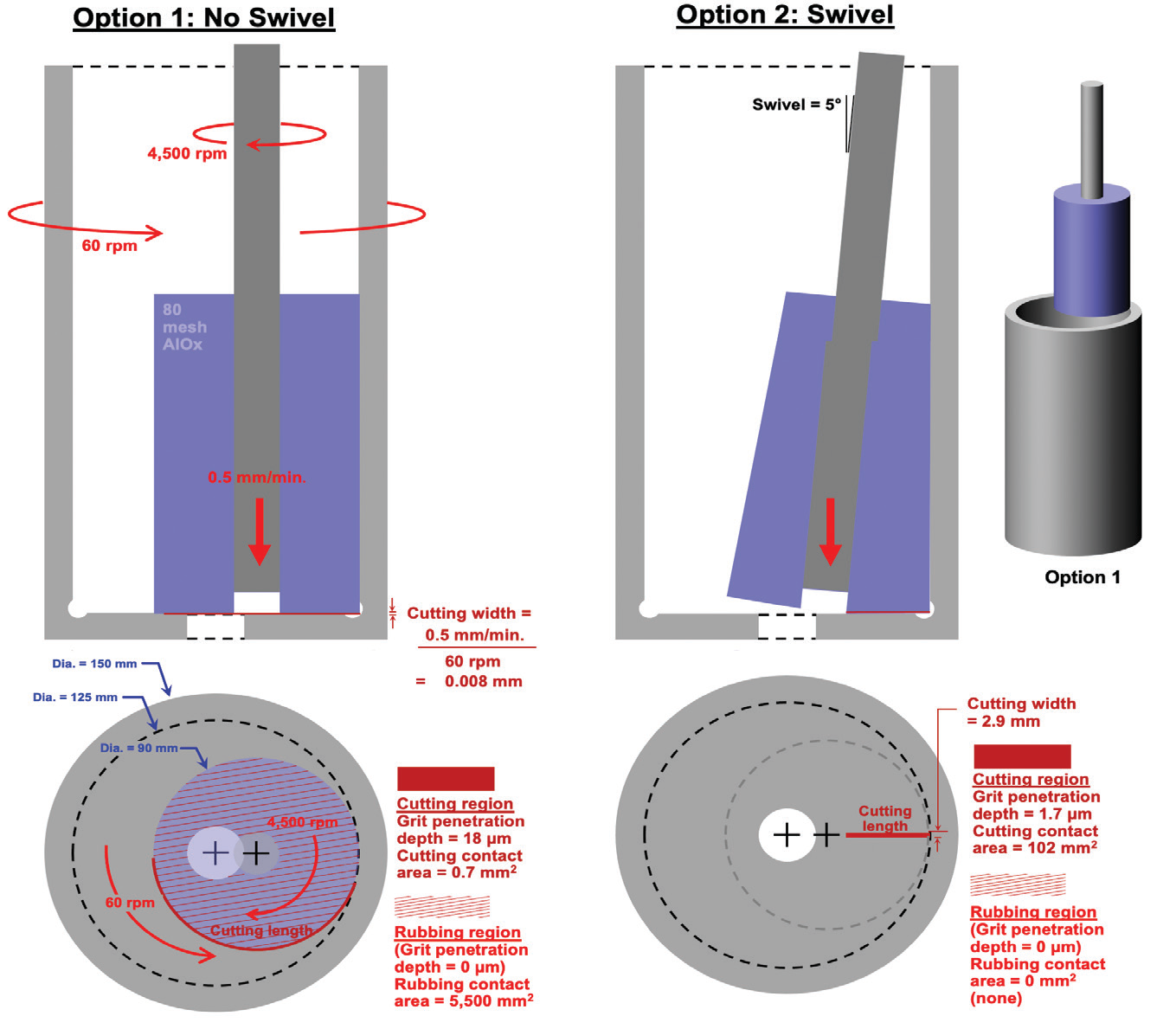
However, if you swivel that wheel even a modest amount, you’re introducing curvature onto the bottom of the wheel. Here it’s a measly 5°. But that’s enough. Now we’re no longer doing cylindrical traverse grinding; we’re doing cylindrical plunge grinding. The cutting area is no longer a tiny 0.7 mm2 (0.001″ sq.) (causing that huge grit penetration depth) but a reasonable 102 mm2 (0.158″ sq.) (and a reasonable grit penetration depth). Even better, the rubbing region is not a painful 5,500 mm2 (8.525″ sq.) anymore but 0 mm2. And zero is much smaller than 5,500.
If your machine is capable of swiveling, don’t make this important change on the fly. Don’t let Joe the Machinist eyeball it in the morning and then tear into it in the afternoon. Find somebody who understands the difference between cylindrical plunge grinding and cylindrical traverse grinding and can do basic trigonometry. He or she will have to wisely take into account the wheel diameter and width, the workpiece diameter and height and the swivel angle — and whether you’ll have to do an extra traverse on the bottom. Map out the geometries, and come up with a game plan.
What if your vertical-spindle grinder can’t swivel? Then you’re in for pain and suffering. But there are ways to mitigate this, such as dressing a relief in the bottom of the wheel to reduce all that rubbing.
If you can swivel, do it. It’s sort of magic how it makes all the pain and suffering disappear.
Glossary terms in this article
Related


Subscribers can use MFGAxis notes, saves and discussion tools with their innoNET account.